

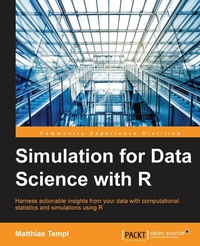
Simulation for Data Science with R
Effective Data-driven Decision Making
Published on 8. July 2025
398 pages
978-1-78588-587-7 (ISBN)
Description

Harness actionable insights from your data with computational statistics and simulations using R
Key Features
[*] Learn five different simulation techniques (Monte Carlo, Discrete Event Simulation, System Dynamics, Agent-Based Modeling, and Resampling) in-depth using real-world case studies
[*] A unique book that teaches you the essential and fundamental concepts in statistical modeling and simulation
Book DescriptionData Science with R aims to teach you how to begin performing data science tasks by taking advantage of Rs powerful ecosystem of packages. R being the most widely used programming language when used with data science can be a powerful combination to solve complexities involved with varied data sets in the real world. The book will provide a computational and methodological framework for statistical simulation to the users. Through this book, you will get in grips with the software environment R. After getting to know the background of popular methods in the area of computational statistics, you will see some applications in R to better understand the methods as well as gaining experience of working with real-world data and real-world problems. This book helps uncover the large-scale patterns in complex systems where interdependencies and variation are critical. An effective simulation is driven by data generating processes that accurately reflect real physical populations. You will learn how to plan and structure a simulation project to aid in the decision-making process as well as the presentation of results. By the end of this book, you reader will get in touch with the software environment R. After getting background on popular methods in the area, you will see applications in R to better understand the methods as well as to gain experience when working on real-world data and real-world problems. What you will learn
[*] The book aims to explore advanced R features to simulate data to extract insights from your data.
[*] Get to know the advanced features of R including high-performance computing and advanced data manipulation
[*] See random number simulation used to simulate distributions, data sets, and populations
[*] Simulate close-to-reality populations as the basis for agent-based micro-, model- and design-based simulations
[*] Applications to design statistical solutions with R for solving scientific and real world problems
[*] Comprehensive coverage of several R statistical packages like boot, simPop, VIM, data.table, dplyr, parallel, StatDA, simecol, simecolModels, deSolve and many more.
Who this book is forThis book is for users who are familiar with computational methods. If you want to learn about the advanced features of R, including the computer-intense Monte-Carlo methods as well as computational tools for statistical simulation, then this book is for you. Good knowledge of R programming is assumed/required.
Key Features
[*] Learn five different simulation techniques (Monte Carlo, Discrete Event Simulation, System Dynamics, Agent-Based Modeling, and Resampling) in-depth using real-world case studies
[*] A unique book that teaches you the essential and fundamental concepts in statistical modeling and simulation
Book DescriptionData Science with R aims to teach you how to begin performing data science tasks by taking advantage of Rs powerful ecosystem of packages. R being the most widely used programming language when used with data science can be a powerful combination to solve complexities involved with varied data sets in the real world. The book will provide a computational and methodological framework for statistical simulation to the users. Through this book, you will get in grips with the software environment R. After getting to know the background of popular methods in the area of computational statistics, you will see some applications in R to better understand the methods as well as gaining experience of working with real-world data and real-world problems. This book helps uncover the large-scale patterns in complex systems where interdependencies and variation are critical. An effective simulation is driven by data generating processes that accurately reflect real physical populations. You will learn how to plan and structure a simulation project to aid in the decision-making process as well as the presentation of results. By the end of this book, you reader will get in touch with the software environment R. After getting background on popular methods in the area, you will see applications in R to better understand the methods as well as to gain experience when working on real-world data and real-world problems. What you will learn
[*] The book aims to explore advanced R features to simulate data to extract insights from your data.
[*] Get to know the advanced features of R including high-performance computing and advanced data manipulation
[*] See random number simulation used to simulate distributions, data sets, and populations
[*] Simulate close-to-reality populations as the basis for agent-based micro-, model- and design-based simulations
[*] Applications to design statistical solutions with R for solving scientific and real world problems
[*] Comprehensive coverage of several R statistical packages like boot, simPop, VIM, data.table, dplyr, parallel, StatDA, simecol, simecolModels, deSolve and many more.
Who this book is forThis book is for users who are familiar with computational methods. If you want to learn about the advanced features of R, including the computer-intense Monte-Carlo methods as well as computational tools for statistical simulation, then this book is for you. Good knowledge of R programming is assumed/required.
All prices
More details
Edition
Digital original
Language
English
Place of publication
Birmingham
United Kingdom
Target group
Professional and scholarly
US School Grade: College Graduate Student
Edition type
Digital original
File size
11,26 MB
ISBN-13
978-1-78588-587-7 (9781785885877)
Copyright in bibliographic data and cover images is held by Nielsen Book Services Limited or by the publishers or by their respective licensors: all rights reserved.
Schweitzer Classification
Other editions
Additional editions
Book
06/2016
Packt Publishing
€63.90
Shipment within 3-4 weeks
Person
Templ Matthias :
Matthias Templ is associated professor at the Institute of Statistics and Mathematical Methods in Economics, Vienna University of Technology (Austria). He is additionally employed as a scientist at the methods unit at Statistics Austria, and together with two colleagues, he owns the company called data-analysis OG. His main research interests are in the areas of imputation, statistical disclosure control, visualization, compositional data analysis, computational statistics, robustness teaching in statistics, and multivariate methods. In the last few years, Matthias has published more than 45 papers in well-known indexed scientific journals. He is the author and maintainer of several R packages for official statistics, such as the R package sdcMicro for statistical disclosure control, the VIM package for visualization and imputation of missing values, the simPop package for synthetic population simulation, and the robCompositions package for robust analysis of compositional data. In addition, he is the editor of the Austrian Journal of Statistics that is free of charge and open-access. The probability is high to find him at the top of a mountain in his leisure time.
Matthias Templ is associated professor at the Institute of Statistics and Mathematical Methods in Economics, Vienna University of Technology (Austria). He is additionally employed as a scientist at the methods unit at Statistics Austria, and together with two colleagues, he owns the company called data-analysis OG. His main research interests are in the areas of imputation, statistical disclosure control, visualization, compositional data analysis, computational statistics, robustness teaching in statistics, and multivariate methods. In the last few years, Matthias has published more than 45 papers in well-known indexed scientific journals. He is the author and maintainer of several R packages for official statistics, such as the R package sdcMicro for statistical disclosure control, the VIM package for visualization and imputation of missing values, the simPop package for synthetic population simulation, and the robCompositions package for robust analysis of compositional data. In addition, he is the editor of the Austrian Journal of Statistics that is free of charge and open-access. The probability is high to find him at the top of a mountain in his leisure time.
Content
Table of Contents
Introduction
R and high-performance computing
The discrepancy between Pencil driven theory and Data driven computational solutions
Simulation of random numbers
Monte-Carlo methods for optimization problems
Probability theory shown by simulation
Resampling Methods
Applications of resampling methods and Monte Carlo tests
The EM algorithm
Simulation of complex data
System dynamics
Introduction
R and high-performance computing
The discrepancy between Pencil driven theory and Data driven computational solutions
Simulation of random numbers
Monte-Carlo methods for optimization problems
Probability theory shown by simulation
Resampling Methods
Applications of resampling methods and Monte Carlo tests
The EM algorithm
Simulation of complex data
System dynamics

