

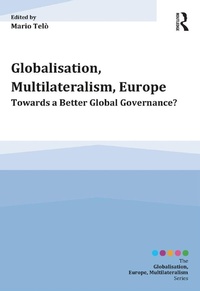
Globalisation, Multilateralism, Europe
Towards a Better Global Governance?
Published on 22. April 2016
512 pages
978-1-317-12714-7 (ISBN)
Description

This student-friendly textbook offers a comprehensive introduction to globalization studies and the European Union within a multipolar world. It provides its readers with critical analysis of the key concepts of multilateral global and regional governance and Europe's role in the world; and this in an accessible and intelligible fashion. This volume collects contributions by eminent scholars from world class universities from five different continents. As such, this unique exercise in transnational multi-disciplinary cooperation, provides extensive coverage of the main issues pertaining to multilateral cooperation - notably its history, troubles, legitimacy challenges and efficiency questions - from a variety of national perspectives.
The book covers the major issues confronting students of European and global studies, amongst which: pressing security challenges, new forms of institutionalized cooperation, shifting international trade flows, the notion of responsibility to protect, social imbalances and environmental emergencies, the need for less contingent forms of legitimacy for global regulation, as well as global public opinion and transnational civil society networks. Each chapter includes a summary of its salient points; methodological indications; illuminating illustrations; and a suggested list for further reading. This textbook strives to help students develop a better and more secure grasp of the innovative balance between interdisciplinary openness and disciplinary rigor when engaging with global governance studies, comparative regionalism, normative studies, international political economy or international law.
The book covers the major issues confronting students of European and global studies, amongst which: pressing security challenges, new forms of institutionalized cooperation, shifting international trade flows, the notion of responsibility to protect, social imbalances and environmental emergencies, the need for less contingent forms of legitimacy for global regulation, as well as global public opinion and transnational civil society networks. Each chapter includes a summary of its salient points; methodological indications; illuminating illustrations; and a suggested list for further reading. This textbook strives to help students develop a better and more secure grasp of the innovative balance between interdisciplinary openness and disciplinary rigor when engaging with global governance studies, comparative regionalism, normative studies, international political economy or international law.
Reviews / Votes
'This may be the most multi-dimensional textbook in international politics ever published. Its multiple authors are multi-cultural and even multi-continental; its approach is multi-disciplinary and multi-layered; its topics are multi-lateralism and multi-polarism; its units of analysis are multi-regional and multi-functional; its observations are multi-faceted and multi-cautious. If this were not enough, they are all brought to bear on the multi-ambiguous process of globalization! Nevertheless, it does manage to present a coherent and challenging message to the advanced student of political science - whether he or she is interested in the national, regional of global level of aggregation. This owes a great deal to the exceptional quality of its contributors and the innovative program that brought them together.' Philippe C. Schmitter, European University Institute, Italy.'Mario Telo and his contributors have done a superb job of conceptualizing, analysing and synthesizing the whole complex called globalization studies. Using the European Union as a multipolar and multilevel entity which the tide of globalization permeates relentlessly, they present a much-needed user-friendly textbook.' - Takashi Inoguchi, University of Niigata Prefecture, Japan.
More details
Series
Language
English
Place of publication
London
United Kingdom
Publishing group
Taylor & Francis Ltd
Target group
College/higher education
Product notice
Reflowable
File size
4,30 MB
ISBN-13
978-1-317-12714-7 (9781317127147)
Copyright in bibliographic data and cover images is held by Nielsen Book Services Limited or by the publishers or by their respective licensors: all rights reserved.
Schweitzer Classification
Other editions
Additional editions
Book
02/2014
1st Edition
Routledge
€62.15
Shipment within 10-20 days
Book
02/2014
1st Edition
Routledge
€178.56
Shipment within 10-20 days
Person
Mario Telo is Jean Monnet professor of International Relations at Universite Libre de Bruxelles, Belgium, and teaches EU institutions at LUISS, Rome, Italy.
Content
Introduction
Part I: Towards a Common Language: Critically Exploring Key Concepts
1. Globalisation: Trends, Limits, and Controversies
2. The Three Historical epochs of Multilateralism
3. Which Multipolarity? Power and World Order
4. Peculiarities of the European Union's External Action
Part II: The State of Art: Disciplinary Approaches to Global Governance
5. Comparative Institutionalisms
6. Normative Approaches to Global Justice 7. International Political Economy 8. Legal Studies and Global Governance 9. Comparative Regionalist Studies
Part III: Efficiency and Legitimacy of the Global Multilateral System: The Institutional Set
10. Troubles with the UN
11. The Pillars of the International Trading System 12. The IMF and the Challenge of Global Monetary Governance 13. Global Environmental Governance
Part IV: Issues at Stake
14. The Complex Social Side of Globalisation
15. New Multilateralisms for Regional Development: Africa Post-2015
16. Cultural Conflicts, Global Governance, and International Institutions
17. Civil Society, Global Governance, and the Quest for Legitimacy
18. The Responsibility to Protect
19. Regional Security Communities
20. Interregional Relations
21. Multilateral Institutions/Regimes and the Dissemination of WMD
22. Multilateralism and Conflict Management: Assessing Peace Operations
Appendix: Regional, Interregional and Global Arrangements and Multilateral Organisations
Part I: Towards a Common Language: Critically Exploring Key Concepts
1. Globalisation: Trends, Limits, and Controversies
2. The Three Historical epochs of Multilateralism
3. Which Multipolarity? Power and World Order
4. Peculiarities of the European Union's External Action
Part II: The State of Art: Disciplinary Approaches to Global Governance
5. Comparative Institutionalisms
6. Normative Approaches to Global Justice 7. International Political Economy 8. Legal Studies and Global Governance 9. Comparative Regionalist Studies
Part III: Efficiency and Legitimacy of the Global Multilateral System: The Institutional Set
10. Troubles with the UN
11. The Pillars of the International Trading System 12. The IMF and the Challenge of Global Monetary Governance 13. Global Environmental Governance
Part IV: Issues at Stake
14. The Complex Social Side of Globalisation
15. New Multilateralisms for Regional Development: Africa Post-2015
16. Cultural Conflicts, Global Governance, and International Institutions
17. Civil Society, Global Governance, and the Quest for Legitimacy
18. The Responsibility to Protect
19. Regional Security Communities
20. Interregional Relations
21. Multilateral Institutions/Regimes and the Dissemination of WMD
22. Multilateralism and Conflict Management: Assessing Peace Operations
Appendix: Regional, Interregional and Global Arrangements and Multilateral Organisations
