

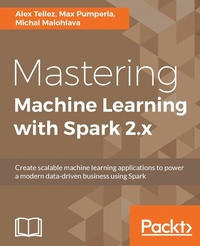
Mastering Machine Learning with Spark 2.x
Harness the potential of machine learning, through spark
Published on 8. July 2025
340 pages
978-1-78528-241-6 (ISBN)
Description

No detailed description available for "Mastering Machine Learning with Spark 2.x".
All prices
More details
Edition
Digital original
Language
English
Place of publication
Birmingham
United Kingdom
Target group
Professional and scholarly
US School Grade: College Graduate Student
Edition type
Digital original
File size
12,39 MB
ISBN-13
978-1-78528-241-6 (9781785282416)
Copyright in bibliographic data and cover images is held by Nielsen Book Services Limited or by the publishers or by their respective licensors: all rights reserved.
Schweitzer Classification
Other editions
Additional editions
Alex Tellez | Max Pumperla | Michal Malohlava
Mastering Machine Learning with Spark 2.x
Book
08/2017
Packt Publishing
€63.40
Shipment within 3-4 weeks
Persons
Malohlava Michal :
Michal Malohlava, creator of Sparkling Water, is a geek and the developer; Java, Linux, programming languages enthusiast who has been developing software for over 10 years. He obtained his PhD from Charles University in Prague in 2012, and post doctorate from Purdue University. During his studies, he was interested in the construction of not only distributed but also embedded and real-time, component-based systems, using model-driven methods and domain-specific languages. He participated in the design and development of various systems, including SOFA and Fractal component systems and the jPapabench control system. Now, his main interest is big data computation. He participates in the development of the H2O platform for advanced big data math and computation, and its embedding into Spark engine, published as a project called Sparkling Water.Tellez Alex :
Alex Tellez is a life-long data hacker/enthusiast with a passion for data science and its application to business problems. He has a wealth of experience working across multiple industries, including banking, health care, online dating, human resources, and online gaming. Alex has also given multiple talks at various AI/machine learning conferences, in addition to lectures at universities about neural networks. When hes not neck-deep in a textbook, Alex enjoys spending time with family, riding bikes, and utilizing machine learning to feed his French wine curiosity!Pumperla Max :
Max Pumperla is a data scientist and engineer specializing in deep learning and its applications. He currently works as a deep learning engineer at Skymind and is a co-founder of aetros.com. Max is the author and maintainer of several Python packages, including elephas, a distributed deep learning library using Spark. His open source footprint includes contributions to many popular machine learning libraries, such as keras, deeplearning4j, and hyperopt. He holds a PhD in algebraic geometry from the University of Hamburg.
Michal Malohlava, creator of Sparkling Water, is a geek and the developer; Java, Linux, programming languages enthusiast who has been developing software for over 10 years. He obtained his PhD from Charles University in Prague in 2012, and post doctorate from Purdue University. During his studies, he was interested in the construction of not only distributed but also embedded and real-time, component-based systems, using model-driven methods and domain-specific languages. He participated in the design and development of various systems, including SOFA and Fractal component systems and the jPapabench control system. Now, his main interest is big data computation. He participates in the development of the H2O platform for advanced big data math and computation, and its embedding into Spark engine, published as a project called Sparkling Water.Tellez Alex :
Alex Tellez is a life-long data hacker/enthusiast with a passion for data science and its application to business problems. He has a wealth of experience working across multiple industries, including banking, health care, online dating, human resources, and online gaming. Alex has also given multiple talks at various AI/machine learning conferences, in addition to lectures at universities about neural networks. When hes not neck-deep in a textbook, Alex enjoys spending time with family, riding bikes, and utilizing machine learning to feed his French wine curiosity!Pumperla Max :
Max Pumperla is a data scientist and engineer specializing in deep learning and its applications. He currently works as a deep learning engineer at Skymind and is a co-founder of aetros.com. Max is the author and maintainer of several Python packages, including elephas, a distributed deep learning library using Spark. His open source footprint includes contributions to many popular machine learning libraries, such as keras, deeplearning4j, and hyperopt. He holds a PhD in algebraic geometry from the University of Hamburg.
Content
- Cover
- Copyright
- Credits
- About the Authors
- About the Reviewer
- www.PacktPub.com
- Customer Feedback
- Table of Contents
- Preface
- Chapter 1: Introduction to Large-Scale Machine Learning and Spark
- Data science
- The sexiest role of the 21st century - data scientist?
- A day in the life of a data scientist
- Working with big data
- The machine learning algorithm using a distributed environment
- Splitting of data into multiple machines
- From Hadoop MapReduce to Spark
- What is Databricks?
- Inside the box
- Introducing H2O.ai
- Design of Sparkling Water
- What's the difference between H2O and Spark's MLlib?
- Data munging
- Data science - an iterative process
- Summary
- Chapter 2: Detecting Dark Matter - The Higgs-Boson Particle
- Type I versus type II error
- Finding the Higgs-Boson particle
- The LHC and data creation
- The theory behind the Higgs-Boson
- Measuring for the Higgs-Boson
- The dataset
- Spark start and data load
- Labeled point vector
- Data caching
- Creating a training and testing set
- What about cross-validation?
- Our first model - decision tree
- Gini versus Entropy
- Next model - tree ensembles
- Random forest model
- Grid search
- Gradient boosting machine
- Last model - H2O deep learning
- Build a 3-layer DNN
- Adding more layers
- Building models and inspecting results
- Summary
- Chapter 3: Ensemble Methods for Multi-Class Classification
- Data
- Modeling goal
- Challenges
- Machine learning workflow
- Starting Spark shell
- Exploring data
- Missing data
- Summary of missing value analysis
- Data unification
- Missing values
- Categorical values
- Final transformation
- Modelling data with Random Forest
- Building a classification model using Spark RandomForest
- Classification model evaluation
- Spark model metrics
- Building a classification model using H2O RandomForest
- Summary
- Chapter 4: Predicting Movie Reviews Using NLP and Spark Streaming
- NLP - a brief primer
- The dataset
- Dataset preparation
- Feature extraction
- Feature extraction method- bag-of-words model
- Text tokenization
- Declaring our stopwords list
- Stemming and lemmatization
- Featurization - feature hashing
- Term Frequency - Inverse Document Frequency (TF-IDF) weighting scheme
- Let's do some (model) training!
- Spark decision tree model
- Spark Naive Bayes model
- Spark random forest model
- Spark GBM model
- Super-learner model
- Super learner
- Composing all transformations together
- Using the super-learner model
- Summary
- Chapter 5: Word2vec for Prediction and Clustering
- Motivation of word vectors
- Word2vec explained
- What is a word vector?
- The CBOW model
- The skip-gram model
- Fun with word vectors
- Cosine similarity
- Doc2vec explained
- The distributed-memory model
- The distributed bag-of-words model
- Applying word2vec and exploring our data with vectors
- Creating document vectors
- Supervised learning task
- Summary
- Chapter 6: Extracting Patterns from Clickstream Data
- Frequent pattern mining
- Pattern mining terminology
- Frequent pattern mining problem
- The association rule mining problem
- The sequential pattern mining problem
- Pattern mining with Spark MLlib
- Frequent pattern mining with FP-growth
- Association rule mining
- Sequential pattern mining with prefix span
- Pattern mining on MSNBC clickstream data
- Deploying a pattern mining application
- The Spark Streaming module
- Summary
- Chapter 7: Graph Analytics with GraphX
- Basic graph theory
- Graphs
- Directed and undirected graphs
- Order and degree
- Directed acyclic graphs
- Connected components
- Trees
- Multigraphs
- Property graphs
- GraphX distributed graph processing engine
- Graph representation in GraphX
- Graph properties and operations
- Building and loading graphs
- Visualizing graphs with Gephi
- Gephi
- Creating GEXF files from GraphX graphs
- Advanced graph processing
- Aggregating messages
- Pregel
- GraphFrames
- Graph algorithms and applications
- Clustering
- Vertex importance
- GraphX in context
- Summary
- Chapter 8: Lending Club Loan Prediction
- Motivation
- Goal
- Data
- Data dictionary
- Preparation of the environment
- Data load
- Exploration - data analysis
- Basic clean up
- Useless columns
- String columns
- Loan progress columns
- Categorical columns
- Text columns
- Missing data
- Prediction targets
- Loan status model
- Base model
- The emp_title column transformation
- The desc column transformation
- Interest RateModel
- Using models for scoring
- Model deployment
- Stream creation
- Stream transformation
- Stream output
- Summary
- Index

