

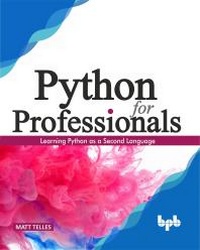
Python for Professionals
Learning Python as a Second Language
1st Edition
Published on 31. December 2019
386 pages
978-93-89423-73-0 (ISBN)
Description

No detailed description available for "Python for Professionals".
More details
Other editions
Additional editions
Book
01/2020
BPB Publications
€44.75
Available (delivery time upon request)
Content
- Cover Page
- Title Page
- Copyright Page
- Dedication
- About the Author
- About the Reviewer
- Acknowledgement
- Preface
- Errata
- Table of Contents
- 1. The History and Installation of Python
- Introduction
- Structure
- Objectives
- Python: the language
- History
- Selecting a Python version
- Why not use 2.7?
- Which 3.x to use?
- Installing
- Testing your installation
- The Zen of Python
- Keeping it simple
- Keeping it readable
- Never is better than right now
- Using pip
- Using virtual environments
- Python IDE's and command line work
- Hello world
- Conclusion
- Questions
- 2. Python Types and Constructs
- Introduction
- Structure
- Objectives
- Integers
- Floating point numbers
- Boolean
- Complex values
- Variable naming
- Strings
- Finding substrings
- Multiple line strings
- Concatenating
- Other methods
- Python Collections
- Lists
- Dictionaries
- Getting the value of a key
- Testing if a key is in a dictionary
- Iterating
- Length of a dictionary
- Adding new items
- Nested dictionaries
- Sets
- Tuples
- Iterators and iterables
- Sorted
- The zip function
- Booleans and truthiness
- Comments
- Conclusion
- Questions
- 3. The Nuts and Bolts
- Introduction
- Structure
- Objectives
- Conditionals
- The "walrus" operator
- ANDs, ORs, NOTs, and logicals
- Indentation
- The pass statement
- Loops
- Functions
- Parameters
- Return values
- Required vs optional arguments
- Keyword arguments
- Variable length arguments
- Lambdas
- Classes
- Scoping
- Objects
- Conclusion
- Questions
- 4. Organizational Skills
- Introduction
- Structure
- Objectives
- Immediate mode
- Modules
- Packages
- Importing
- Paths
- Dot notation in naming
- Installing packages using pip
- Insuring requirements with pip
- User installs vs system installs
- Conclusion
- Questions
- 5. Object-Oriented Programming
- Introduction
- Structure
- Objective
- Object-oriented programming with Python
- Abstraction
- Encapsulation
- Inheritance
- Multiple inheritance
- Polymorphism, the Python way
- Overloading of methods
- Overloading of operators
- Comparisons and overloading
- Read-only attributes
- The __new__operator
- Classes and Iteratables
- Chaining of operations
- Initialization
- Conclusion
- Questions
- 6. Advanced Manipulations
- Introduction
- Structure
- Objectives
- List comprehensions
- Dictionary comprehensions
- Nested dictionary comprehensions
- Applying functions
- Restrictions on dictionary comprehensions
- Set comprehensions
- Generators
- Building a string from a list
- Searching a string
- Searching a collection
- Using a set of functions to create an extensible state machine
- Filtering vs removing
- Slicing
- Lambda expressions
- The 'splat' operator and unpacking
- Conclusion
- Questions
- 7. File Input and Output
- Introduction
- Structure
- Objectives
- Files
- Working with files
- Using the with statement
- Reading fixed length data from files in Python
- Reading a text file by lines in Python
- A readlines real-world example
- Python and binary files
- JSON parsing
- JSON writing
- Serializing complex objects in JSON
- Reading in text vs reading in lines
- Writing out lines
- Output formatting
- Pickling
- Conclusion
- Questions
- 8. Imports and Reuse
- Introduction
- Structure
- Objectives
- Import and reuse of code
- Importing
- Importing modules
- Importing packages
- Dynamic imports
- Working with the os module
- Directory and file information
- Listing installed packages
- Reflection
- Using Reflection
- Conclusion
- Questions
- 9. Miscellaneous
- Introduction
- Structure
- Objectives
- Decorators
- Variable arguments
- Character encoding
- Properties
- Description strings
- Namespaces
- Context managers
- Metaclasses
- Dynamic classes and functions
- Deep vs shallow copying
- Exception handling
- Conclusion
- Questions
- 10. Not Reinventing the Wheel
- Introduction
- Structure
- Objectives
- Not reinventing the wheel
- Itertools
- Flask
- Adding authentication
- Numpy
- Installing Numpy
- Getting started: The basic array
- Accessing Numpy Data
- Data types
- Modifying arrays with Numpy
- Numpy mathematical functions
- Logging
- Unit test
- Setup and teardown
- Mocking
- Concurrency
- The emoji package
- The pprint package
- The requests package
- Conclusion
- Questions
- 11. General Tips and Tricks
- Introduction
- Structure
- Objectives
- Implementing a switch statement with dictionaries
- Remove duplicates from a list
- Determine the size of your objects in memory
- Find the most frequent item in a list
- Creating an enum in a class
- Detect Python version
- Using the _ (underscore) operator
- Discovering where a module is imported from
- Swapping two values without an intermediate temporary
- Using the classmethod decorator to create static methods
- Using the **kwargs to pass a named list of parameters
- Type hints
- Finding the day of the week using the calendar module
- Working with regular expressions
- Conclusion
- Questions
