

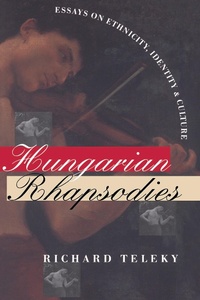
Hungarian Rhapsodies
Description

Like the renowned American writer Edmund Wilson, who began to learn Hungarian at the age of 65, Richard Teleky started his study of that difficult language as an adult. Unlike Wilson, he is a third-generation Hungarian American with a strong desire to understand how his ethnic background has affected the course of his life. ?Exploring my ethnicity,? he writes, ?became a way of exploring the arbitrary nature of my own life. It was not so much a search for roots as for a way of understanding rootlessness - how I stacked up against another way of being.? He writes with clarity, perception, and humor about a subject of importance to many Americans - reconciling their contemporary identity with a heritage from another country.
From an examination of photographer Andre Kertesz to a visit to a Hungarian American church in Cleveland, from a consideration of stereotypical treatment of Hungarians in North American fiction and film to a description of the process of translating Hungarian poetry into English, Teleky's interests are wide-ranging. he concludes with an account of his first visit to Hungary at the end of Soviet rule.
More details
Other editions
Additional editions
Person
Content
Preface
A Note on Hungarian Names
Playtime: Adult Language Learning, Edmund Wilson, and Me
"What the Moment Told Me": The Photographs of Andre Kertesz
The Archives of St. Elizabeth of Hungary
Without Words: Hungarians in North American Fiction
The Empty Box: Hollywood Ethnicity and Joe Eszterhas
A Short Dictionary of Hungarian Stereotypes and Kitsch
Visiting Pannonia
Toward a Course on Central European Literature in Translation
The Poet as Translator: Margaret Avison's "Hungarian Snap"
Introducing Peter Esterhazy
"What Comes After": Hungarian Voices, Summer 1993
The Third Generation and the "Problem" of Ethnicty
Notes
Bibliography
Credits
Index
