

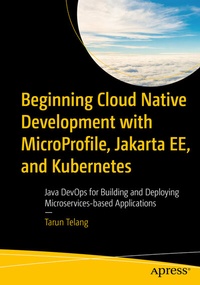
Beginning Cloud Native Development with MicroProfile, Jakarta EE, and Kubernetes
Description

This book introduces you to cloud-native applications and teaches you how to set up your development environment. You'll learn about the various components of MicroProfile, such as fault tolerance, config, health check, metrics, and JWT auth. You'll develop a RESTful web service made up of some microservices. You'll deploy your application on Docker and Kubernetes.
After reading this book, you'll come away with the fundamentals you need to build and deploy your first cloud-native Java-based app.
What You'll Learn
- Build your first cloud-native Java-based app with the open source MicroProfile platform, and Jakarta EE 10 APIs
-
Develop a RESTful web service using MicroProfile and Jakarta EE
- Discover and explore the key components of the MicroProfile framework, such as config, metrics, health, JWT authentication, and more
- Deploy your cloud-native application on the Kubernetes container orchestration platform
-
Get up to speed with other popular technologies such as Docker containers, Kubernetes clusters, and Zipkin
Who This Book Is For
Programmers with at least some prior experience in Java programming who may be new to MicroProfile and Jakarta EE. Some prior experience with Java-based microservices and web development is recommended, but not required.
More details
Other editions
Additional editions
Person
In 2005, Tarun worked on configuration and management in several enterprise solutions for SAP using the Java Management Extensions (JMX) technology. He also gained expertise in various integration technologies, such as SOAP, XML, and JSON, and used them to develop solutions to handle message-oriented communications across numerous systems. In 2007, Tarun was named SAP Mentor and Community Influencer for his articles and blog posts on emerging technologies and for promoting innovative solutions in the SAP Developer Community.
Tarun has the following certifications: Oracle Certified Programmer for Java 6.0 Platform, SAP Certified Development Consultant for NetWeaver 04 Java Web Application Development, SAP Certified Application Management Expert for End-to-End Root Cause Analysis - Solution Manager 4.0, and NASBA Certification on Remote Work.
Tarun is an expert in web, mobile, and cloud technologies. He has developed many end-to-end cloud-based solutions using various architectural patterns, including Microservices, RESTful web services, and Service Oriented Architecture.
For more than 15 years, Tarun has been actively publishing technical articles and blogs on various software technologies. He frequently writes articles on Java and related technologies. He has also authored multiple books on Java and Jakarta EE 10.
Tarun loves mentoring software professionals and programmers, and teaching them about current industry trends and best practices. His blogs at blogs.taruntelang.me are excellent resources for everything related to Java technology.
