

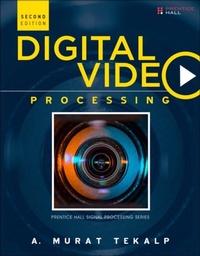
Digital Video Processing
2nd Edition
Published on 6. June 2015
624 pages
978-0-13-399110-9 (ISBN)
Description

Over the years, thousands of engineering students and professionals relied on Digital Video Processing as the definitive, in-depth guide to digital image and video processing technology. Now, Dr. A. Murat Tekalp has completely revamped the first edition to reflect today's technologies, techniques, algorithms, and trends.
Digital Video Processing, Second Edition, reflects important advances in image processing, computer vision, and video compression, including new applications such as digital cinema, ultra-high-resolution video, and 3D video.
This edition offers rigorous, comprehensive, balanced, and quantitative coverage of image filtering, motion estimation, tracking, segmentation, video filtering, and compression. Now organized and presented as a true tutorial, it contains updated problem sets and new MATLAB projects in every chapter.
Coverage includes
Multi-dimensional signals/systems: transforms, sampling, and lattice conversion
Digital images and video: human vision, analog/digital video, and video quality
Image filtering: gradient estimation, edge detection, scaling, multi-resolution representations, enhancement, de-noising, and restoration
Motion estimation: image formation; motion models; differential, matching, optimization, and transform-domain methods; and 3D motion and shape estimation
Video segmentation: color and motion segmentation, change detection, shot boundary detection, video matting, video tracking, and performance evaluation
Multi-frame filtering: motion-compensated filtering, multi-frame standards conversion, multi-frame noise filtering, restoration, and super-resolution
Image compression: lossless compression, JPEG, wavelets, and JPEG2000
Video compression: early standards, ITU-T H.264/MPEG-4 AVC, HEVC, Scalable Video Compression, and stereo/multi-view approaches
Digital Video Processing, Second Edition, reflects important advances in image processing, computer vision, and video compression, including new applications such as digital cinema, ultra-high-resolution video, and 3D video.
This edition offers rigorous, comprehensive, balanced, and quantitative coverage of image filtering, motion estimation, tracking, segmentation, video filtering, and compression. Now organized and presented as a true tutorial, it contains updated problem sets and new MATLAB projects in every chapter.
Coverage includes
Multi-dimensional signals/systems: transforms, sampling, and lattice conversion
Digital images and video: human vision, analog/digital video, and video quality
Image filtering: gradient estimation, edge detection, scaling, multi-resolution representations, enhancement, de-noising, and restoration
Motion estimation: image formation; motion models; differential, matching, optimization, and transform-domain methods; and 3D motion and shape estimation
Video segmentation: color and motion segmentation, change detection, shot boundary detection, video matting, video tracking, and performance evaluation
Multi-frame filtering: motion-compensated filtering, multi-frame standards conversion, multi-frame noise filtering, restoration, and super-resolution
Image compression: lossless compression, JPEG, wavelets, and JPEG2000
Video compression: early standards, ITU-T H.264/MPEG-4 AVC, HEVC, Scalable Video Compression, and stereo/multi-view approaches
All prices
More details
Edition
2nd edition
Language
English
Place of publication
Hoboken
United States
Publishing group
Pearson Education (US)
Target group
College/higher education
ISBN-13
978-0-13-399110-9 (9780133991109)
Copyright in bibliographic data and cover images is held by Nielsen Book Services Limited or by the publishers or by their respective licensors: all rights reserved.
Schweitzer Classification
Other editions
Additional editions
A. Murat Tekalp
Digital Video Processing
Book
07/2015
2nd Edition
Prentice Hall
€114.50
Article exhausted; check different version
Person
A. Murat Tekalp is a Professor at Koc University, Istanbul, Turkey, and is a Fellow of IEEE and a member of Academia Europaea and Turkish Academy of Sciences. He received a Ph.D. degree in electrical, computer, and systems engineering from Rensselaer Polytechnic Institute (RPI), Troy, New York, in 1984. He was with the Eastman Kodak Company, Rochester, New York, from 1984 to 1987, and was a professor at the University of Rochester, Rochester, New York, from 1987 to 2005, where he was named Distinguished University Professor. His research interests are in the area of digital image and video processing, image and video compression, and video networking.
Professor Tekalp received the TUBITAK Science Award (highest scientific award in Turkey) in 2004. He is a former Chair of the IEEE Technical Committee on Image and Multidimensional Signal Processing, and a Founding Member of IEEE Technical Committee on Multimedia Signal Processing. He was appointed as the Technical Program Co-Chair for IEEE ICASSP 2000 in Istanbul, Turkey; the General Chair of the IEEE International Conference on Image Processing (ICIP) at Rochester, New York, in 2002; and Technical Program Co-Chair of EUSIPCO 2005 in Antalya, Turkey.
Professor Tekalp received the TUBITAK Science Award (highest scientific award in Turkey) in 2004. He is a former Chair of the IEEE Technical Committee on Image and Multidimensional Signal Processing, and a Founding Member of IEEE Technical Committee on Multimedia Signal Processing. He was appointed as the Technical Program Co-Chair for IEEE ICASSP 2000 in Istanbul, Turkey; the General Chair of the IEEE International Conference on Image Processing (ICIP) at Rochester, New York, in 2002; and Technical Program Co-Chair of EUSIPCO 2005 in Antalya, Turkey.
Content
Preface xvii
About the Author xxv
Chapter 1: Multi-Dimensional Signals and Systems 1
1.1 Multi-Dimensional Signals 2
1.2 Multi-Dimensional Transforms 8
1.3 Multi-Dimensional Systems 20
1.4 Multi-Dimensional Sampling Theory 30
1.5 Sampling Structure Conversion 42
References 47
Exercises 48
Chapter 2: Digital Images and Video 53
2.1 Human Visual System and Color 54
2.2 Analog Video 63
2.3 Digital Video 67
2.4 3D Video 79
2.5 Digital-Video Applications 85
2.6 Image and Video Quality 96
References 100
Chapter 3: Image Filtering 105
3.1 Image Smoothing 106
3.2 Image Re-Sampling and Multi-Resolution Representations 110
3.3 Image-Gradient Estimation, Edge and Feature Detection 127
3.4 Image Enhancement 137
3.5 Image Denoising 147
3.6 Image Restoration 164
References 181
Exercises 186
MATLAB Resources 193
Chapter 4: Motion Estimation 195
4.1 Image Formation 196
4.2 Motion Models 202
4.3 2D Apparent-Motion Estimation 214
4.4 Differential Methods 225
4.5 Matching Methods 233
4.6 Nonlinear Optimization Methods 245
4.7 Transform-Domain Methods 249
4.8 3D Motion and Structure Estimation 251
References 263
Exercises 268
MATLAB Resources 272
Chapter 5: Video Segmentation and Tracking 273
5.1 Image Segmentation 275
5.2 Change Detection 289
5.3 Motion Segmentation 298
5.4 Motion Tracking 317
5.5 Image and Video Matting 328
5.6 Performance Evaluation 330
References 331
MATLAB Exercises 338
Internet Resources 339
Chapter 6: Video Filtering 341
6.1 Theory of Spatio-Temporal Filtering 342
6.2 Video-Format Conversion 349
6.3 Multi-Frame Noise Filtering 367
6.4 Multi-Frame Restoration 374
6.5 Multi-Frame Super-Resolution 377
References 394
Exercises 399
Chapter 7: Image Compression 401
7.1 Basics of Image Compression 402
7.2 Lossless Image Compression 417
7.3 Discrete-Cosine Transform Coding and JPEG 431
7.4 Wavelet-Transform Coding and JPEG2000 443
References 454
About the Author xxv
Chapter 1: Multi-Dimensional Signals and Systems 1
1.1 Multi-Dimensional Signals 2
1.2 Multi-Dimensional Transforms 8
1.3 Multi-Dimensional Systems 20
1.4 Multi-Dimensional Sampling Theory 30
1.5 Sampling Structure Conversion 42
References 47
Exercises 48
Chapter 2: Digital Images and Video 53
2.1 Human Visual System and Color 54
2.2 Analog Video 63
2.3 Digital Video 67
2.4 3D Video 79
2.5 Digital-Video Applications 85
2.6 Image and Video Quality 96
References 100
Chapter 3: Image Filtering 105
3.1 Image Smoothing 106
3.2 Image Re-Sampling and Multi-Resolution Representations 110
3.3 Image-Gradient Estimation, Edge and Feature Detection 127
3.4 Image Enhancement 137
3.5 Image Denoising 147
3.6 Image Restoration 164
References 181
Exercises 186
MATLAB Resources 193
Chapter 4: Motion Estimation 195
4.1 Image Formation 196
4.2 Motion Models 202
4.3 2D Apparent-Motion Estimation 214
4.4 Differential Methods 225
4.5 Matching Methods 233
4.6 Nonlinear Optimization Methods 245
4.7 Transform-Domain Methods 249
4.8 3D Motion and Structure Estimation 251
References 263
Exercises 268
MATLAB Resources 272
Chapter 5: Video Segmentation and Tracking 273
5.1 Image Segmentation 275
5.2 Change Detection 289
5.3 Motion Segmentation 298
5.4 Motion Tracking 317
5.5 Image and Video Matting 328
5.6 Performance Evaluation 330
References 331
MATLAB Exercises 338
Internet Resources 339
Chapter 6: Video Filtering 341
6.1 Theory of Spatio-Temporal Filtering 342
6.2 Video-Format Conversion 349
6.3 Multi-Frame Noise Filtering 367
6.4 Multi-Frame Restoration 374
6.5 Multi-Frame Super-Resolution 377
References 394
Exercises 399
Chapter 7: Image Compression 401
7.1 Basics of Image Compression 402
7.2 Lossless Image Compression 417
7.3 Discrete-Cosine Transform Coding and JPEG 431
7.4 Wavelet-Transform Coding and JPEG2000 443
References 454
