

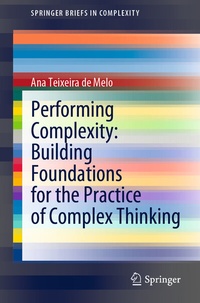
Performing Complexity: Building Foundations for the Practice of Complex Thinking
1st Edition
Published on 28. April 2020
XVII, 69 pages
978-3-030-46245-1 (ISBN)
Description

In the face of growing challenges, we need modes of thinking that allow us to not only grasp complexity but also perform it. In this book, the author approaches complexity from the standpoint of a relational worldview. The author recasts complex thinking as a mode of coupling between an observer and the world. Further, she explores the process and outcome of that coupling, namely, meaningful information that may have transformative effects and impact the management of change in the 'real world'. The author presents a new framework for operationalising complex thinking in a set of dimensions and properties through which it may be enacted. This framework may inform the development and coordination of new tools and strategies to support the practice and evaluation of complex thinking across a variety of domains. Intended for a wide interdisciplinary audience of academics, practitioners and policymakers alike, the book is an invitation to pursue inter- and transdisciplinary dialogues and collaborations.
More details
Series
Language
English
Place of publication
Cham
Switzerland
Publishing group
Springer International Publishing
Target group
Professional and scholarly
Product notice
Reflowable
Illustrations
XVII, 69 p. 5 illus., 1 illus. in color.
File size
2,35 MB
ISBN-13
978-3-030-46245-1 (9783030462451)
DOI
10.1007/978-3-030-46245-1
Schweitzer Classification
Other editions
Additional editions
Ana Teixeira de Melo
Performing Complexity: Building Foundations for the Practice of Complex Thinking
Book
04/2020
Springer
€58.84
Shipment within 7-9 days
Content
- Intro
- Preface
- Acknowledgements
- About This Book
- Contents
- About the Author
- List of Figures
- 1 Introduction: Thinking Complexity
- 1.1 Modes of Thinking
- 1.2 Thinking Complexity
- 1.3 Thinking Complexity Complexly
- References
- 2 A Relational Framework for Complexity and Complex Thinking
- 2.1 What and Where Is Complexity?
- 2.2 A Relational Worldview for Complexity: From Differentiation and Integration, to Recursiveness and Emergence
- 2.3 The (Co)Evolution of Complexity: The Universe and Its Observers
- 2.4 Knowing Through Coupling
- 2.5 From Relational to Relative Complexity(Ies)
- References
- 3 Complex Thinking as the Complexity of the Coupling Observer-World: Processes and Outcomes
- 3.1 Complex Thinking as a Mode of Coupling
- 3.2 Dimensions and Properties of Complex Thinking
- 3.3 First and Second-Order or Emergent Complex Thinking
- 3.4 The Processes and Contents of the Thinking: Complex Thinking, Complexity Thinking and Complex Systems Thinking
- References
- 4 An Operational Framework for Complex Thinking
- 4.1 Structural Complexity
- 4.1.1 Structural Variety and Dimensionality
- 4.1.2 Relationality
- 4.1.3 Recursiveness
- 4.2 Dynamic/Process Complexity
- 4.2.1 Timescales
- 4.2.2 Dynamic Processes
- 4.2.3 Relativity, Ambiguity and Uncertainty
- 4.3 Causal and Explanatory Complexity
- 4.3.1 Complementary Modes of Explanation and Finalities
- 4.3.2 Historicity
- 4.3.3 Complex Circularity: Part-Whole Relations
- 4.3.4 Emergence
- 4.4 Dialogic Complexity
- 4.4.1 Dualities and Complementarities
- 4.4.2 Trinities and Levels
- 4.5 Observer's Complexity
- 4.5.1 Multipositioning
- 4.5.2 Reflexivity
- 4.5.3 Intentionalities
- 4.6 Developmental and Adaptive Complexity
- 4.6.1 Developmental Adaptive Value
- 4.6.2 Developmental Evolvability
- 4.7 Pragmatic Complexity
- 4.7.1 Pragmatic Value
- 4.7.2 Pragmatic Sustainability
- 4.8 Ethical and Aesthetical Complexity
- 4.8.1 Ethical Value
- 4.8.2 Aesthetical Value
- 4.9 Narrative Complexity
- 4.9.1 Differentiation and Integration
- 4.9.2 Identities
- 4.9.3 Flexibility/Openness
- References
- 5 Discussion: From Thinking to Performing Complexity
- 5.1 From Thinking to Performing Complexity
- References
- Postface
