

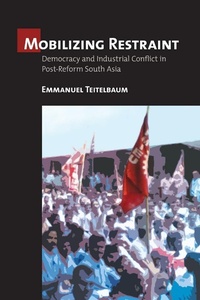
Mobilizing Restraint
Democracy and Industrial Conflict in Post-Reform South Asia
Published on 15. August 2011
248 pages
978-0-8014-6336-5 (ISBN)
Description

In Mobilizing Restraint, Emmanuel Teitelbaum argues that, contrary to conventional wisdom, democracies are better at managing industrial conflict than authoritarian regimes. This is because democracies have two unique tools at their disposal for managing worker protest: mutually beneficial union-party ties and worker rights. By contrast, authoritarian governments have tended to repress unions and to sever mutually beneficial ties to organized labor. Many of the countries that fall between these two extremes-from those that have only the trappings of democracy to those that have imperfectly implemented democratic reforms-exert control over labor in the absence of overt repression but without the robust organizational and institutional capacity enjoyed by full-fledged democracies. Based on the recent history of industrial conflict and industrial peace in South Asia, Teitelbaum argues that the political exclusion and repression of organized labor commonly witnessed in authoritarian and hybrid regimes has extremely deleterious effects on labor relations and ultimately economic growth.
To test his arguments, Teitelbaum draws on an array of data, including his original qualitative interviews and survey evidence from Sri Lanka and three Indian states-Kerala, Maharashtra, and West Bengal. He also analyzes panel data from fifteen Indian states to evaluate the relationship between political competition and worker protest and to study the effects of protective labor legislation on economic performance. In Teitelbaum's view, countries must undergo further political liberalization before they are able to replicate the success of the sophisticated types of growth-enhancing management of industrial protest seen throughout many parts of South Asia.
To test his arguments, Teitelbaum draws on an array of data, including his original qualitative interviews and survey evidence from Sri Lanka and three Indian states-Kerala, Maharashtra, and West Bengal. He also analyzes panel data from fifteen Indian states to evaluate the relationship between political competition and worker protest and to study the effects of protective labor legislation on economic performance. In Teitelbaum's view, countries must undergo further political liberalization before they are able to replicate the success of the sophisticated types of growth-enhancing management of industrial protest seen throughout many parts of South Asia.
Reviews / Votes
Mobilizing Restraint makes important contributions to the theorizing of labor politics as well as to the methods of studying the subject. By identifying the importance of competitive political parties and basic labor rights legislation found in democratic states, the author effectively denounces the premises of developmental authoritarianism and neoliberal economics that advocate for unprotected and subdued labor. Methodologically, this study demonstrates rigorous empirical work based on a mixed-methods approach.... It makes an obvious theoretical contribution to the way we think about labor and democracy, especially outside of Europe and North America.- Yoonkyung Lee (British Journal of Industrial Relations)
More details
Language
English
Place of publication
New York
United States
Publishing group
Cornell University Press
Product notice
Reflowable
ISBN-13
978-0-8014-6336-5 (9780801463365)
Copyright in bibliographic data and cover images is held by Nielsen Book Services Limited or by the publishers or by their respective licensors: all rights reserved.
Schweitzer Classification
Other editions
Additional editions
Book
08/2011
ILR Press
€148.56
Shipment within 10-20 days
Book
08/2011
ILR Press
€29.70
Shipment within 10-20 days
Person
Emmanuel Teitelbaum is Assistant Professor of Political Science and International Affairs at George Washington University.
Content
1. Introduction: The Political Management of Industrial ConflictPart I. A Puzzle and an Argument
2. Industrial Relations in the Context of Economic Change
3. A Political Theory of Industrial ProtestPart II. The Evidence
4. Democracy, Union-Party Ties, and Industrial Conflict
5. Labor Institutions, FACB Rights, and Economic Performance in India
6. The Deleterious Effects of Labor Repression in Sri Lanka7. Conclusion: Theoretical and Policy ImplicationsAppendix A. Survey Methods and Response Rates
Appendix B. Labor Law Coding
Notes
Works Cited
Index
2. Industrial Relations in the Context of Economic Change
3. A Political Theory of Industrial ProtestPart II. The Evidence
4. Democracy, Union-Party Ties, and Industrial Conflict
5. Labor Institutions, FACB Rights, and Economic Performance in India
6. The Deleterious Effects of Labor Repression in Sri Lanka7. Conclusion: Theoretical and Policy ImplicationsAppendix A. Survey Methods and Response Rates
Appendix B. Labor Law Coding
Notes
Works Cited
Index
