

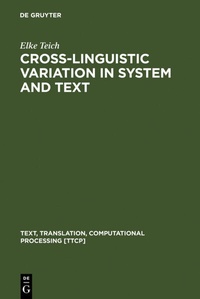
Cross-Linguistic Variation in System and Text
A Methodology for the Investigation of Translations and Comparable Texts
1st Edition
Published on 13. February 2012
X, 276 pages
978-3-11-089654-1 (ISBN)
Description

The intuition that translations are somehow different from texts that are not translations has been around for many years, but most of the common linguistic frameworks are not comprehensive enough to account for the wealth and complexity of linguistic phenomena that make a translation a special kind of text.
The present book provides a novel methodology for investigating the specific linguistic properties of translations. As this methodology is both corpus-based and driven by a functional theory of language, it is powerful enough to account for the multi-dimensional nature of cross-linguistic variation in translations and cross-lingually comparable texts.
More details
Series
Thesis
Professorial dissertation
2001
Universität des Saarlandes
Language
English
Place of publication
Berlin/Boston
Germany
Publishing group
de Gruyter Mouton
Target group
Professional and scholarly
US School Grade: College Graduate Student
Illustrations
54 Abbildungen, 77 s/w Tabellen
54 ill., 77 tbl.
File size
8,10 MB
ISBN-13
978-3-11-089654-1 (9783110896541)
Schweitzer Classification
Other editions
Additional editions
Elke Teich
Cross-Linguistic Variation in System and Text
A Methodology for the Investigation of Translations and Comparable Texts
Book
05/2003
1st Edition
De Gruyter Mouton
€119.95
Shipment within 7-9 days
Elke Teich
Cross-Linguistic Variation in System and Text
A Methodology for the Investigation of Translations and Comparable Texts
Book
01/2003
1st Edition
De Gruyter Mouton
€169.95
Article exhausted; check different version
Person
Elke Teich teaches at the University of Saarland, Saarbrücken, Germany.
Content
1 Introduction
1.1 Goals
1.2 Motivation
1.3 Methods
1.4 Road map through this book
2 State-of-the-art
2.1 Introduction
2.2 Multilingual research: objectives and methods
2.3 Hawkins' comparative typology of English and German
2.4 Doherty's research on English-German contrasts in translations
2.5 Baker's universal features of translations
2.6 Contrastive linguistics: register analysis
2.7 Summary and conclusions
3 Theory and Model of cross-linguistic variation
3.1 Introduction
3.2 Systemic Functional Linguistics: theory and model
3.3 Model of multilinguality
3.4 Summary and envoi
4 System: English-German grammatical contrasts and commonalities
4.1 Introduction
4.2 The grammar of the clause
4.3 Other ranks
4.4 Summary of major contrasts and commonalities
5 Text: English-German parallel, multilingually comparable and monolingually comparable texts
5.1 Introduction
5.2 Hypotheses and their testing
5.3 Analyses and interpretation of hypotheses
5.4 Summary and conclusions
6 Summary and conclusions
6.1 Summary: Cross-linguistic variation in multilingual texts
6.2 Assessment of the methodology
6.3 Envoi: Other contexts of application and issues for future research
Appendix A: Text sources
Appendix B: Statistical table
Appendix C: Analysis results in tabular form
Notes
References
Subject Index
Author Index
1.1 Goals
1.2 Motivation
1.3 Methods
1.4 Road map through this book
2 State-of-the-art
2.1 Introduction
2.2 Multilingual research: objectives and methods
2.3 Hawkins' comparative typology of English and German
2.4 Doherty's research on English-German contrasts in translations
2.5 Baker's universal features of translations
2.6 Contrastive linguistics: register analysis
2.7 Summary and conclusions
3 Theory and Model of cross-linguistic variation
3.1 Introduction
3.2 Systemic Functional Linguistics: theory and model
3.3 Model of multilinguality
3.4 Summary and envoi
4 System: English-German grammatical contrasts and commonalities
4.1 Introduction
4.2 The grammar of the clause
4.3 Other ranks
4.4 Summary of major contrasts and commonalities
5 Text: English-German parallel, multilingually comparable and monolingually comparable texts
5.1 Introduction
5.2 Hypotheses and their testing
5.3 Analyses and interpretation of hypotheses
5.4 Summary and conclusions
6 Summary and conclusions
6.1 Summary: Cross-linguistic variation in multilingual texts
6.2 Assessment of the methodology
6.3 Envoi: Other contexts of application and issues for future research
Appendix A: Text sources
Appendix B: Statistical table
Appendix C: Analysis results in tabular form
Notes
References
Subject Index
Author Index
