

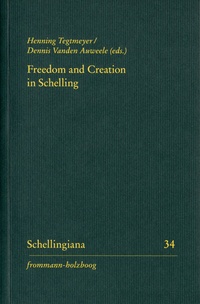
Freedom and Creation in Schelling
1st Edition
Published on 19. December 2022
412 pages
978-3-7728-3645-9 (ISBN)
Description

Der vorliegende Sammelband enthält internationale Forschungsbeiträge zum Zusammenhang von Freiheit und Schöpfung in F. W. J. Schellings Spätphilosophie. Das in der Forschung gestiegene Interesse an Letzterer sowie die zunehmende Verfügbarkeit von Schellings Texten führt dazu, dass traditionelle Lehrmeinungen über den Charakter seiner Spätphilosophie hinterfragt oder gänzlich verworfen werden. Anstatt etwa seine Erlanger, Münchener und Berliner Philosophie als bloße Apologie eines orthodoxen Theismus zu interpretieren, fokussieren Forscher*innen auf die Entwicklung und die Kontinuitäten in Schellings Denken insgesamt. Der Schellings gesamte Philosophie prägende Zusammenhang zwischen dem Freiheitsbegriff und der Schöpfungslehre wird hier eingehend untersucht, in einer ausgewogenen Mischung aus Exegese, systematischer Rekonstruktion und philosophischer Analyse.
This volume is dedicated to the exploration of the connection between freedom and creation in Schelling's late philosophy. It contains contributions of internationally renowned and younger Schelling scholars from several countries. The scholarly interest in Schelling's late philosophy has considerably increased during the last decades. Together with the rising number of available primary texts and translations, this has led, among other things, to a received scholarly view of Schelling's Erlangen, Munich, and Berlin years that partly challenges and partly rejects many claims of the older literature on Schelling. For example, his late philosophy is not conceived as a straightforward defence of orthodox theism anymore but seen within the context of his philosophical development, with a focus on the continuity between his early, middle, and late philosophy. The concepts of freedom and creation occupy a central position in these studies. The present volume examines the complex interrelations between these two concepts in detail, in a well-balanced combination of exegesis, systematic reconstruction and philosophical analysis.
More details
Other editions
Additional editions
Henning Tegtmeyer | Dennis Vanden Auweele
Freedom and Creation in Schelling
Book
12/2022
1st Edition
frommann-holzboog
from
€128.00
Shipment within 7-9 days
Persons
Content
- Intro
- Contents
- Introduction
- I Freedom in Schelling's Freedom Essay
- The Intelligible Deed, Lore Hühn
- 1. Schelling's Hamartiological Radicalization of the Idealistic Concept of Freedom
- 2. The Ruinous Self-Perversion of Being Able to Begin without Prerequisites
- 3. Self-Withdrawal and the Negation of the Will: Schopenhauer's Paradoxical Conception of Freedom
- 4. »Will is Primal Being«: The Voluntaristic Foundation of Being for Schelling and Schopenhauer
- References
- The >Real and Vital Concept< of HumanFreedom in Schelling's Freedom Essay, Nora C. Wachsmann
- 1. Candidates for Freedom: System of the Equilibrium of Free Will versus Determinism
- 2. Kant's >Intelligible Deed<
- 3. Schelling's >Formal Essence< of Freedom
- 4. Schelling's >own nature< of the Intelligible Essence
- 5. Conclusion
- References
- »Wille in dem Willen«, Brigita Gelzinyte
- 1. The Abfall of the Ideal into the Real
- 2. Ungrounding the Ground as Realising the Ideal
- References
- Schelling's Contribution to Natural Theology, Ryan Scheerlinck
- 1. The Subject Matter of the Philosophical Investigations
- 3. Schelling's Argument
- References
- II From the Freedom Essay to The Ages of the World and Beyond
- The Failure to Think Freedom, Dennis Vanden Auweele
- 1. The Project of The Ages of the World
- 2. Emerging from the Past Organically in The Ages of the World (1811)
- 3. The Tension of Freedom in The Ages of the World (1813)
- 4. Synthesising Freedom and Necessity in The Ages of the World (1815)
- 5. Conclusion
- References
- Freedom as the Temporal Unfolding of Being, Philipp Luy
- 1. Schelling's Approach to Temporality in The Ages of the World
- 2. The Concept of Inner Time and its Relation to Individuation
- 3. Creating a Ground: The True Present and Human Freedom
- 4. Freedom and the Radical Openness of the Present
- References
- The >Absolute Idea< in the Presentation of the Process of Nature, Christian Danz
- 1. From Positive to Negative Philosophy, or: The Formation of Schelling's Late Philosophy in Munich
- 2. Form as Symbol in the Philosophy of Identity
- 3. The Idea of »What Exists« in the Presentation of the Process of Nature
- References
- III Freedom and Creation in Schelling's Late Philosophy
- »Every salvation presupposes a danger, a narrowness, angustias«, Fernando Wirtz
- 1. The Problem of Freedom and Creation
- 2. The Role of Angst within Freedom and Creation
- 3. Angst in the Historical-Critical Introduction
- 4. Angst in the Philosophy of Mythology
- 5. Conclusion
- References
- Schelling and the Wesen of Good and Evil, Jason M. Wirth
- 1. Inverting the Wesen
- 2. Satan and Naturvernichtung
- 3. Conclusion
- References
- Divine Freedom and Creation, Henning Tegtmeyer
- 1. Schelling's 1809 Account of Human and Divine Freedom
- 2. Trinity and Creation
- 3. Methodology: Negative and Positive Philosophy
- 4. Divine Potencies and Persons
- 5. Freedom in Creation
- 6. Conclusion
- References
- IV The Impact of Schelling's Account of Freedom and Creation on German Post-Idealism
- Freedom and Self-Grounding, Mark J. Thomas
- 1. Common Features of the Two Accounts of Freedom
- 2. A Fundamental Difference: Groundlessness versus Self-Grounding
- 3. Implications of the Difference: Necessity and Moral Responsibility
- 4. Conclusion: The Possibility of Self-Grounding?
- References
- Schelling on Moving Beyond Idealism, Yu Xia
- 1. The Context of the Problem
- 2. Heidegger's Critique of Idealism as the Ground of Higher Realism
- 3. Schelling on Higher Realism as the Basis of Idealism
- 4. Heidegger on the Problem of the Will and the Groundless Ground
- 5. Schelling's Response to the Problem of the Will and the Non-Ground
- 6. Heidegger on God as Ultimate Subjectivity and on Ontotheology
- 7. Schelling's Response to the >Subjectivity< Problem
- 8. Conclusion
- References
- The Life-Long Discussion between Friedrich Schlegel and Schelling in the Aftermath of the Freedom Essay and Its Impact on Schelling's Shift towards Positive Philosophy, Ljudevit Fran Jezic
- 1. Introduction
- 2. Schelling's Challenge to Friedrich Schlegel in the Freedom Essay
- 3. August Wilhelm Schlegel's Reply to the Freedom Essay
- 4. Friedrich Schlegel's Manuscript Métaphysique
- 5. The Postponement of Friedrich Schlegel's Reply and his Poem »Irrlichter«
- 6. Schelling's The Ages of the World (1811) and his Debate with the Schlegel Brothers
- 7. Friedrich Schlegel's Concealed Reply to Schelling in His Jacobi Review ( January 1812)
- 8. Schelling's Ambivalent Reaction to Schlegel's Jacobi Review and Their Rapprochement
- 9. The Culmination of the Positive Relationship between Schelling and Friedrich Schlegel
- 10. Friedrich Schlegel's 1822 Jacobi Review and his Lectures on the Philosophy of History (1828)
- 11. Schelling's Discussion of Friedrich Schlegel in the Lectures on the Philosophy of Mythology
- 12. Conclusion
- References
- Essay
- Schelling, Nietzsche, and the Reawakening God, Joseph P. Lawrence
- 1. The Schelling-Nietzsche-Nexus
- 2. Love and Will to Power
- 3. Christ and Dionysus
- 4. Tragedy
- References
- About the Authors
- Index of Names
- Index of Subjects
