

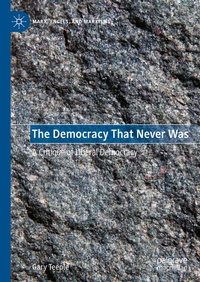
The Democracy That Never Was
Description

Liberal democracy is usually treated as an independent variable, as possessing the absolutes of democratic rule. Its variable forms, changing principles and practice, and conscious destruction by its own advocates, in particular the United States, however, suggest that it is not what it appears to be. This book argues that it is a dependent variable, the political form required by the changing configurations of national capital and their countervailing forces. The forms of liberal democracy have always shifted in concert with the mode of production as their premise.
The absolutes of liberal democracy, the author contends, have never been anything but the abstracted principles of the marketplace. Their nature has now become especially visible for what they have been because the premise as national capital development has changed, leaving liberal democracy as a form without its original content, and its present content out of keeping with a national jurisdiction. As a political form, it persists, but its role has been transformed from the regulation of national capital accumulation to the enforcer of the demands of global configurations of capital.
It is a role that its citizens implicitly understand, as revealed in widespread political cynicism, decreasing electoral participation, and declining legitimacy that require ever greater measures of deceit from political leaders and increased means of coercive social control, including militarized police forces and pervasive electronic surveillance. There can be no going back to the stage of national politics because the neoliberal content of liberal democratic policies represents the necessities of global capital. And it is the contradictions of global capital that define the character of early 21st century political conflict.
Reviews / Votes
"A tour de force of historical sociology. Within a Marxist framework the book engages the problems facing contemporary democracy, and convincingly argues that liberal-democracy has always functioned to protect the interests of the propertied class in a system notionally founded on political equality - an exercise in management of contradictions that has now run its course." (Stephen McBride, McMaster University, Hamilton, Canada)
More details
Other editions
Additional editions
Person
Gary Teeple is Professor of Sociology in the Department of Sociology and Anthropology at Simon Fraser University, British Columbia, Canada. He was also the Director of the Labour Studies Program at SFU from 2010-2016. He received an MA from the Department of Sociology, University of Toronto, and a D. Phil. from the Department of Comparative Politics, University of Sussex, UK.
Content
Chapter 1: Introduction: Definition of the problem, outline of the argument.- Chapter 2: Politics: The problem of definition.- Chapter 3: The meaning of politics: The state and civil society.- Chapter 4: The origins of the modern state or the transition from feudalism to capitalism.- Chapter 5: Private property and human rights.- Chapter 6: The constitution.- Chapter 7: The executive: Elected and permanent.- Chapter 8: The legislature.- Chapter 9: The law and judiciary.- Chapter 10: Suffrage and citizenship.- Chapter 11: Political parties, and other links.- Chapter 12: Politics and religion.- Chapter 13: The completion of politics and the end of liberal democracy.
