

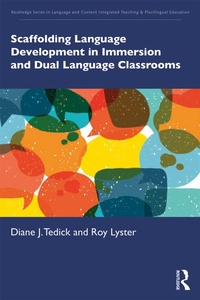
Scaffolding Language Development in Immersion and Dual Language Classrooms
1st Edition
Published on 28. November 2019
382 pages
978-0-429-76661-9 (ISBN)
Description

This book introduces research-based pedagogical practices for supporting and enhancing language development and use in school-based immersion and dual language programs in which a second, foreign, heritage, or indigenous language is used as the medium of subject-matter instruction. Using counterbalanced instruction as the volume's pedagogical framework, the authors map out the specific pedagogical skill set and knowledge base that teachers in immersion and dual language classrooms need so their students can engage with content taught through an additional language while continuing to improve their proficiency in that language. To illustrate key concepts and effective practices, the authors draw on classroom-based research and include teacher-created examples of classroom application. The following topics are covered in detail:
defining characteristics of immersion and dual language programs and features of well-implemented programs
strategies to promote language and content integration in curricular planning as well as classroom instruction and performance assessment
an instructional model to counterbalance form-focused and content-based instruction
scaffolding strategies that support students' comprehension and production while ensuring continued language development
an approach to creating cross-linguistic connections through biliteracy instruction
a self-assessment tool for teachers to reflect on their pedagogical growth
Also applicable to content and language integrated learning and other forms of content-based language teaching, this comprehensive volume includes graphics to facilitate navigation and provides Resources for Readers and Application Activities at the end of each chapter.
The book will be a key resource for preservice and in-service teachers, administrators, and teacher educators.
defining characteristics of immersion and dual language programs and features of well-implemented programs
strategies to promote language and content integration in curricular planning as well as classroom instruction and performance assessment
an instructional model to counterbalance form-focused and content-based instruction
scaffolding strategies that support students' comprehension and production while ensuring continued language development
an approach to creating cross-linguistic connections through biliteracy instruction
a self-assessment tool for teachers to reflect on their pedagogical growth
Also applicable to content and language integrated learning and other forms of content-based language teaching, this comprehensive volume includes graphics to facilitate navigation and provides Resources for Readers and Application Activities at the end of each chapter.
The book will be a key resource for preservice and in-service teachers, administrators, and teacher educators.
Reviews / Votes
'I would highly recommend this book to preservice and in-service K-12 teachers, other educators, and researchers interested in second language education. Tedick and Lyster provide a much-needed research-based presentation of pedagogical practices to enhance language development in dual language and immersion classrooms. Their clear definitions, specific strategies and instructional models, and self-assessment tools add a significant layer of depth to our understanding of how to teach two languages in dual language and immersion classrooms. This book provides important implications for program design, curriculum, and instructional practices in dual language and immersion programs to significantly improve language learning and teaching. Buy it today and use it tomorrow!' - Kathryn Lindholm-Leary, Professor Emerita, Child and Adolescent Development, San Jose State University, USA'Tedick and Lyster have drawn on decades of research and experience to produce this remarkable book. The authors' deep knowledge of classroom practices and their respect for teachers' creativity and hard work are reflected on every page. From reviewing research findings to providing guidance for lesson planning and pedagogy, the book is comprehensive, original, and practical. It will become a foundational text for teacher education and professional development in immersion and dual language education.' - Patsy Lightbown, Distinguished Professor Emerita, Education, Concordia University, Canada 'I would highly recommend this book to preservice and in-service K-12 teachers, other educators, and researchers interested in second language education. Tedick and Lyster provide a much-needed research-based presentation of pedagogical practices to enhance language development in dual language and immersion classrooms. Their clear definitions, specific strategies and instructional models, and self-assessment tools add a significant layer of depth to our understanding of how to teach two languages in dual language and immersion classrooms. This book provides important implications for program design, curriculum, and instructional practices in dual language and immersion programs to significantly improve language learning and teaching. Buy it today and use it tomorrow!' - Kathryn Lindholm-Leary, Professor Emerita, Child and Adolescent Development, San Jose State University, USA
'Tedick and Lyster have drawn on decades of research and experience to produce this remarkable book. The authors' deep knowledge of classroom practices and their respect for teachers' creativity and hard work are reflected on every page. From reviewing research findings to providing guidance for lesson planning and pedagogy, the book is comprehensive, original, and practical. It will become a foundational text for teacher education and professional development in immersion and dual language education.' - Patsy Lightbown, Distinguished Professor Emerita, Education, Concordia University, Canada
More details
Series
Edition
1. Auflage
Language
English
Place of publication
London
United Kingdom
Publishing group
Taylor & Francis Ltd
Target group
College/higher education
Professional and scholarly
Product notice
Reflowable
Fixed format
Illustrations
35 Tables, black and white; 24 Line drawings, black and white; 5 Halftones, black and white; 29 Illustrations, black and white
File size
3,67 MB
ISBN-13
978-0-429-76661-9 (9780429766619)
Copyright in bibliographic data and cover images is held by Nielsen Book Services Limited or by the publishers or by their respective licensors: all rights reserved.
Schweitzer Classification
Other editions
Additional editions
Diane J. Tedick | Roy Lyster
Scaffolding Language Development in Immersion and Dual Language Classrooms
Book
12/2019
1st Edition
Routledge
€61.60
Shipment within 10-20 days
Diane J. Tedick | Roy Lyster
Scaffolding Language Development in Immersion and Dual Language Classrooms
Book
12/2019
1st Edition
Routledge
€208.60
Shipment within 10-20 days
Persons
Diane J. Tedick is Professor of Second Language Education at the University of Minnesota. Her research interests include student language development in immersion classrooms, content-based language instruction, and immersion/dual language teacher education and professional development. She provides professional development experiences for immersion and bilingual teachers in the U.S. and internationally. She has co-edited two books on immersion, both published by Multilingual Matters: Pathways to Multilingualism: Evolving Perspectives on Immersion Education (2008) and Immersion Education: Practices, Policies, Possibilities (2011). She has twice received the U.S. Paul Pimsleur Award for Research in Foreign Language Education, in 2013 with co-recipient Laurent Cammarata, and in 2016 with Tara Fortune.
Roy Lyster is Professor Emeritus of Second Language Education at McGill University. His research examines content-based second-language instruction and the effects of instructional interventions designed to counterbalance form-focused and content-based approaches. He was co-recipient with colleague Leila Ranta of the 1998 Paul Pimsleur Award for Research in Foreign Language Education and was presented the Robert Roy Award by the Canadian Association of Second Language Teachers in 2017. He is author of a module called Content-Based Language Teaching published by Routledge in 2018, and two books: Learning and Teaching Languages Through Content published by Benjamins in 2007 and Vers une approche integree en immersion published by Les Editions CEC in 2016.
Roy Lyster is Professor Emeritus of Second Language Education at McGill University. His research examines content-based second-language instruction and the effects of instructional interventions designed to counterbalance form-focused and content-based approaches. He was co-recipient with colleague Leila Ranta of the 1998 Paul Pimsleur Award for Research in Foreign Language Education and was presented the Robert Roy Award by the Canadian Association of Second Language Teachers in 2017. He is author of a module called Content-Based Language Teaching published by Routledge in 2018, and two books: Learning and Teaching Languages Through Content published by Benjamins in 2007 and Vers une approche integree en immersion published by Les Editions CEC in 2016.
Content
INTRODUCTION
PART I: WHAT IS IMMERSION AND DUAL LANGUAGE EDUCATION?
Chapter 1: From Goals and Outcomes to Program Models and Characteristics
Chapter 2: Characteristics of Well-Implemented Immersion and Dual Language Programs
PART II: WHAT IS COUNTERBALANCED INSTRUCTION?
Chapter 3: Counterbalanced Instruction: Its Rationale and Key Characteristics
Chapter 4: Contextualization, Awareness, Practice, and Autonomy: The CAPA Model
PART III: WHAT IS SCAFFOLDING?
Chapter 5: Effective Scaffolding and Questioning Techniques
Chapter 6: Corrective Feedback
PART IV: CURRICULUM PLANNING AND ASSESSMENT
Chapter 7: Unit-Level Instructional Design
Chapter 8: Module and Lesson Design
Chapter 9: Scaffolding Biliteracy Development
Chapter 10: Performance Assessment
CONCLUSION
REFERENCES
Appendix A: ImDL Unit Design Example
Appendix B: ImDL Module and Lesson Design Example
Appendix C: ImDL IPA Example
Appendix D: Self-Assessment Rubric for ImDL Teachers
Appendix E: Answer Keys
Index
PART I: WHAT IS IMMERSION AND DUAL LANGUAGE EDUCATION?
Chapter 1: From Goals and Outcomes to Program Models and Characteristics
Chapter 2: Characteristics of Well-Implemented Immersion and Dual Language Programs
PART II: WHAT IS COUNTERBALANCED INSTRUCTION?
Chapter 3: Counterbalanced Instruction: Its Rationale and Key Characteristics
Chapter 4: Contextualization, Awareness, Practice, and Autonomy: The CAPA Model
PART III: WHAT IS SCAFFOLDING?
Chapter 5: Effective Scaffolding and Questioning Techniques
Chapter 6: Corrective Feedback
PART IV: CURRICULUM PLANNING AND ASSESSMENT
Chapter 7: Unit-Level Instructional Design
Chapter 8: Module and Lesson Design
Chapter 9: Scaffolding Biliteracy Development
Chapter 10: Performance Assessment
CONCLUSION
REFERENCES
Appendix A: ImDL Unit Design Example
Appendix B: ImDL Module and Lesson Design Example
Appendix C: ImDL IPA Example
Appendix D: Self-Assessment Rubric for ImDL Teachers
Appendix E: Answer Keys
Index
