

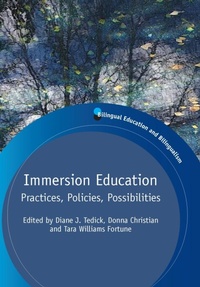
Immersion Education
Practices, Policies, Possibilities
Published on 5. July 2011
304 pages
978-1-84769-473-7 (ISBN)
Description

This volume builds on Fortune and Tedick's 2008 Pathways to Multilingualism: Evolving Perspectives on Immersion Education and showcases the practice and promise of immersion education through in-depth investigations of program design, implementation practices, and policies in one-way, two-way and indigenous programs. Contributors present new research and reflect on possibilities for strengthening practices and policies in immersion education. Questions explored include: What possibilities for program design exist in charter programs for both two-way and indigenous models? How do studies on learner outcomes lead to possibilities for improvements in program implementation? How do existing policies and practices affect struggling immersion learners and what possibilities can be imagined to better serve such learners? In addressing such questions, the volume invites readers to consider the possibilities of immersion education to enrich the language development and educational achievement of future generations of learners.
Reviews / Votes
This collection of cutting-edge research into different immersion contexts and student types around the globe - many of which the field has never read about before - will be of interest not only to researchers, but also to parents, teachers, administrators, program evaluators, and community members. Kudos to the editors for a fascinating compilation. -- Kim Potowski, University of Illinois-Chicago The editors of this timely volume invite readers to 'dwell in possibility' as they reflect on the current and future state of immersion education across the globe. While highlighting the continued growth and benefits of a range of immersion programs, this volume effectively addresses the many challenges inherent in teaching languages through content and aptly explores the 'yet-to-be-realized potential' of immersion education. -- Roy Lyster, McGill University Educational research on immersion education offers an important rejoinder to the monolingual bias that still shapes so much educational policy and practice towards bilingual students. Edited by leading international authorities in immersion education, this timely and important volume is a major contribution to the field. It provides a comprehensive and compelling account of the latest developments in immersion education. Its emphasis on policy and pedagogy, along with its international reach, make it a must read for all those interested in improving the educational outcomes of bilingual students. -- Stephen May, University of Auckland "Immersion Education -- Practices, Policies, Possibilities" is a resource full of interesting material for anybody interested in L2 acquisition. The book offers so many insights into various ways of implementing immersion, some of which have received little attention elsewhere...This is a highly recommended book for anyone interested in the immersion approach to language learning. It opens up new perspectives, and indeed "dwells in possibility" for the future implementation of immersion programs in various shapes. -- Liss Kerstin Sylven, University of Gothenburg * the LINGUIST List 23.1100 *More details
Series
Language
English
Place of publication
Bristol
United Kingdom
Publishing group
Channel View Publications Ltd
Target group
Professional and scholarly
ISBN-13
978-1-84769-473-7 (9781847694737)
Copyright in bibliographic data and cover images is held by Nielsen Book Services Limited or by the publishers or by their respective licensors: all rights reserved.
Schweitzer Classification
Other editions
Additional editions
Diane J. Tedick | Donna Christian | Tara Williams Fortune
Immersion Education
Practices, Policies, Possibilities
Book
07/2011
Multilingual Matters
€48.20
Shipment within 10-20 days
Persons
Diane Tedick is Associate Professor of Second Languages and Cultures Education at the University of Minnesota. For over 20 years she has worked in the preparation of preservice teachers and ongoing professional development of inservice teachers representing a variety of language teaching contexts: immersion and bilingual programs, world languages, and ESL. Her professional and research interests focus on the pedagogy required for successful integration of language and content instruction, student oral language proficiency development in immersion programs, and language teacher development.
Donna Christian is a senior fellow at the Center for Applied Linguistics in Washington, DC (www.cal.org). Her work focuses on the role of language in education and society, with special interests in dual language education, second language learning, dialect diversity, and public policy.
Tara Williams Fortune is an Immersion Teaching Specialist and Coordinator of the Immersion Projects at the Center for Advanced Research on Language Acquisition at the University of Minnesota. She is founding editor of The American Council on Immersion Education (ACIE) Newsletter, a publication written for and by immersion practitioners that is currently in its 14th year of dissemination. Her professional and research interests focus on struggling immersion learners, K-8 oral proficiency development of immersion students, and language and literacy development in early total Chinese immersion programs.
Donna Christian is a senior fellow at the Center for Applied Linguistics in Washington, DC (www.cal.org). Her work focuses on the role of language in education and society, with special interests in dual language education, second language learning, dialect diversity, and public policy.
Tara Williams Fortune is an Immersion Teaching Specialist and Coordinator of the Immersion Projects at the Center for Advanced Research on Language Acquisition at the University of Minnesota. She is founding editor of The American Council on Immersion Education (ACIE) Newsletter, a publication written for and by immersion practitioners that is currently in its 14th year of dissemination. Her professional and research interests focus on struggling immersion learners, K-8 oral proficiency development of immersion students, and language and literacy development in early total Chinese immersion programs.
Content
Merrill Swain: Foreword
Diane J. Tedick, Donna Christian and Tara Williams Fortune: Acknowledgements Introduction to the Volume
Diane J. Tedick, Donna Christian and Tara Williams Fortune: The Future of Immersion Education: An Invitation to 'Dwell in Possibility'
Section I: Practices in Immersion Program Design
Siv Bjoerklund and Karita Mard-Miettinen: Integrating Multiple Languages in Immersion: Swedish Immersion in Finland
William H. Wilson and Kauanoe Kamana: Insights from Indigenous Language Immersion in Hawai?i: The Case of Nawahi School
Gareth Diaz Zehrbach: Two-Way Immersion Charter Schools: An Analysis of Program Characteristics and Student Body Compositions
Section II: Program Outcomes and Implications for Practice
Kathryn Lindholm-Leary: Student Outcomes in Chinese Two-Way Immersion Programs: Language Proficiency, Academic Achievement, and Student Attitudes
Ester J. de Jong and Carol I. Bearse: The Same Outcomes for All? High School Students Reflect on Their Two-Way Immersion Program Experiences
Sandra Burger, Alysse Weinberg, Carla Hall, Parvin Movassat, and Amelia Hope: French Immersion Studies at the University of Ottawa: Program Evaluation and Pedagogical Challenges
Section III: Language Use and Assessment Practices in Immersion Programs
Padraig O Duibhir: 'I thought that we had good Irish': Irish Immersion Students' Insights into Their Target Language Use
Maggie Broner and Diane J. Tedick: Talking in the 5th Grade Classroom: Language Use in an Early, Total Spanish Immersion Program
Lizette Peter, Gloria Sly and Tracy Hirata-Edds: Using Language Assessment to Inform Instruction in Indigenous Language Immersion
Section IV: Policy and Practice in Immersion Education
Philip Hoare: Context and Constraints: Immersion in Hong Kong and Mainland China
Lisa Dorner: US Immigrants and Two-Way Immersion Policies: The Mismatch between District Designs and Family Experiences
Tara Williams Fortune: Struggling Learners and the Language Immersion Classroom
Concluding Synthesis Chapter for the Volume Fred Genesee: Reflecting on Possibilities for Immersion
Diane J. Tedick, Donna Christian and Tara Williams Fortune: Acknowledgements Introduction to the Volume
Diane J. Tedick, Donna Christian and Tara Williams Fortune: The Future of Immersion Education: An Invitation to 'Dwell in Possibility'
Section I: Practices in Immersion Program Design
Siv Bjoerklund and Karita Mard-Miettinen: Integrating Multiple Languages in Immersion: Swedish Immersion in Finland
William H. Wilson and Kauanoe Kamana: Insights from Indigenous Language Immersion in Hawai?i: The Case of Nawahi School
Gareth Diaz Zehrbach: Two-Way Immersion Charter Schools: An Analysis of Program Characteristics and Student Body Compositions
Section II: Program Outcomes and Implications for Practice
Kathryn Lindholm-Leary: Student Outcomes in Chinese Two-Way Immersion Programs: Language Proficiency, Academic Achievement, and Student Attitudes
Ester J. de Jong and Carol I. Bearse: The Same Outcomes for All? High School Students Reflect on Their Two-Way Immersion Program Experiences
Sandra Burger, Alysse Weinberg, Carla Hall, Parvin Movassat, and Amelia Hope: French Immersion Studies at the University of Ottawa: Program Evaluation and Pedagogical Challenges
Section III: Language Use and Assessment Practices in Immersion Programs
Padraig O Duibhir: 'I thought that we had good Irish': Irish Immersion Students' Insights into Their Target Language Use
Maggie Broner and Diane J. Tedick: Talking in the 5th Grade Classroom: Language Use in an Early, Total Spanish Immersion Program
Lizette Peter, Gloria Sly and Tracy Hirata-Edds: Using Language Assessment to Inform Instruction in Indigenous Language Immersion
Section IV: Policy and Practice in Immersion Education
Philip Hoare: Context and Constraints: Immersion in Hong Kong and Mainland China
Lisa Dorner: US Immigrants and Two-Way Immersion Policies: The Mismatch between District Designs and Family Experiences
Tara Williams Fortune: Struggling Learners and the Language Immersion Classroom
Concluding Synthesis Chapter for the Volume Fred Genesee: Reflecting on Possibilities for Immersion
