

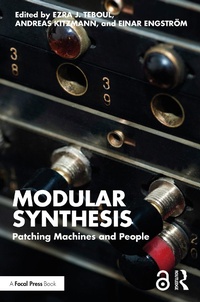
Modular Synthesis
Patching Machines and People
1st Edition
Published on 24. April 2024
500 pages
978-1-040-01572-8 (ISBN)
Description

Modular Synthesis: Patching Machines and People brings together scholars, artists, composers, and musical instrument designers in an exploration of modular synthesis, an unusually multifaceted musical instrument that opens up many avenues for exploration and insight, particularly with respect to technological use, practice, and resistance.
Through historical, technical, social, aesthetic, and other perspectives, this volume offers a collective reflection on the powerful connections between technology, creativity, culture, and personal agency. Ultimately, this collection is about creativity in a technoscientific world and speaks to issues fundamental to our everyday lives and experiences, by providing insights into the complex relationships between content creators, the technologies they use, and the individuals and communities who design and engage with them.
With chapters covering VCV Rack, modular synthesis, instrument design, and the histories of synthesizer technology, as well as interviews with Dave Rossum, Corry Banks, Meng Qi, and Dani Dobkin, among others, Modular Synthesis is recommended reading for advanced undergraduates, researchers, and practitioners of electronic music and music technology.
Chapter 3 of this book is freely available as a downloadable Open Access PDF at http://www.taylorfrancis.com under a Creative Commons Attribution-Non Commercial-No Derivatives (CC-BY-NC-ND) 4.0 license.
Through historical, technical, social, aesthetic, and other perspectives, this volume offers a collective reflection on the powerful connections between technology, creativity, culture, and personal agency. Ultimately, this collection is about creativity in a technoscientific world and speaks to issues fundamental to our everyday lives and experiences, by providing insights into the complex relationships between content creators, the technologies they use, and the individuals and communities who design and engage with them.
With chapters covering VCV Rack, modular synthesis, instrument design, and the histories of synthesizer technology, as well as interviews with Dave Rossum, Corry Banks, Meng Qi, and Dani Dobkin, among others, Modular Synthesis is recommended reading for advanced undergraduates, researchers, and practitioners of electronic music and music technology.
Chapter 3 of this book is freely available as a downloadable Open Access PDF at http://www.taylorfrancis.com under a Creative Commons Attribution-Non Commercial-No Derivatives (CC-BY-NC-ND) 4.0 license.
Reviews / Votes
"Just when everyone thought digital had evolved into music's alpha species, modular analog synthesizers resurged after decades of dormancy. Modular Synthesis provides a valuable overview of how and why the technology that redefined the musical instrument in the 1960s became relevant and transformative again."Nicolas Collins, composer and author of Handmade Electronic Music - The Art of Hardware Hacking
"It's no accident that the first academic collection on modular synthesizers touches on so many disciplines. Across its pages you will hear from musicians, artists, makers, and scholars from across the arts and human sciences. How many books on music discuss looms, switchboards, and electric fish? How many books on philosophy examine the material metaphors on which philosophers' ideas are based? How many books on electronics include studies of education or the gendered politics of naming? Modular Synthesis is as varied, multidisciplinary, and enchanting as its object of study."
Jonathan Sterne, author of Diminished Faculties, MP3, and The Audible Past
More details
Edition
1. Auflage
Language
English
Place of publication
Oxford
United Kingdom
Publishing group
Taylor & Francis Ltd
Target group
College/higher education
Professional and scholarly
Illustrations
3 Tables, black and white; 24 Line drawings, black and white; 22 Halftones, black and white; 46 Illustrations, black and white
ISBN-13
978-1-040-01572-8 (9781040015728)
Copyright in bibliographic data and cover images is held by Nielsen Book Services Limited or by the publishers or by their respective licensors: all rights reserved.
Schweitzer Classification
Other editions
Additional editions
Book
04/2024
1st Edition
Focal Press
€76.20
Shipment within 10-20 days
Book
04/2024
1st Edition
Focal Press
€207.40
Shipment within 10-20 days

Modular Synthesis
Patching Machines and People
Book
04/2024
Taylor & Francis
Unfortunately, price unknown
Article exhausted; check different version
Persons
Ezra J. Teboul is a researcher and artist, and currently a student librarian at Concordia University. They obtained a PhD in Electronic Arts from Rensselaer Polytechnic Institute in 2020. In 2022, they were a scholar-in-residence at the Columbia University Computer Music Center. Their work focuses on the material histories of electricity, work, and music.
Andreas Kitzmann is an associate professor of Humanities at York University in Toronto, Canada. His research interests include modular synthesis, technology and culture, digital media and community, and memory studies. His self-authored books include The Hypertext Handbook: The Straight Story and Saved from Oblivion: Documenting the Daily from Diaries to Web Cams. He has co-edited two books, and his work has also been included in various edited collections and journals such as A History of English Autobiography (2016), From Text to Txting: New Media in the Classroom (2012), the International Journal of Research into New Media Technologies (2017), First Monday (2015), and Organized Sound (2023).
Einar Engstroem is a software engineer, modular synthesist, and computer musician. Creatively, he has been known to code in Lua, SuperCollider, Tidal Cycles, and the Teletype esolang, whilst professionally he primarily inhabits the BEAM ecosystem. Both practices are natural extensions to Einar's previous PhD research into the history and philosophy of computing music programming, which focused on the Acoustical and Behavioral Research Center at Bell Laboratories-the first behemoth of innovation in both telecommunications and computing. He also holds an MA in Visual Culture from Waseda University (Tokyo, Japan), is a former editor-in-chief of the bilingual international contemporary art magazine LEAP (Beijing, China) and technician and researcher at RE/Lab (Toronto Metropolitan University), and has hands in various electronic music record labels.
Andreas Kitzmann is an associate professor of Humanities at York University in Toronto, Canada. His research interests include modular synthesis, technology and culture, digital media and community, and memory studies. His self-authored books include The Hypertext Handbook: The Straight Story and Saved from Oblivion: Documenting the Daily from Diaries to Web Cams. He has co-edited two books, and his work has also been included in various edited collections and journals such as A History of English Autobiography (2016), From Text to Txting: New Media in the Classroom (2012), the International Journal of Research into New Media Technologies (2017), First Monday (2015), and Organized Sound (2023).
Einar Engstroem is a software engineer, modular synthesist, and computer musician. Creatively, he has been known to code in Lua, SuperCollider, Tidal Cycles, and the Teletype esolang, whilst professionally he primarily inhabits the BEAM ecosystem. Both practices are natural extensions to Einar's previous PhD research into the history and philosophy of computing music programming, which focused on the Acoustical and Behavioral Research Center at Bell Laboratories-the first behemoth of innovation in both telecommunications and computing. He also holds an MA in Visual Culture from Waseda University (Tokyo, Japan), is a former editor-in-chief of the bilingual international contemporary art magazine LEAP (Beijing, China) and technician and researcher at RE/Lab (Toronto Metropolitan University), and has hands in various electronic music record labels.
Content
1. The Buchla Music Easel: From Cyberculture to Market Culture 2. Modular Synthesizers as Conceptual Models 3. A Time-Warped Assemblage as a Musical Instrument: Flexibility and Constauration of Modular Synthesis in Willem Twee Studio 1 4. Interview 5. Gordon Mumma's Sound-Modifier Console 6. Artist Statement: Switchboard Modulars - Vacant Levels and Intercept Tones 7. Eurorack to VCV Rack: Modular Synthesis as Compositional Performance 8. Strange Play: Parametric Design and Modular Learning 9. Grid Culture 10. Modular Ecologies 11. Ourorack: Altered States of Consciousness and Auto-Experimentation with Electronic Sound 12. Patching Possibilities: Resisting Normative Logics in Modular Interfaces 13. Draft/Patch/Weave: Interfacing the Modular Synthesizer with the Floor Loom 14. Composing Autonomy in Thresholds and Fragile States 15. Virtual Materiality: Simulated Mediation in the Eurorack Synthesizer Format 16. Interview: Designing Instruments as Designing Problems 17. Interviews with Four Toronto-based Modular Designers 18. Interview 19. Interview 20. Interview 21. Modular Synthesis in the Era of Control Societies 22. Randomness, Chaos, and Communication 23. Interview 24. From "What If?" To "What Diff?" and Back Again 25. Interview: The Mycelia of Does-Nothing Objects
