

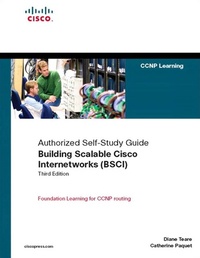
Building Scalable Cisco Internetworks (BSCI) (Authorized Self-Study Guide)
3rd Edition
Published on 26. December 2006
1006 pages
978-1-58714-081-5 (ISBN)
Description

Learn intermediate and advanced routing techniques with the only Cisco-authorized self-study book for CCNP routing foundation learning
Learn intermediate and advance routing techniques from the newest edition of the best-selling CCNP BSCI foundational learning book
Rely on learning from the only Cisco-authorized book publisher
Master your learning with tools like self-assessment review questions, configuration exercises, chapter objectives and summaries, key term definitions, job aids and command summaries
CCNP Self-Study: Building Scalable Cisco Internetworks (BSCI) , Third Edition is a Cisco authorized, self-paced learning tool for CCNP preparation. This book teaches readers to design, configure, maintain, and scale routed networks that are growing in size and complexity. The book covers routing principles of both distance vector and link-state routing protocols; IP addressing techniques; the theory behind the IGP and EGP routing protocols; and configuration and troubleshooting information for each protocol. Upon completion readers will be able to select and implement the appropriate Cisco IOS Software services required to build scalable, routed networks.
The book provides early and comprehensive foundation learning for the CCNP BSCI exam. This revision to the popular second edition is updated to include complete coverage of all important routing topics, including advanced IP addressing, routing principles, manipulating routing updates, and EIGRP, OSPF, IS-IS, and BGP configuration. Chapters open with a list of objectives to focus the reader's study. Configuration exercises at the end of each chapter and a master lab exercise that ties all the topics together in the last chapter help illuminate theoretical concepts. Key terms are highlighted and defined, and each chapter concludes with a summary to help review key concepts.
What's new in the book? The book matches changes to the CCNP course and exam as per Cisco Systems.
Learn intermediate and advance routing techniques from the newest edition of the best-selling CCNP BSCI foundational learning book
Rely on learning from the only Cisco-authorized book publisher
Master your learning with tools like self-assessment review questions, configuration exercises, chapter objectives and summaries, key term definitions, job aids and command summaries
CCNP Self-Study: Building Scalable Cisco Internetworks (BSCI) , Third Edition is a Cisco authorized, self-paced learning tool for CCNP preparation. This book teaches readers to design, configure, maintain, and scale routed networks that are growing in size and complexity. The book covers routing principles of both distance vector and link-state routing protocols; IP addressing techniques; the theory behind the IGP and EGP routing protocols; and configuration and troubleshooting information for each protocol. Upon completion readers will be able to select and implement the appropriate Cisco IOS Software services required to build scalable, routed networks.
The book provides early and comprehensive foundation learning for the CCNP BSCI exam. This revision to the popular second edition is updated to include complete coverage of all important routing topics, including advanced IP addressing, routing principles, manipulating routing updates, and EIGRP, OSPF, IS-IS, and BGP configuration. Chapters open with a list of objectives to focus the reader's study. Configuration exercises at the end of each chapter and a master lab exercise that ties all the topics together in the last chapter help illuminate theoretical concepts. Key terms are highlighted and defined, and each chapter concludes with a summary to help review key concepts.
What's new in the book? The book matches changes to the CCNP course and exam as per Cisco Systems.
More details
Edition
3rd edition
Language
English
Place of publication
Indianapolis
United States
Publishing group
Pearson Education (US)
Target group
Professional and scholarly
ISBN-13
978-1-58714-081-5 (9781587140815)
Copyright in bibliographic data and cover images is held by Nielsen Book Services Limited or by the publishers or by their respective licensors: all rights reserved.
Schweitzer Classification
Other editions
Additional editions
Diane Teare | Catherine Paquet
Building Scalable Cisco Internetworks (BSCI) (Authorized Self-Study Guide)
Book
01/2007
3rd Edition
Cisco Press
€78.17
Article exhausted; check different version
Persons
Diane Teare is a professional in the networking, training, and e-learning fields. She has more than 20 years of experience in designing, implementing, and troubleshooting network hardware and software and has also been involved in teaching, course design, and project management. She has extensive knowledge of network design and routing technologies and is an instructor with one of the largest authorized Cisco Learning Partners. She was recently the director of e-learning for the same company, where she was responsible for planning and supporting all the company's e-learning offerings in Canada, including Cisco courses. Diane was part of the team that developed the latest version of the BSCI course. She has a bachelor's degree in applied science in electrical engineering (BASc) and a master's degree in applied science in management science (MASc). She is a certified Cisco Systems instructor and currently holds her CCNP and CCDP certifications. She coauthored the Cisco Press titlesCampus Network Design Fundamentals and the first two editions of this book; and edited CCDA Self-Study: Designing for Cisco Internetwork Solutions (DESGN) and Designing Cisco Networks.
Catherine Paquet has in-depth knowledge of security systems, remote access, and routing technology. She is a CCSP, a CCNP, and a CCSI with one of the largest Cisco Learning Partners. She started her internetworking career as a LAN manager, moved to MAN manager, and eventually became the nationwide WAN manager with a federal agency. Prior to starting Netrisec Inc., a network security consultancy, Catherine was the director of technical resources for a Cisco Learning Partner. Catherine currently works on network design and implementation projects and lectures on topics related to security frameworks, regulations, and return on security investments. In 2002 and 2003, she volunteered with the U.N. mission in Kabul, Afghanistan, to train Afghan public servants in the area of networking. Catherine has a master's degree in business administration with a major in management information systems (MBA [MIS]). She coauthored the Cisco Press titles Campus Network Design Fundamentals, The Business Case for Network Security: Advocacy, Governance, and ROI, and the first two editions of this book, and edited Building Cisco Remote Access Networks.
Catherine Paquet has in-depth knowledge of security systems, remote access, and routing technology. She is a CCSP, a CCNP, and a CCSI with one of the largest Cisco Learning Partners. She started her internetworking career as a LAN manager, moved to MAN manager, and eventually became the nationwide WAN manager with a federal agency. Prior to starting Netrisec Inc., a network security consultancy, Catherine was the director of technical resources for a Cisco Learning Partner. Catherine currently works on network design and implementation projects and lectures on topics related to security frameworks, regulations, and return on security investments. In 2002 and 2003, she volunteered with the U.N. mission in Kabul, Afghanistan, to train Afghan public servants in the area of networking. Catherine has a master's degree in business administration with a major in management information systems (MBA [MIS]). She coauthored the Cisco Press titles Campus Network Design Fundamentals, The Business Case for Network Security: Advocacy, Governance, and ROI, and the first two editions of this book, and edited Building Cisco Remote Access Networks.
