

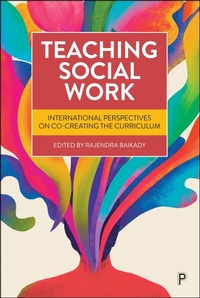
Teaching Social Work
International Perspectives on Co-Creating the Curriculum
Policy Press
1st Edition
Published on 27. January 2026
304 pages
978-1-4473-7732-0 (ISBN)
Description

The challenge of standardising social work education remains a much-discussed but under-documented issue, particularly in developing and less-developed countries. Existing literature often emphasises the need for student-centred learning but lacks a comprehensive examination of how students can shape curricula, lesson plans and teaching methods in cooperation with educators.
This edited volume brings together leading scholars from across the Global North and South to explore the co-creation of social work curricula. Through case studies from New Zealand, Italy, Slovenia, Rwanda, Georgia, Spain, India, Portugal, Indonesia, Nepal and China, it highlights the roles of students, international collaboration and academic partnerships in producing responsive and effective social work education.
With invaluable practical insights, this book provides core guidance for developing a curriculum that equips future social workers with the skills to meet global challenges in an evolving professional landscape.
This edited volume brings together leading scholars from across the Global North and South to explore the co-creation of social work curricula. Through case studies from New Zealand, Italy, Slovenia, Rwanda, Georgia, Spain, India, Portugal, Indonesia, Nepal and China, it highlights the roles of students, international collaboration and academic partnerships in producing responsive and effective social work education.
With invaluable practical insights, this book provides core guidance for developing a curriculum that equips future social workers with the skills to meet global challenges in an evolving professional landscape.
More details
Edition
First Edition
Language
English
Place of publication
Bristol
United Kingdom
Publishing group
Bristol University Press
Target group
Professional and scholarly
Illustrations
4 s/w Abbildungen, 2 s/w Tabellen
Not illustrated
File size
1,33 MB
ISBN-13
978-1-4473-7732-0 (9781447377320)
Copyright in bibliographic data and cover images is held by Nielsen Book Services Limited or by the publishers or by their respective licensors: all rights reserved.
Schweitzer Classification
Other editions
Additional editions
Teaching Social Work
International Perspectives on Co-Creating the Curriculum
Book
approx. 01/2026
1st Edition
Policy Press
€160.50
Not yet published
Persons
Rajendra Baikady is Assistant Professor in the Department of Social Work at the Central University of Kerala and Senior Research Associate in the Department of Social Work and Community Development at the University of Johannesburg.
Content
1. Curriculum matters: co-creating social work curriculum through partnership - Rajendra Baikady
PART I: Students as co-creators of curriculum - Rajendra Baikady
2. Co-creating with students: academic co- creative inquiry - Ksenija Napan
3. Engaging students in co-creating the curriculum: participation practices in an Italian bachelor's degree in social work - Angela Rosignoli
4. Co-creating a social work curriculum in Slovenia: student involvement - Bojana Mesec and Liljana Rihter
5. Co-creating curriculum in social work: an Indian experience - Shibilshad P and Rajendra Baikady
PART II: International collaboration and co-creation of curriculum - Rajendra Baikady
6. Resilient education and mitigation of social problems: introducing community social labs in the social
work curriculum - Charles Kalinganire, Eric Awich Ochen, Janestic Twikirize, Zena Mnasi Mabeyo and Ann Christin E. Nilsen
7. Using Erasmus+ scholarships for the internationalisation of social work programmes: the case of Georgia - Shorena Sadzaglishvili, Rusudan Asatiani and Teona Gotsiridze
8. European perspectives on the digital adaptation of the social work curriculum in Spain - Clara Grech-Santi, Ruben Gonzalez-Rodriguez, Paula Frieiro and Breogan Rioboo-Lois
9. The impact of international collaboration and exchange of ideas on curriculum development in social work - Adi Fahrudin
Part III: Partnership and co-creation of the curriculum - Rajendra Baikady
10. Insights into co-creation from Aotearoa New Zealand: working together in partnership to develop a Bachelor of
Social Work programme that serves our rich diversity of peoples and communities - Sarah Fraser, Rehia Whaanga, Ngati Rakaipaaka and Ngati Rongomaiwahine
11. Ecological narrative approach in co-creating the social work curriculum: a pathway to inclusive and holistic education - Emanuela Fato and Giuseppina Parisi
12. Co-creation in the curriculum through service learning - Paula Sousa
PART IV: Importance of curriculum co-creation in higher education - Rajendra Baikady
13. Collaborative curriculum development in social work education: insights from China - Meng Liu, Kai Zhu, Yulian Zhang, Xianmi Wang, Ying Li and Jinfeng Xu
14. Embedding critical localism practice principles in supervision: co-creating reflective conversations with students
undertaking international field education experiences - Jaryd Stobaus, Chloe Dillon, Annie Townsend and Emily McDonnell
15. Way forward: revisiting the curriculum-making process in social work - Rajendra Baikady
PART I: Students as co-creators of curriculum - Rajendra Baikady
2. Co-creating with students: academic co- creative inquiry - Ksenija Napan
3. Engaging students in co-creating the curriculum: participation practices in an Italian bachelor's degree in social work - Angela Rosignoli
4. Co-creating a social work curriculum in Slovenia: student involvement - Bojana Mesec and Liljana Rihter
5. Co-creating curriculum in social work: an Indian experience - Shibilshad P and Rajendra Baikady
PART II: International collaboration and co-creation of curriculum - Rajendra Baikady
6. Resilient education and mitigation of social problems: introducing community social labs in the social
work curriculum - Charles Kalinganire, Eric Awich Ochen, Janestic Twikirize, Zena Mnasi Mabeyo and Ann Christin E. Nilsen
7. Using Erasmus+ scholarships for the internationalisation of social work programmes: the case of Georgia - Shorena Sadzaglishvili, Rusudan Asatiani and Teona Gotsiridze
8. European perspectives on the digital adaptation of the social work curriculum in Spain - Clara Grech-Santi, Ruben Gonzalez-Rodriguez, Paula Frieiro and Breogan Rioboo-Lois
9. The impact of international collaboration and exchange of ideas on curriculum development in social work - Adi Fahrudin
Part III: Partnership and co-creation of the curriculum - Rajendra Baikady
10. Insights into co-creation from Aotearoa New Zealand: working together in partnership to develop a Bachelor of
Social Work programme that serves our rich diversity of peoples and communities - Sarah Fraser, Rehia Whaanga, Ngati Rakaipaaka and Ngati Rongomaiwahine
11. Ecological narrative approach in co-creating the social work curriculum: a pathway to inclusive and holistic education - Emanuela Fato and Giuseppina Parisi
12. Co-creation in the curriculum through service learning - Paula Sousa
PART IV: Importance of curriculum co-creation in higher education - Rajendra Baikady
13. Collaborative curriculum development in social work education: insights from China - Meng Liu, Kai Zhu, Yulian Zhang, Xianmi Wang, Ying Li and Jinfeng Xu
14. Embedding critical localism practice principles in supervision: co-creating reflective conversations with students
undertaking international field education experiences - Jaryd Stobaus, Chloe Dillon, Annie Townsend and Emily McDonnell
15. Way forward: revisiting the curriculum-making process in social work - Rajendra Baikady
