

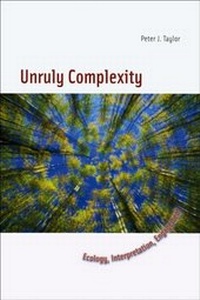
Unruly Complexity
Ecology, Interpretation, Engagement
1st Edition
Published on 15. December 2010
312 pages
978-0-226-79039-8 (ISBN)
Description

Ambitiously identifying fresh issues in the study of complex systems, Peter J. Taylor, in a model of interdisciplinary exploration, makes these concerns accessible to scholars in the fields of ecology, environmental science, and science studies. Unruly Complexity explores concepts used to deal with complexity in three realms: ecology and socio-environmental change, the collective constitution of knowledge, and the interpretations of science as they influence subsequent research.For each realm Taylor shows that unruly complexity-situations that lack definite boundaries, where what goes on ",outside", continually restructures what is ",inside,", and where diverse processes come together to produce change-should not be suppressed by partitioning complexity into well-bounded systems that can be studied or managed from an outside vantage point. Using case studies from Australia, North America, and Africa, he encourages readers to be troubled by conventional boundaries-especially between science and the interpretation of science-and to reflect more self-consciously on the conceptual and practical choices researchers make.
More details
Other editions
Additional editions
Book
10/2005
University of Chicago Press
€39.62
Shipment within 10-20 days
Book
09/2005
University of Chicago Press
€99.04
Article not available at the moment
Content
- Intro
- Contents
- Acknowledgments
- Prologue
- Part I: Modelling Ecological Complexity
- Chapter 1: Problems of Boundedness in Modeling Ecological Systems
- A. The Construction of Complexity
- B. The Hidden Complexity of Simple Models
- Chapter 2: Open Sites in Model Building
- Part II: Interpreting Ecological Modelers in Their Complex Social Context
- Chapter 3: Metaphors and Allegory in the Origins of Systems Ecology
- A. Social-Personal-Scientific Correlations in the Work of H. T. Odum: A First Reading
- B. Another Look: Diagrams and Physical Analogies
- Chapter 4: Reconstructing Heterogeneous Webs in Socio-Environmental Research
- A. The Simulated Future of a Salt-Affected Agricultural Region
- B. An Intersection of Domains of Action that Include MIT, USAID, System Dynamics Modelers, and Nomadic Pastoralists
- Part III: Engaging Reflexively within Ecological, Scientific, and Social Complexity
- Chapter 5: Reflecting on Researchers' Diverse Resources
- A. Further Intersections that Affect Researchers and Interpreters Extending Their Webs
- B. Workshops in which Ecologists Map Their Webs of Knowledge-Making
- C. Two Terms that Help Researchers Conceptualize More Complexity
- Chapter 6: Reasoned Understandings and Social Change in Research on Common Resources: Introducing a Framework to Keep Tensions Active, Productive, and Ever-Present
- A. Researchers Conduct a Dialogue, Involving Concepts and Evidence, with the Situations Studied
- B. Socially Situated Researchers Interact with Other Social Agents to Establish What Counts as Knowledge
- C. Researchers Pursue Social Change by Addressing Self-Consciously the Complexities of the Situations They Study and Their Own Social Situatedness
- Epilogue: Three Stories
- A. Participation
- B. Flexible Engagement
- C. Open Questions
- Summary of Themes and Questions Opened Up
- Glossary
- Notes
- References
- Index
