

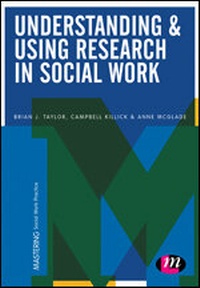
Understanding and Using Research in Social Work
1st Edition
Published on 19. October 2015
192 pages
978-1-4739-4322-3 (ISBN)
Description

How do social work students learn to use research to underpin their practice decisions? How do they learn that research is not an activity unconnected to their professional role and responsibilities, but rather acts as a foundation for their knowledge?
By using the examples drawn from evidence-based practice (e.g. what is known to work and what we know about social work processes), the authors deliver a text that will help support students to appraise and then integrate research into both their daily practice decisions and their assignments and assessments. It will do this by defining key concepts like 'knowledge' and 'evidence' and then look at how these concepts include component parts - from law and legislation to practice knowledge and reflective and critical practice. Case examples are used to illustrate how a clear understanding of these component parts can build to a substantial evidence base from which to draw upon. Identifying relevant research and appraising its quality are core aspects of the book. Later chapters show students how robust knowledge of evidence-based practice can develop into a clear and confident approach to their workloads and their daily practice dilemmas.
By using the examples drawn from evidence-based practice (e.g. what is known to work and what we know about social work processes), the authors deliver a text that will help support students to appraise and then integrate research into both their daily practice decisions and their assignments and assessments. It will do this by defining key concepts like 'knowledge' and 'evidence' and then look at how these concepts include component parts - from law and legislation to practice knowledge and reflective and critical practice. Case examples are used to illustrate how a clear understanding of these component parts can build to a substantial evidence base from which to draw upon. Identifying relevant research and appraising its quality are core aspects of the book. Later chapters show students how robust knowledge of evidence-based practice can develop into a clear and confident approach to their workloads and their daily practice dilemmas.
More details
Series
Language
English
Place of publication
London
United Kingdom
Publishing group
Sage Publications Ltd
Target group
College/higher education
Professional and scholarly
ISBN-13
978-1-4739-4322-3 (9781473943223)
Copyright in bibliographic data and cover images is held by Nielsen Book Services Limited or by the publishers or by their respective licensors: all rights reserved.
Schweitzer Classification
Other editions
Additional editions
Brian J. Taylor | Campbell Killick | Anne McGlade
Understanding and Using Research in Social Work
Book
11/2015
1st Edition
Learning Matters Ltd
€130.60
Shipment within 15-20 days
Brian J. Taylor | Campbell Killick | Anne McGlade
Understanding and Using Research in Social Work
Book
11/2015
1st Edition
Learning Matters Ltd
€63.90
Shipment within 15-20 days
Persons
Brian J Taylor, PhD, is Emeritus Professor of Social Work at Ulster University, Northern Ireland. Professionally qualified in social work and teaching, he spent 10 years as a practitioner and manager, and then 15 years in training and organisation development in health and social care before joining the University. Brian was founder and principal organiser of the biennial conference series: Decisions, Assessment, Risk and Evidence in Social Work, 2010-2022. He has taught, researched and published on these topics, including being author on over 100 peer-reviewed journal articles. He has supervised about 20 PhD students, including some jointly with colleagues in communication studies, health care, psychology, youth and community work, law and computer science. Brian is a Fellow of the UK Academy of Social Sciences; honorary Senior Fellow of the School for Social Care Research at the National Institute for Health Research, London; and honorary Associate of the Harding Centre for Risk Literacy at the Max Planck Institute for Human Development, Berlin. He was a founder member of the Board of the European Social Work Research Association (ESWRA), and founder-Convenor of the ESWRA Decisions, Assessment and Risk Special Interest Group.
Campbell Killick, PhD, is Lecturer in Social Work at Ulster University, Northern Ireland, where he teaches assessment and decision making on undergraduate (qualifying social work) courses and post-qualifying, post-graduate courses. He is Course Director for the MSc in Research Methods for social workers, service users, carers and others involved in social work services. Campbell's research focuses on professional decision making particularly in relation to the abuse of children and adults. Campbell is Co-Founder and Deputy Convenor of the Decisions, Assessment and Risk Special Interest Group (DARSIG) of the European Social Work Research Association and Coordinator of Ulster University's DARES initiative which supports research, teaching and organisation development for social work in relation to decision-making, assessment, risk and the use of evidence to inform practice and management of services. He is co-author of 'Assessment, Risk and Decision Making in Social Work' published by Sage.
Anne McGlade has been Social Care Research Lead for the Social Care and Children's Directorate, Health and Social Care Board since October 2013. She is the lead on the development of the Research and Continuous Improvement Strategy (2015-2020) In Pursuit of Excellence in Evidence Informed Social Work Services in Northern Ireland. She has a long-standing career working in research and evaluation research in health and social care and other settings in England and Northern Ireland. She has a keen interest in the needs of older people, people with disabilities and people from black and minority ethnic groups. She has undertaken and published a range of research studies in these areas. Her interest in equality and human rights led to a career spanning a number of years as an adviser to a range of health and social care organisations. She is also a visiting lecturer and co-tutor on two post-qualifying programmes for social workers at Ulster University: the Application of Research Methods in Social Work and the Evidence Informed Professional and Organisation.
Campbell Killick, PhD, is Lecturer in Social Work at Ulster University, Northern Ireland, where he teaches assessment and decision making on undergraduate (qualifying social work) courses and post-qualifying, post-graduate courses. He is Course Director for the MSc in Research Methods for social workers, service users, carers and others involved in social work services. Campbell's research focuses on professional decision making particularly in relation to the abuse of children and adults. Campbell is Co-Founder and Deputy Convenor of the Decisions, Assessment and Risk Special Interest Group (DARSIG) of the European Social Work Research Association and Coordinator of Ulster University's DARES initiative which supports research, teaching and organisation development for social work in relation to decision-making, assessment, risk and the use of evidence to inform practice and management of services. He is co-author of 'Assessment, Risk and Decision Making in Social Work' published by Sage.
Anne McGlade has been Social Care Research Lead for the Social Care and Children's Directorate, Health and Social Care Board since October 2013. She is the lead on the development of the Research and Continuous Improvement Strategy (2015-2020) In Pursuit of Excellence in Evidence Informed Social Work Services in Northern Ireland. She has a long-standing career working in research and evaluation research in health and social care and other settings in England and Northern Ireland. She has a keen interest in the needs of older people, people with disabilities and people from black and minority ethnic groups. She has undertaken and published a range of research studies in these areas. Her interest in equality and human rights led to a career spanning a number of years as an adviser to a range of health and social care organisations. She is also a visiting lecturer and co-tutor on two post-qualifying programmes for social workers at Ulster University: the Application of Research Methods in Social Work and the Evidence Informed Professional and Organisation.
Content
Introduction
What is Knowledge and How Does it Inform Practice?
Practice Questions and Research Types
Identifying Relevant Research
Appraising Surveys
Appraising Qualitative Studies
Appraising Studies of Effectiveness
Synthesising Research
Getting Research Knowledge into Practice within Organisations
Conclusion
What is Knowledge and How Does it Inform Practice?
Practice Questions and Research Types
Identifying Relevant Research
Appraising Surveys
Appraising Qualitative Studies
Appraising Studies of Effectiveness
Synthesising Research
Getting Research Knowledge into Practice within Organisations
Conclusion
