

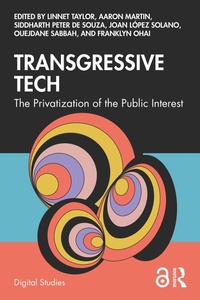
Transgressive Tech
The Privatization of the Public Interest
1st Edition
Published on 22. May 2026
140 pages
978-1-040-84091-7 (ISBN)
Description

This collection of essays, written by authors from diverse countries across four continents, explores the similarities and differences in technological expansionism. It examines how technology companies establish themselves in new markets and sectors and charts how technology projects increasingly capture public functions and infrastructures, raising critical concerns for democratic legitimacy and accountability.
Starting from the changes in technology politics and governance brought by the pandemic, the book charts technology firms' entry into critical public sectors such as healthcare, welfare, and education. The chapters demonstrate how market capture and other forms of expansion-often framed as emergency measures-are facilitated by diminished ethical, legal, and sector-specific oversight, as well as weakened transparency and public contestability. These 'sector transgressions' have enabled technology companies to consolidate power through accelerated privatisation, reduced public sector control over digital infrastructure, and increased dependency on private actors for policymaking and regulation.
Through a series of case studies, the essays examine how this phenomenon emerges in different parts of the world, analysing its implications for data governance, public interest, and human rights. The book offers strategies for civil society and policymakers to address these challenges and ultimately argues for rethinking digital governance structures to safeguard the public interest.
The Open Access version of this book, available at http://www.taylorfrancis.com, has been made available under a Creative Commons Attribution-Non Commercial-No Derivatives (CC BY-NC-ND) 4.0 license
Starting from the changes in technology politics and governance brought by the pandemic, the book charts technology firms' entry into critical public sectors such as healthcare, welfare, and education. The chapters demonstrate how market capture and other forms of expansion-often framed as emergency measures-are facilitated by diminished ethical, legal, and sector-specific oversight, as well as weakened transparency and public contestability. These 'sector transgressions' have enabled technology companies to consolidate power through accelerated privatisation, reduced public sector control over digital infrastructure, and increased dependency on private actors for policymaking and regulation.
Through a series of case studies, the essays examine how this phenomenon emerges in different parts of the world, analysing its implications for data governance, public interest, and human rights. The book offers strategies for civil society and policymakers to address these challenges and ultimately argues for rethinking digital governance structures to safeguard the public interest.
The Open Access version of this book, available at http://www.taylorfrancis.com, has been made available under a Creative Commons Attribution-Non Commercial-No Derivatives (CC BY-NC-ND) 4.0 license
More details
Series
Edition
1. Auflage
Language
English
Place of publication
London
United Kingdom
Publishing group
Taylor & Francis Ltd
Target group
Professional and scholarly
College/higher education
Illustrations
1 Line drawings, black and white; 1 Illustrations, black and white
File size
1,70 MB
ISBN-13
978-1-040-84091-7 (9781040840917)
Copyright in bibliographic data and cover images is held by Nielsen Book Services Limited or by the publishers or by their respective licensors: all rights reserved.
Schweitzer Classification
Other editions
Additional editions
Linnet Taylor | Aaron Martin | Siddharth Peter de Souza
Transgressive Tech
The Privatization of the Public Interest
Book
05/2026
1st Edition
Pallas Publications
€191.50
Shipment within 15-20 days
Persons
Linnet Taylor is Professor of International Data Governance at the Tilburg Institute for Law, Technology, and Society (TILT), the Netherlands. Her research focuses on digital data, representation, and democracy, with particular attention to transnational governance issues.
Aaron Martin is Assistant Professor of Media Studies and Data Science at the University of Virginia, USA. A social scientist specialising in technology policy and data governance, he studies how regulation can facilitate just, inclusive, and secure digital societies.
Siddharth Peter de Souza is Assistant Professor in AI and Society at the Centre for Interdisciplinary Methodologies, University of Warwick, UK. His research looks at developments in law and technology from a legal pluralist, data justice, and decolonial perspective. He is the founder of Justice Adda, a law and design social venture which seeks to build legal literacy and awareness in India.
Joan Lopez Solano is a PhD researcher at the Tilburg Institute for Law, Technology, and Society (TILT), the Netherlands. His research analyses the impacts of data-intensive systems on the fundamental rights of vulnerable communities and includes data systems used for social security, migration management, and national identification systems.
Ouejdane Sabbah is a PhD researcher in Political and Economic Geography at the University of Amsterdam, the Netherlands. Her doctoral research focuses on African digital and connectivity infrastructures, specifically examining the perceptions of state and non-state stakeholders in West Africa regarding big tech-led subsea internet cables.
Franklyn Ohai is an associate researcher with the Global Data Justice project at Tilburg University, the Netherlands. He has also conducted research at KU Leuven's Centre for IT and IP Law, focusing on the legal, ethical, and regulatory aspects of digital, data-driven, and connected technologies.
Aaron Martin is Assistant Professor of Media Studies and Data Science at the University of Virginia, USA. A social scientist specialising in technology policy and data governance, he studies how regulation can facilitate just, inclusive, and secure digital societies.
Siddharth Peter de Souza is Assistant Professor in AI and Society at the Centre for Interdisciplinary Methodologies, University of Warwick, UK. His research looks at developments in law and technology from a legal pluralist, data justice, and decolonial perspective. He is the founder of Justice Adda, a law and design social venture which seeks to build legal literacy and awareness in India.
Joan Lopez Solano is a PhD researcher at the Tilburg Institute for Law, Technology, and Society (TILT), the Netherlands. His research analyses the impacts of data-intensive systems on the fundamental rights of vulnerable communities and includes data systems used for social security, migration management, and national identification systems.
Ouejdane Sabbah is a PhD researcher in Political and Economic Geography at the University of Amsterdam, the Netherlands. Her doctoral research focuses on African digital and connectivity infrastructures, specifically examining the perceptions of state and non-state stakeholders in West Africa regarding big tech-led subsea internet cables.
Franklyn Ohai is an associate researcher with the Global Data Justice project at Tilburg University, the Netherlands. He has also conducted research at KU Leuven's Centre for IT and IP Law, focusing on the legal, ethical, and regulatory aspects of digital, data-driven, and connected technologies.
Content
List of Abbreviations
1. What is a 'sector transgression', and why should we care?
Linnet Taylor, Aaron Martin, Siddharth Peter de Souza, Joan Lopez-Solano, Ouejdane Sabbah, and Franklyn Ohai.
2. Transgression through a Sector - On COVID-19, power and technology
Vidushi Marda
3. The Crutch of Big Tech: Thinking critically about tech companies' sphere transitions in Malaysia and their implications for national policy
Anisha Nadkarni
4. A technology response to a public health emergency
Grace Mutung'u
5. COVID-19, Health Tech and Sphere Transgression in Ethiopia
Kinfe Yilma
6. Technology-led border management in Greece: When the EU funds private vendors, Centaurs and Titans turn from myth to reality
Eleftherios Chelioudakis
7. Brazil and the case of Incognia
Bruno Bioni , Gabriela Vergili , Mariana Rielli , Pedro Saliba
8. The app in the middle: Displacement of the Colombian public health surveillance system by COVID apps
Joan Lopez-Solano , Juliana Valdes , Juan Diego Castaneda
9. A Digital Push in Agriculture: Multiple locations, shared patterns and the dynamics of displacement
Franklyn Ohai and Siddharth Peter de Souza
10. One Gate Leads to Many Doors, a Case Study of MyGate in India
Anushka Mittal
11. Super-apps and the Encroachment of Tech Companies in Indonesia
Paska Darmawan
12. Big Tech and Big Money: Examining Big Tech's entry into India's payment sector
Aman Nair
13. A system error has occurred: Reclaiming the public governance of technology
Linnet Taylor
Index
1. What is a 'sector transgression', and why should we care?
Linnet Taylor, Aaron Martin, Siddharth Peter de Souza, Joan Lopez-Solano, Ouejdane Sabbah, and Franklyn Ohai.
2. Transgression through a Sector - On COVID-19, power and technology
Vidushi Marda
3. The Crutch of Big Tech: Thinking critically about tech companies' sphere transitions in Malaysia and their implications for national policy
Anisha Nadkarni
4. A technology response to a public health emergency
Grace Mutung'u
5. COVID-19, Health Tech and Sphere Transgression in Ethiopia
Kinfe Yilma
6. Technology-led border management in Greece: When the EU funds private vendors, Centaurs and Titans turn from myth to reality
Eleftherios Chelioudakis
7. Brazil and the case of Incognia
Bruno Bioni , Gabriela Vergili , Mariana Rielli , Pedro Saliba
8. The app in the middle: Displacement of the Colombian public health surveillance system by COVID apps
Joan Lopez-Solano , Juliana Valdes , Juan Diego Castaneda
9. A Digital Push in Agriculture: Multiple locations, shared patterns and the dynamics of displacement
Franklyn Ohai and Siddharth Peter de Souza
10. One Gate Leads to Many Doors, a Case Study of MyGate in India
Anushka Mittal
11. Super-apps and the Encroachment of Tech Companies in Indonesia
Paska Darmawan
12. Big Tech and Big Money: Examining Big Tech's entry into India's payment sector
Aman Nair
13. A system error has occurred: Reclaiming the public governance of technology
Linnet Taylor
Index
