

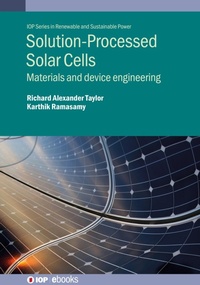
Solution-Processed Solar Cells
Description

The field of photovoltaics (PVs) has seen accelerated growth towards meeting global energy demand. However, the traditional vacuum-based PV cells fabrication approach is expensive, and their performance efficiencies are limited. Thus, there has been tremendous research and development of cost-effective solution-based fabrication of PV cells with improved performance. This has led to new/emerging PV technologies like perovskite solar cells, quantum dot solar cells, organic solar cells, nano-ink based solar cells and dye-sensitized solar cells with impressive efficiencies close to 30 %. As such, these emerging technologies are expected to result in more wide scale application of PV technologies in various forms.
This book comprehensively covers this vastly growing area with reference to fundamental chemical and physical aspects of various solution-processed solar cells including different components of solar cells stacks, their characteristics , and working mechanisms with latest developments as reported in scientific literature. It thoroughly examines these state of the art solution processing approaches covering advances in each technology, highlighting challenges related to cell performance and reliability improvements aimed at a readership of students and researchers in the field. Importantly, the discussions are predicated on the fundamental chemistry and physics concepts of the various types of materials and how their properties are exploited for these technologies.
More details
Other editions
Additional editions
Persons
Richard A. Taylor is Senior Lecturer in materials chemistry at the University of the West Indies, St. Augustine Campus, Trinidad and Tobago. He gained his PhD in Chemistry from the University of the West Indies, Mona Campus, Jamaica in 2009. His research focuses on optoelectronic materials for use in electronic devices, including solar cells, metal-organic liquid crystals, chalcogenide semiconductor thin films and luminescent metal-organic frameworks.
Karthik Ramasamy is a Scientist at the Los Alamos National Laboratory, NM, US. He received his PhD from the University of Manchester, UK in 2010. His main research interests are development and studies of materials and material composites for energy and catalytic applications.
Content
Chapter 1: Energy and the solar photovoltaics landscape: an overview
Chapter 2: Introduction to solar cell devices
Chapter 3: Solution-processed fabrication methods
Chapter 4: Copper-based chalcogenide solar cells
Chapter 5: Colloidal quantum dot solar cells
Chapter 6: Dye-sensitized solar cells
Chapter 7: Perovskite-based solar cells
Chapter 8: Organic and polymer-based cells
