


The Situated Organization
Case Studies in the Pragmatics of Communication Research
Published on 13. September 2010
288 pages
978-1-136-94574-8 (ISBN)
Description

The Situated Organization explores recent research in organizational communication, emphasizing the organization as constructed in and emerging out of communication practices. Working from the tradition of the Montreal School in its approach, it focuses not only on how an organization's members understand the purposes of the organization through communication, but also on how they realize and recognize the organization itself as they work within it.
The text breaks through with an alternative viewpoint to the currently popular idea of 'organization-as-network,' viewing organization instead as a configuration of agencies, and their fields of practice. It serves as an original, comprehensive, and well-written text, elaborated by case studies that make the theory come to life. The substantial ideas and insights are presented in a deep and meaningful way while remaining comprehensible for student readers.
This text has been developed for students at all levels of study in organizational communication, who need a systematic introduction to conducting empirical field research. It will serve as an invaluable sourcebook in planning and conducting research.
The text breaks through with an alternative viewpoint to the currently popular idea of 'organization-as-network,' viewing organization instead as a configuration of agencies, and their fields of practice. It serves as an original, comprehensive, and well-written text, elaborated by case studies that make the theory come to life. The substantial ideas and insights are presented in a deep and meaningful way while remaining comprehensible for student readers.
This text has been developed for students at all levels of study in organizational communication, who need a systematic introduction to conducting empirical field research. It will serve as an invaluable sourcebook in planning and conducting research.
Reviews / Votes
"What happens when a fresh but solid foothold in the theory of pragmatics starts to interact with a range of novel case studies in communication research? Read it yourself and be inspired!"Hans Weigand, Tilburg University, the Netherlands
"The Situated Organization is an innovative work that accomplishes its purpose: to present its readers with theories and to reflect upon such theories through empirical studies."
Marlene Marchiori, Londrina State University, Brazil
"The Situated Organization was an eye-opener to me. It presents and illustrates new, fundamental and important insights in what organizations are from a communication point of view, and how essential communication is in understanding what organization is. These insights can contribute beyond communication studies, in realms like organization science, management science, information systems, and enterprise engineering."
Stijn Hoppenbrouwers, Radboud University Nijmegen, the Netherlands
"This book develops an interesting conceptual framework based on the idea of "organization-as-thirdness". Applying concepts from semiotic, philosophy of language, ethnomethodology, etc; the authors put forth a convincing argument demonstrating the constructive role of communication in organization."
Sylvie Grosjean, University of Ottawa
"Taylor and Van Every contribute to the general understanding of the sometimes overly abstract writing of the Montreal School. ... The Situated Organization is a good first read for students and teachers of organizational communication ... it is Taylor and Van Every's very practice of empirical research that sheds yet another light on organization, organizations, and - organization studies. In the words of Taylor and Van Every, 'Organization is alive and well!'"
Organization Studies 2011 (Reviewed by Steffen Blaschke, University of Hamburg, Germany)
More details
Series
Language
English
Place of publication
London
United Kingdom
Publishing group
Taylor & Francis Ltd
Target group
College/higher education
File size
2,02 MB
ISBN-13
978-1-136-94574-8 (9781136945748)
Copyright in bibliographic data and cover images is held by Nielsen Book Services Limited or by the publishers or by their respective licensors: all rights reserved.
Schweitzer Classification
Other editions
Additional editions
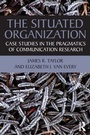
James R. Taylor | Elizabeth J. Van Every
The Situated Organization
Case Studies in the Pragmatics of Communication Research
Book
07/2010
1st Edition
Routledge
€84.90
Shipment within 15-20 days
James R. Taylor | Elizabeth J. Van Every
The Situated Organization
Case Studies in the Pragmatics of Communication Research
Book
07/2010
1st Edition
Routledge
€206.70
Shipment within 15-20 days
Persons
James R. Taylor is Professor Emeritus and founder of the Department of Communication at the University of Montreal. He is the author, co-author or editor of six books, including The Emergent Organization (2000).
Elizabeth J. Van Every is an historian and sociologist by training and has worked in both the public and private sectors. She has co-authored two previous books with James Taylor: The Vulnerable Fortress (1993) and The Emergent Organization (2000) as well as co-edited The Computerization of Work (2001) and Communication as Organizing (2006).
Elizabeth J. Van Every is an historian and sociologist by training and has worked in both the public and private sectors. She has co-authored two previous books with James Taylor: The Vulnerable Fortress (1993) and The Emergent Organization (2000) as well as co-edited The Computerization of Work (2001) and Communication as Organizing (2006).
Content
Prologue: The Puzzle of Organization
The Premise of Organization as Thirdness
The Frame Game, And How Communication Establishes and Distributes Organizational Authority
Language as Both Meaning and Action
PART TWO: RESEARCH
Text as the Constitutive Basis of Organization
The Accounts of a Business-Or Perhaps Rather the Business of Accounting?
Playing On the Game while Playing In the Game-Frames, Identities and the "Fall Plan"
The Organization as Text
The "Western," 21st Century Version-Mapping the Boundaries Through Texts
PART THREE: SYNTHESIS
The Organization as Thirdness, or How to Do Organizational Communication Research
The Premise of Organization as Thirdness
The Frame Game, And How Communication Establishes and Distributes Organizational Authority
Language as Both Meaning and Action
PART TWO: RESEARCH
Text as the Constitutive Basis of Organization
The Accounts of a Business-Or Perhaps Rather the Business of Accounting?
Playing On the Game while Playing In the Game-Frames, Identities and the "Fall Plan"
The Organization as Text
The "Western," 21st Century Version-Mapping the Boundaries Through Texts
PART THREE: SYNTHESIS
The Organization as Thirdness, or How to Do Organizational Communication Research
