

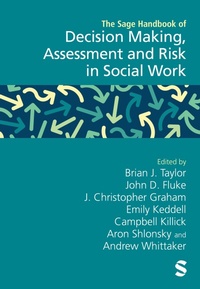
The Sage Handbook of Decision Making, Assessment and Risk in Social Work
Published on 16. August 2023
656 pages
978-1-5296-1463-3 (ISBN)
Description

The SAGE Handbook on Decision Making, Assessment and Risk in Social Work provides a comprehensive overview of key strands of research and theoretical concepts in this increasingly important field.
With 49 chapters and four section summaries, this Handbook describes the 'state of the art'; discuss key debates and issues; and gives pointers on future directions for practice, research, teaching, management of services, and development of theoretical understandings.
A key aim of this Handbook is to support the development of sound, applied knowledge and values to underpin reasoned professional judgement and decision making by social workers in practice and those in management and regulatory roles.
With contributions from a global interdisciplinary body of leading and emerging scholars from a wide variety of roles, this handbook has been designed to be internationally generalisable and applicable to all major areas of social work.
This Handbook provides a field-defining account of decision making, assessment and risk in social work which is unrivalled for its diversity and strength of coverage, and will be of value to social work researchers, teachers and practitioners, as well as to those in allied fields such as health care.
Section 1: Professional Judgement
Section 2: Assessment, Risk and Decision Processes
Section 3: Assessment Tools and Approaches
Section 4: Developing and Managing Practice
Section 5: Concluding Section / Afterword
With 49 chapters and four section summaries, this Handbook describes the 'state of the art'; discuss key debates and issues; and gives pointers on future directions for practice, research, teaching, management of services, and development of theoretical understandings.
A key aim of this Handbook is to support the development of sound, applied knowledge and values to underpin reasoned professional judgement and decision making by social workers in practice and those in management and regulatory roles.
With contributions from a global interdisciplinary body of leading and emerging scholars from a wide variety of roles, this handbook has been designed to be internationally generalisable and applicable to all major areas of social work.
This Handbook provides a field-defining account of decision making, assessment and risk in social work which is unrivalled for its diversity and strength of coverage, and will be of value to social work researchers, teachers and practitioners, as well as to those in allied fields such as health care.
Section 1: Professional Judgement
Section 2: Assessment, Risk and Decision Processes
Section 3: Assessment Tools and Approaches
Section 4: Developing and Managing Practice
Section 5: Concluding Section / Afterword
Reviews / Votes
Expert yet accessible, this Handbook interweaves research learning with experience. While tuned to the social work profession, the authors' knowledge of assessment, decision making and risk will be of wider interest to other professionals and those supporting them. With contributions from 20 different countries the relevance of the subjects is clearly global. Drawing on a wide range of disciplines, this Handbook looks set to inspire new thinking and practice innovations. -- Prof Jill Manthorpe, CBE Trevor Spratt opens the first chapter of The Sage Handbook of Decision Making, Assessment and Risk in Social Work with the phrase of being somewhat in awe of social workers decision-making abilities. I'm somewhat in awe too. Every day, social workers face challenges in decision-making by evaluating a complex interplay of risks and protective factors while lacking information for many of them. In this complex environment, humans are prone to using shortcuts and rules of thumb. Consequently, the authors of this Handbook not only present evidence on good practice, but also on biases and errors - combined with strategies to overcome these shortcomings. -- Prof. Dr Andreas Jud This impressive, well-structured, and extensively researched Handbook, edited by leading academics in the field, is a 'must have'. The individual chapter contributions, written by key academics, researchers, practitioners, and professionals from wide-ranging backgrounds, explore current theories, research, and practice in an accessible and thought-provoking way. The lead editor, with a highly regarded reputation for agenda setting in this area, has succeeded in bringing into one volume an authoritative account of contemporary issues regarding risk, assessment and decision making in social work. Essential for students, academics and people in practice, the Handbook is guaranteed to stimulate new ways of understanding, thinking, and doing. -- Karen WinterMore details
Edition
First
Language
English
Place of publication
London
United Kingdom
Publishing group
Sage Publications Ltd (Digital)
Target group
Professional and scholarly
Product notice
Reflowable
File size
7,99 MB
ISBN-13
978-1-5296-1463-3 (9781529614633)
Copyright in bibliographic data and cover images is held by Nielsen Book Services Limited or by the publishers or by their respective licensors: all rights reserved.
Schweitzer Classification
Other editions
Additional editions
Brian J. Taylor | John D. Fluke | J. Christopher Graham
The Sage Handbook of Decision Making, Assessment and Risk in Social Work
Book
08/2023
1st Edition
SAGE Publications Ltd
€186.40
Shipment within 15-20 days
Persons
Brian J Taylor, PhD, is Emeritus Professor of Social Work at Ulster University, Northern Ireland. Professionally qualified in social work and teaching, he spent 10 years as a practitioner and manager, and then 15 years in training and organisation development in health and social care before joining the University. Brian was founder and principal organiser of the biennial conference series: Decisions, Assessment, Risk and Evidence in Social Work, 2010-2022. He has taught, researched and published on these topics, including being author on over 100 peer-reviewed journal articles. He has supervised about 20 PhD students, including some jointly with colleagues in communication studies, health care, psychology, youth and community work, law and computer science. Brian is a Fellow of the UK Academy of Social Sciences; honorary Senior Fellow of the School for Social Care Research at the National Institute for Health Research, London; and honorary Associate of the Harding Centre for Risk Literacy at the Max Planck Institute for Human Development, Berlin. He was a founder member of the Board of the European Social Work Research Association (ESWRA), and founder-Convenor of the ESWRA Decisions, Assessment and Risk Special Interest Group.
John D Fluke, PhD, is Associate Director for Systems Research and Evaluation at the Kempe Center with appointments as Professor in the Department of Pediatrics at the University of Colorado School of Medicine, USA, and the Department of Epidemiology at the Colorado School of Public Health. His research focuses on child protection decision making and child maltreatment epidemiology. He is known internationally for his research involving child welfare administrative data analysis, workload and costing, and performance and outcome measurement for children and family services. For the US government as well as local governments, foundations, and international entities he has been PI or key staff for numerous projects. He participates in ongoing international efforts to improve the global capacity to understand the epidemiology of child maltreatment. He is the author or co-author of many peer reviewed publications, as well as numerous edited books, book chapters and reports.
J. Christopher Graham, PhD, is a Senior Researcher in Child Welfare at the Washington State Department of Children, Youth, and Families (DCYF), Office of Innovation, Alignment, and Accountability. Dr. Graham holds a Doctoral Degree in Social Psychology from the University of Texas at Austin, USA. He has specialized in caseworker decision making, program evaluation, and performance monitoring for agencies working with vulnerable children, youth, and families, and is the author of numerous reports, scholarly articles, and some book chapters in the field of child welfare.
Emily Keddell, PhD, is an Associate Professor in Social and Community Work at the University of Otago - Te Whare Wananga o Otago. Her research focusses on child protection systems, specifically social inequities affecting system contact and experience, decision-making variability, knowledge interpretation in practice, the use of algorithmic decision tools, and the politics of state intervention in family life. She is a founding member of the Reimagining Social Work blog, an associate editor of Qualitative Social Work, and a member of the editorial collective of the journal Aotearoa New Zealand Social Work. Her work highlights issues of rights, equity and justice within child protection systems.
Campbell Killick, PhD, is Lecturer in Social Work at Ulster University, Northern Ireland, where he teaches assessment and decision making on undergraduate (qualifying social work) courses and post-qualifying, post-graduate courses. He is Course Director for the MSc in Research Methods for social workers, service users, carers and others involved in social work services. Campbell's research focuses on professional decision making particularly in relation to the abuse of children and adults. Campbell is Co-Founder and Deputy Convenor of the Decisions, Assessment and Risk Special Interest Group (DARSIG) of the European Social Work Research Association and Coordinator of Ulster University's DARES initiative which supports research, teaching and organisation development for social work in relation to decision-making, assessment, risk and the use of evidence to inform practice and management of services. He is co-author of 'Assessment, Risk and Decision Making in Social Work' published by Sage.
Aron Shlonsky, PhD, is Professor and Head of Department (Social Work) at Monash University School of Primary and Allied Health Care. He is known for his work in child and youth services, particularly in the generation, synthesis and implementation of evidence to inform practice and policy in the child and family services field. He has authored and co-authored over 100 other books, peer-reviewed articles and government reports in the child protection and family services areas including decision-making and risk assessment in child welfare, youth justice and domestic violence services, the predictors and effects of sibling separation in foster care, issues surrounding kinship foster care, and the teaching and implementation of evidence-informed practice.
Andrew Whittaker, PhD, is Professor of Social Work Research at London South Bank University, England, where he is head of the Risk Resilience and Expert Decision Making (RRED) research group. His research on risk and decision making has ranged from ethnographic to randomised controlled trial research designs. Andrew recently completed a review of professional decision making for a child death inquiry in Queensland, Australia. He is the Convenor of the Decisions, Assessment and Risk Special Interest Group (DARSIG) of the European Social Work Research Association. DARSIG is the main European network for researchers in the field of assessment, risk and decision making in social work, with more than 80 members in over 20 countries. Andrew is Editor of the Journal of Social Work Practice.
John D Fluke, PhD, is Associate Director for Systems Research and Evaluation at the Kempe Center with appointments as Professor in the Department of Pediatrics at the University of Colorado School of Medicine, USA, and the Department of Epidemiology at the Colorado School of Public Health. His research focuses on child protection decision making and child maltreatment epidemiology. He is known internationally for his research involving child welfare administrative data analysis, workload and costing, and performance and outcome measurement for children and family services. For the US government as well as local governments, foundations, and international entities he has been PI or key staff for numerous projects. He participates in ongoing international efforts to improve the global capacity to understand the epidemiology of child maltreatment. He is the author or co-author of many peer reviewed publications, as well as numerous edited books, book chapters and reports.
J. Christopher Graham, PhD, is a Senior Researcher in Child Welfare at the Washington State Department of Children, Youth, and Families (DCYF), Office of Innovation, Alignment, and Accountability. Dr. Graham holds a Doctoral Degree in Social Psychology from the University of Texas at Austin, USA. He has specialized in caseworker decision making, program evaluation, and performance monitoring for agencies working with vulnerable children, youth, and families, and is the author of numerous reports, scholarly articles, and some book chapters in the field of child welfare.
Emily Keddell, PhD, is an Associate Professor in Social and Community Work at the University of Otago - Te Whare Wananga o Otago. Her research focusses on child protection systems, specifically social inequities affecting system contact and experience, decision-making variability, knowledge interpretation in practice, the use of algorithmic decision tools, and the politics of state intervention in family life. She is a founding member of the Reimagining Social Work blog, an associate editor of Qualitative Social Work, and a member of the editorial collective of the journal Aotearoa New Zealand Social Work. Her work highlights issues of rights, equity and justice within child protection systems.
Campbell Killick, PhD, is Lecturer in Social Work at Ulster University, Northern Ireland, where he teaches assessment and decision making on undergraduate (qualifying social work) courses and post-qualifying, post-graduate courses. He is Course Director for the MSc in Research Methods for social workers, service users, carers and others involved in social work services. Campbell's research focuses on professional decision making particularly in relation to the abuse of children and adults. Campbell is Co-Founder and Deputy Convenor of the Decisions, Assessment and Risk Special Interest Group (DARSIG) of the European Social Work Research Association and Coordinator of Ulster University's DARES initiative which supports research, teaching and organisation development for social work in relation to decision-making, assessment, risk and the use of evidence to inform practice and management of services. He is co-author of 'Assessment, Risk and Decision Making in Social Work' published by Sage.
Aron Shlonsky, PhD, is Professor and Head of Department (Social Work) at Monash University School of Primary and Allied Health Care. He is known for his work in child and youth services, particularly in the generation, synthesis and implementation of evidence to inform practice and policy in the child and family services field. He has authored and co-authored over 100 other books, peer-reviewed articles and government reports in the child protection and family services areas including decision-making and risk assessment in child welfare, youth justice and domestic violence services, the predictors and effects of sibling separation in foster care, issues surrounding kinship foster care, and the teaching and implementation of evidence-informed practice.
Andrew Whittaker, PhD, is Professor of Social Work Research at London South Bank University, England, where he is head of the Risk Resilience and Expert Decision Making (RRED) research group. His research on risk and decision making has ranged from ethnographic to randomised controlled trial research designs. Andrew recently completed a review of professional decision making for a child death inquiry in Queensland, Australia. He is the Convenor of the Decisions, Assessment and Risk Special Interest Group (DARSIG) of the European Social Work Research Association. DARSIG is the main European network for researchers in the field of assessment, risk and decision making in social work, with more than 80 members in over 20 countries. Andrew is Editor of the Journal of Social Work Practice.
Content
Foreword - Annamaria Campanini
Introduction to the Handbook - Brian J Taylor
Section 1: Professional Judgement
Introduction to Section One - Emily Keddell & Aron Shlonsky
Sub-section A: Heuristics& Biases
Chapter 1: Confirmation bias in social work - Trevor Spratt
Chapter 2. Blame & emotion in professional judgement - Alessandro Sicora
Chapter 3: The influence of optimism on analysis in professional judgement - Martin Kettle
Chapter 4: Heuristics in professional judgement: between proximity & distance - Jacob Magnussen & Annemette Matthiesen
Sub-section B: Professional Judgment in Context
Chapter 5: Collective cultures, risk, and individual judgement - Tracie Mafile'o, Jean Mitaera & Halaevalu Vakalahi
Chapter 6: Social & relational contexts of professional judgement in organisations - David Hodgson,Lynelle Watts & Donna Chung
Sub-section C: Knowledge Use in Judgement Processes
Chapter 7: . Intuition in social work practice - Laura Cook
Chapter 8: Challenges to using knowledge (evidence) in professional judgement - Paul McCafferty
Chapter 9: Critical thinking and professional judgement - Eileen Gambrill
Sub-section D: Discretion & Reasoning
Chapter 10: Sense making in professional judgement - Duncan Helm
Chapter 11: Theories of professional judgement - Christian Ghanem & Joel Gautschi
Sub-section E: Prospects & Developments
Chapter 12: Methods for studying professional judgement in social work - Joel Gautschi & Christian Ghanem
Section 2: Assessment, Risk and Decision Process
Introduction to Section Two - Campbell Killick
Sub-section A: Contextual Aspects of Decision Making and Working with Risk
Chapter 13: Cultural aspects of assessment and decision-making processes - Prospera Tedam
Chapter 14: Legally-literate decision making and management of risk in social work - Michael Preston-Shoot
Chapter 15: Interprofessional decision making - Ravit Alfandari, Jaroslaw Przeperski & Brian J Taylor
Chapter 16: Decision making in organisational contexts - Mark Gregory
Chapter 17: Assessment and risk: recognising the circularity of child-adverse-events and psychiatric disorders in children and adults - Colin Pritchard & Richard Williams
Sub-section B: Engaging Children and Families in Assessment and Decision Processes
Chapter 18: Engaging client families in assessment and managing risks - Lorna Montgomery, Mandi MacDonald & Eddy J Walakira
Chapter 19: Engaging children in assessment and decisions - Janne Fengler & Peter Schaefer
Chapter 20: Reimagining participation of young people in decision making in contexts of vulnerability - Monica Lopez Lopez, Leo Wieldraaiher-Vincent & Mijntje ten Brummelaar
Sub-section C: Engaging Adults in Assessment and Decision Processes
Chapter 21: Engaging adults in the assessment - Gavin Davidson, Katherine Greer, Aodan Mulholland & Paul Webb
Chapter 22: Shared decision making with clients - Anna Olaison & Sarah Donnelly
Chapter 23: Decisional capacity in mental health social work - Jim Campbell & Ross Campbell
Chapter 24: Risk, desistance and engagement: working with adult service users in Probation - Hazel Kemshall
Sub-section D: Prospects & Developments
Chapter 25: Studying risk-managing, decision-making & assessment processes - Campbell Killick & Brian J Taylor
Section 3: Assessment Tools and Approaches
Introduction to Section Three - John D Fluke & J Christopher Graham
Sub-section A: Foundations of Assessment Tools & Predicting Harm
Chapter 26: Foundations of valid assessment - J Christopher Graham & John D Fluke
Chapter 27: From validity to validation and beyond - J Christopher Graham & Doug Klinman
Chapter 28: Standardized risk assessment tools: methods, development & applications - Julie L Crouch & Joel S Milner
Sub-section B: Assessment and the Use of Tools
Chapter 29: Implementing assessments using structured tools - Kresta M Sorensen
Chapter 30: Decision aids, decision supports and managing risk - Pascal Bastian & Mark Schroedter
Chapter 31: Legal aspects of decision-making processes in social work - Donald C Bross & Henry Plum
Chapter 32: Data visualization as an assessment tool - Kelly G Stepura
Sub-section C: Approaches to Assessment
Chapter 33: Big data analytics for making decisions and managing risk - Beth Coulthard & Brian J Taylor
Chapter 34: The devil in the detail: algorithmic risk prediction tools and their implications for ethics, justice and decision making - Emily Keddell
Chapter 35: Natural language processing: opportunities and challenges - Beth Coulthard
Chapter 36: Understanding risk through social epidemiology - Emmaline Houston, Barbara Fallon & John D Fluke
Section 4: Developing and Managing Practice
Introduction to Section Four - Andrew Whittaker
Sub-section A: Learning & Teaching Decision Making
Chapter 37: Complexity and troublesome knowledge: teaching decision-making in social work - David Saltiel
Chapter 38: Improving high-risk decision-making in situations of risk and uncertainty: the role of deliberate attention - Cheryl Regehr
Sub-section B: Continuing Professional Development
Chapter 39: Developing professional expertise: transitions and thresholds in complex organisational contexts - Louise O'Connor & Kate Leonard
Chapter 40: The contribution of reflective practice to developing professional judgement and decision-making knowledge and skills - Danielle Turney & Gillian Ruch
Chapter 41: Supervising professional judgement - David Wilkins
Sub-section C: Contextual & Organisational Aspects
Chapter 42: Accountability for risk decision-making in social care - David Carson & Judith Mullineux
Chapter 43: Getting evidence into organisations to support decision making and risk work - Anne McGlade
Chapter 44: Accountability, management & professional discretion - Jochen Devlieghere & Rudi Roose
Sub-section D: Managing Services in a Risk Context
Chapter 45: Managing risk and decision-making processes - Denise Harvey & Arlene P Weekes
Chapter 46: Regulating risk in care services - Mary McColgan, Suzanne Cunnningham, James Laverty & Insa Osterhus
Chapter 47: Risk and regulation of the social care workforce - Marian O'Rourke, Helen McVicker & Catherine Maguire
Sub-section E: Prospects & Developments
Chapter 48: Studying the effectiveness of interventions to improve decision making and work with risk - Joanne Hilder & Andrew Whittaker
Section 5: Concluding Section / Afterword
Chapter 49: Challenges in less developed welfare systems and professional contexts - Janet Ananias, Rajendra Baikady & Vivian Lou
Glossary
Introduction to the Handbook - Brian J Taylor
Section 1: Professional Judgement
Introduction to Section One - Emily Keddell & Aron Shlonsky
Sub-section A: Heuristics& Biases
Chapter 1: Confirmation bias in social work - Trevor Spratt
Chapter 2. Blame & emotion in professional judgement - Alessandro Sicora
Chapter 3: The influence of optimism on analysis in professional judgement - Martin Kettle
Chapter 4: Heuristics in professional judgement: between proximity & distance - Jacob Magnussen & Annemette Matthiesen
Sub-section B: Professional Judgment in Context
Chapter 5: Collective cultures, risk, and individual judgement - Tracie Mafile'o, Jean Mitaera & Halaevalu Vakalahi
Chapter 6: Social & relational contexts of professional judgement in organisations - David Hodgson,Lynelle Watts & Donna Chung
Sub-section C: Knowledge Use in Judgement Processes
Chapter 7: . Intuition in social work practice - Laura Cook
Chapter 8: Challenges to using knowledge (evidence) in professional judgement - Paul McCafferty
Chapter 9: Critical thinking and professional judgement - Eileen Gambrill
Sub-section D: Discretion & Reasoning
Chapter 10: Sense making in professional judgement - Duncan Helm
Chapter 11: Theories of professional judgement - Christian Ghanem & Joel Gautschi
Sub-section E: Prospects & Developments
Chapter 12: Methods for studying professional judgement in social work - Joel Gautschi & Christian Ghanem
Section 2: Assessment, Risk and Decision Process
Introduction to Section Two - Campbell Killick
Sub-section A: Contextual Aspects of Decision Making and Working with Risk
Chapter 13: Cultural aspects of assessment and decision-making processes - Prospera Tedam
Chapter 14: Legally-literate decision making and management of risk in social work - Michael Preston-Shoot
Chapter 15: Interprofessional decision making - Ravit Alfandari, Jaroslaw Przeperski & Brian J Taylor
Chapter 16: Decision making in organisational contexts - Mark Gregory
Chapter 17: Assessment and risk: recognising the circularity of child-adverse-events and psychiatric disorders in children and adults - Colin Pritchard & Richard Williams
Sub-section B: Engaging Children and Families in Assessment and Decision Processes
Chapter 18: Engaging client families in assessment and managing risks - Lorna Montgomery, Mandi MacDonald & Eddy J Walakira
Chapter 19: Engaging children in assessment and decisions - Janne Fengler & Peter Schaefer
Chapter 20: Reimagining participation of young people in decision making in contexts of vulnerability - Monica Lopez Lopez, Leo Wieldraaiher-Vincent & Mijntje ten Brummelaar
Sub-section C: Engaging Adults in Assessment and Decision Processes
Chapter 21: Engaging adults in the assessment - Gavin Davidson, Katherine Greer, Aodan Mulholland & Paul Webb
Chapter 22: Shared decision making with clients - Anna Olaison & Sarah Donnelly
Chapter 23: Decisional capacity in mental health social work - Jim Campbell & Ross Campbell
Chapter 24: Risk, desistance and engagement: working with adult service users in Probation - Hazel Kemshall
Sub-section D: Prospects & Developments
Chapter 25: Studying risk-managing, decision-making & assessment processes - Campbell Killick & Brian J Taylor
Section 3: Assessment Tools and Approaches
Introduction to Section Three - John D Fluke & J Christopher Graham
Sub-section A: Foundations of Assessment Tools & Predicting Harm
Chapter 26: Foundations of valid assessment - J Christopher Graham & John D Fluke
Chapter 27: From validity to validation and beyond - J Christopher Graham & Doug Klinman
Chapter 28: Standardized risk assessment tools: methods, development & applications - Julie L Crouch & Joel S Milner
Sub-section B: Assessment and the Use of Tools
Chapter 29: Implementing assessments using structured tools - Kresta M Sorensen
Chapter 30: Decision aids, decision supports and managing risk - Pascal Bastian & Mark Schroedter
Chapter 31: Legal aspects of decision-making processes in social work - Donald C Bross & Henry Plum
Chapter 32: Data visualization as an assessment tool - Kelly G Stepura
Sub-section C: Approaches to Assessment
Chapter 33: Big data analytics for making decisions and managing risk - Beth Coulthard & Brian J Taylor
Chapter 34: The devil in the detail: algorithmic risk prediction tools and their implications for ethics, justice and decision making - Emily Keddell
Chapter 35: Natural language processing: opportunities and challenges - Beth Coulthard
Chapter 36: Understanding risk through social epidemiology - Emmaline Houston, Barbara Fallon & John D Fluke
Section 4: Developing and Managing Practice
Introduction to Section Four - Andrew Whittaker
Sub-section A: Learning & Teaching Decision Making
Chapter 37: Complexity and troublesome knowledge: teaching decision-making in social work - David Saltiel
Chapter 38: Improving high-risk decision-making in situations of risk and uncertainty: the role of deliberate attention - Cheryl Regehr
Sub-section B: Continuing Professional Development
Chapter 39: Developing professional expertise: transitions and thresholds in complex organisational contexts - Louise O'Connor & Kate Leonard
Chapter 40: The contribution of reflective practice to developing professional judgement and decision-making knowledge and skills - Danielle Turney & Gillian Ruch
Chapter 41: Supervising professional judgement - David Wilkins
Sub-section C: Contextual & Organisational Aspects
Chapter 42: Accountability for risk decision-making in social care - David Carson & Judith Mullineux
Chapter 43: Getting evidence into organisations to support decision making and risk work - Anne McGlade
Chapter 44: Accountability, management & professional discretion - Jochen Devlieghere & Rudi Roose
Sub-section D: Managing Services in a Risk Context
Chapter 45: Managing risk and decision-making processes - Denise Harvey & Arlene P Weekes
Chapter 46: Regulating risk in care services - Mary McColgan, Suzanne Cunnningham, James Laverty & Insa Osterhus
Chapter 47: Risk and regulation of the social care workforce - Marian O'Rourke, Helen McVicker & Catherine Maguire
Sub-section E: Prospects & Developments
Chapter 48: Studying the effectiveness of interventions to improve decision making and work with risk - Joanne Hilder & Andrew Whittaker
Section 5: Concluding Section / Afterword
Chapter 49: Challenges in less developed welfare systems and professional contexts - Janet Ananias, Rajendra Baikady & Vivian Lou
Glossary
