

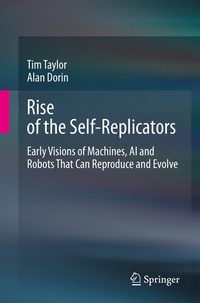
Rise of the Self-Replicators
Description

In this book the authors provide a chronological survey and comprehensive archive of the early history of thought about machine self-reproduction and evolution. They discuss contributions from philosophy, science fiction, science and engineering, and uncover many examples that have never been discussed in the Artificial Intelligence and Artificial Life literature before now. In the final chapter they provide a synthesis of the concepts discussed, offer their views on the field's future directions, and call for a broad community discussion about the significant implications of intelligent evolving machines.
The book will be of interest to general readers, and a valuable resource for researchers, practitioners, and historians engaged with ideas in artificial intelligence, artificial life, robotics, and evolutionary computing.
Reviews / Votes
"In addition to describing historical sources and summarizing their ideas, the authors offer full-text, translated quotations, which makes the book an extremely useful reference source for studying artificial life philosophy that focuses on self-replication. . Rise of the Self-Replicators is undoubtedly exciting and inspirational for its primary audience-fellow members of the ALife community-as well as for philosophers, science fiction enthusiasts, and futurists." (Yulia Frumer, Technology and Culture, Vol. 62 (4), October, 2021)
"Their book brings to light many historical and scientific facts that have never been published in the modern literature before. . Taylor and Dorin have written their book Rise of the Self-Replicators in such a way that I fully recommend it to anyone interested in learning about the origins of the idea of artificial objects that can reproduce and evolve. . I believe that all open-minded readers could benefit from the knowledge that they get from this excellent book." (J. Cejková, Artificial Life, September 13, 2021)
"The book Rise of the Self-Replicators by Taylor and Dorin provides an intriguing historical perspective on the origin of the ideas around self-replication and evolution in machines. . Rise of the Self-Replicators is a great read, and highly recommended to all the readers of the journal and their collaborators." (Stefano Nichele, Genetic Programming and Evolvable Machines, Vol. 22, 2021)
More details
Other editions
Additional editions
Persons
Alan Dorin is an Associate Professor at Monash University in Australia where he leads the Computational and Collective Intelligence group within the Department of Data Science and AI. His research interests include artificial life, ecological modelling, insect-plant interaction and simulation, biologically-inspired electronic media art, generative art, and the history of technology. He promotes an understanding of the relationships between technology, society and the natural environment by encouraging interdisciplinary curiosity.
