

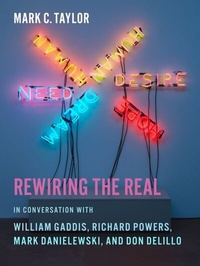
Rewiring the Real
In Conversation with William Gaddis, Richard Powers, Mark Danielewski, and Don DeLillo
1st Edition
Published on 29. October 2015
344 pages
978-0-231-53164-1 (ISBN)
Description

Digital and electronic technologies that act as extensions of our bodies and minds are changing how we live, think, act, and write. Some welcome these developments as bringing humans closer to unified consciousness and eternal life. Others worry that invasive globalized technologies threaten to destroy the self and the world. Whether feared or desired, these innovations provoke emotions that have long fueled the religious imagination, suggesting the presence of a latent spirituality in an era mistakenly deemed secular and posthuman.
William Gaddis, Richard Powers, Mark Danielewski, and Don DeLillo are American authors who explore this phenomenon thoroughly in their work. Engaging the works of each in conversation, Mark C. Taylor discusses their sophisticated representations of new media, communications, information, and virtual technologies and their transformative effects on the self and society. He focuses on Gaddis's The Recognitions, Powers's Plowing the Dark, Danielewski's House of Leaves, and DeLillo's Underworld, following the interplay of technology and religion in their narratives and their imagining of the transition from human to posthuman states. Their challenging ideas and inventive styles reveal the fascinating ways religious interests affect emerging technologies and how, in turn, these technologies guide spiritual aspirations. To read these novels from this perspective is to see them and the world anew.
William Gaddis, Richard Powers, Mark Danielewski, and Don DeLillo are American authors who explore this phenomenon thoroughly in their work. Engaging the works of each in conversation, Mark C. Taylor discusses their sophisticated representations of new media, communications, information, and virtual technologies and their transformative effects on the self and society. He focuses on Gaddis's The Recognitions, Powers's Plowing the Dark, Danielewski's House of Leaves, and DeLillo's Underworld, following the interplay of technology and religion in their narratives and their imagining of the transition from human to posthuman states. Their challenging ideas and inventive styles reveal the fascinating ways religious interests affect emerging technologies and how, in turn, these technologies guide spiritual aspirations. To read these novels from this perspective is to see them and the world anew.
All prices
More details
Other editions
Additional editions
Mark C. Taylor
Rewiring the Real
In Conversation with William Gaddis, Richard Powers, Mark Danielewski, and Don DeLillo
Book
01/2013
Columbia University Press
€86.77
Shipment within 10-20 days
Person
Mark C. Taylor is professor of religion and chair of the Department of Religion at Columbia University. His most recent books are Recovering Place: Reflections on Stone Hill; Refiguring the Spiritual: Beuys, Barney, Turrell, Goldsworthy; Field Notes from Elsewhere: Reflections on Dying and Living; After God; Mystic Bones; and Confidence Games: Money and Markets in a World Without Redemption.
Content
List of Illustrations
neXus
1. Counterfeiting Counterfeit Religion: William Gaddis, The Recognitions
2. Mosaics: Richard Powers, Plowing the Dark
3. Figuring Nothing: Mark Danielewski, House of Leaves
4. "Holy Shit!": Don DeLillo, Underworld
5. Concluding Unscientific Postscript: Two Styles of the Philosophy of Religion
Acknowledgments
Notes
Index
neXus
1. Counterfeiting Counterfeit Religion: William Gaddis, The Recognitions
2. Mosaics: Richard Powers, Plowing the Dark
3. Figuring Nothing: Mark Danielewski, House of Leaves
4. "Holy Shit!": Don DeLillo, Underworld
5. Concluding Unscientific Postscript: Two Styles of the Philosophy of Religion
Acknowledgments
Notes
Index
Read the chapter "Nexus" from Rewiring the Real: In Conversation with William Gaddis, Richard Powers, Mark Danielewski, and Don Delillo

