

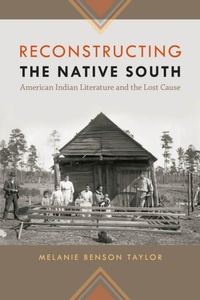
Reconstructing the Native South
Description

In Reconstructing the Native South, Melanie Benson Taylor examines the diverse body of Native American literature in the contemporary U.S. South-literature written by the descendants of tribes who evaded Removal and have maintained ties with their southeastern homelands. In so doing Taylor advances a provocative, even counterintuitive claim: that the U.S. South and its Native American survivors have far more in common than mere geographical proximity. Both cultures have long been haunted by separate histories of loss and nostalgia, Taylor contends, and the moments when those experiences converge in explicit and startling ways have yet to be investigated by scholars. These convergences often bear the scars of protracted colonial antagonism, appropriation, and segregation, and they share preoccupations with land, sovereignty, tradition, dispossession, subjugation, purity, and violence.
Taylor poses difficult questions in this work. In the aftermath of Removal and colonial devastation, what remains-for Native and non-Native southerners-to be recovered? Is it acceptable to identify an Indian "lost cause"? Is a deep sense of hybridity and intercultural affiliation the only coherent way forward, both for the New South and for its oldest inhabitants? And in these newly entangled, postcolonial environments, has global capitalism emerged as the new enemy for the twenty-first century? Reconstructing the Native South is a compellingly original work that contributes to conversations in Native American, southern, and transnational American studies.
More details
Other editions
Additional editions
Person
Content
- COVER
- CONTENTS
- ACKNOWLEDGMENTS
- INTRODUCTION: Reconstructing the South: Region, Tribe, and Sovereignty in the Age of Global Capitalism
- CHAPTER ONE: Reconstructing Loss: Native Americans, Nostalgia, and Tribalography in Southern Literature
- CHAPTER TWO: Red, Black, and Southern: Alliances and Erasures in the Biracial South
- CHAPTER THREE: Reckoning the Future: Capitalism, Culture, and the Production of Community
- CHAPTER FOUR: Excavating the World: Unearthing the Past and Finding the Future on Southern Soil
- CONCLUSION: The South in the Indian and the Indian in the South
- NOTES
- BIBLIOGRAPHY
- INDEX
- A
- B
- C
- D
- E
- F
- G
- H
- I
- J
- K
- L
- M
- N
- O
- P
- Q
- R
- S
- T
- U
- V
- W
- X
- Y
- Z
