Alles über E-Books | Antworten auf Fragen rund um E-Books, Kopierschutz und Dateiformate finden Sie in unserem Info- & Hilfebereich.
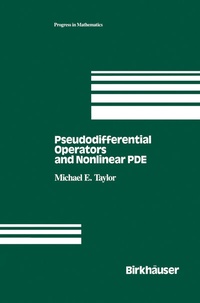
For the past 25 years the theory of pseudodifferential operators has played an important role in many exciting and deep investigations into linear PDE. Over the past decade, this tool has also begun to yield interesting results in nonlinear PDE. This book is devoted to a summary and reconsideration of some used of pseudodifferential operator techniques in nonlinear PDE.
One goal has been to build a bridge between two approaches which have been used in a number of papers written in the last decade, one being the theory of paradifferential operators, pioneered by Bony and Meyer, the other the study of pseudodifferential operators whose symbols have limited regularity. The latter approach is a natural successor to classical devices of deriving estimates for linear PDE whose coefficients have limited regularity in order to obtain results in nonlinear PDE.
After developing the requisite tools, we proceed to demonstrate their effectiveness on a range of basic topics in nonlinear PDE. For example, for hyperbolic systems, known sufficient conditions for persistence of solutions are both sharpened and extended in scope. In the treatment of parabolic equations and elliptic boundary problems, it is shown that the results obtained here interface particularly easily with the DeGiorgi-Nash-Moser theory, when that theory applies.
To make the work reasonable self-contained, there are appendices treating background topics in harmonic analysis and the DeGiorgi-Nash-Moser theory, as well as an introductory chapter on pseudodifferential operators as developed for linear PDE.
The book should be of interest to graduate students, instructors, and researchers interested in partial differential equations, nonlinear analysis in classical mathematical physics and differential geometry, and in harmonic analysis.
Series
Language
Place of publication
Publishing group
Target group
Professional and scholarly
Illustrations
File size
ISBN-13
978-1-4612-0431-2 (9781461204312)
DOI
10.1007/978-1-4612-0431-2
Schweitzer Classification
Introduction..- 0. Pseudodifferential operators and linear PDE..- §0.1 The Fourier integral representation and symbol classes.- §0.2 Schwartz kernels of pseudodifferential operators.- §0.3 Adjoints and products.- §0.4 Elliptic operators and parametrices.- §0.5 L2 estimates.- §0.6 Gårding's inequality.- §0.7 The sharp Gårding inequality.- §0.8 Hyperbolic evolution equations.- §0.9 Egorov's theorem.- §0.10 Microlocal regularity.- §0.11 Lp estimates.- §0.12 Operators on manifolds.- 1. Symbols with limited smoothness..- §1.1 Symbol classes.- §1.2 Some simple elliptic regularity theorems.- §1.3 Symbol smoothing.- 2. Operator estimates and elliptic regularity..- §2.1 Bounds for operators with nonregular symbols.- §2.2 Further elliptic regularity theorems.- §2.3 Adjoints.- §2.4 Sharp Gårding inequality.- 3. Paradifferential operators..- §3.1 Composition and paraproducts.- §3.2 Various forms of paraproduct.- §3.3 Nonlinear PDE and paradifferential operators.- §3.4 Operator algebra.- §3.5 Product estimates.- §3.6 Commutator estimates.- 4. Calculus for OPC1Sclm..- §4.1 Commutator estimates.- §4.2 Operator algebra.- §4.3 Gårding inequality.- §4.4 C1-paradifferential calculus.- 5. Nonlinear hyperbolic systems..- §5.1 Quasilinear symmetric hyperbolic systems.- §5.2 Symmetrizable hyperbolic systems.- §5.3 Higher order hyperbolic equations.- §5.4 Completely nonlinear hyperbolic systems.- 6. Propagation of singularities..- §6.1 Propagation of singularities.- §6.2 Nonlinear formation of singularities.- §6.3 Egorov's theorem.- 7. Nonlinear parabolic systems..- §7.1 Strongly parabolic quasilinear systems.- §7.2 Petrowski parabolic quasilinear systems.- §7.3 Sharper estimates.- §7.4 Semilinear parabolic systems.- 8. Nonlinear ellipticboundary problems..- §8.1 Second order elliptic equations.- §8.2 Quasilinear elliptic equations.- §8.3 Interface with DeGiorgi-Nash-Moser theory.- 9. Extension of the Schauder estimates..- §9.1 Nirenberg's refinement.- §9.2 Elliptic boundary problems.- A. Function spaces..- §A.1 Hölder spaces, Zygmund spaces, and Sobolev spaces.- §A.2 Morrey spaces.- §A.3 BMO.- B. Sup norm estimates..- C. DeGiorgi-Nash-Moser estimates..- §C.2 Hölder continuity.- §C.3 Inhomogeneous equations.- §C.4 Boundary regularity.- D. Paraproduct estimates..- Index of notation..- References..