

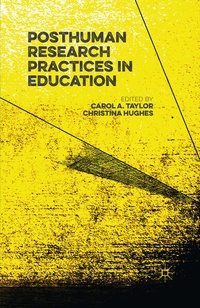
Posthuman Research Practices in Education
Description

How do we include and develop understandings of those beyond-the-human aspects of the world in social research? Through fifteen contributions from leading international thinkers, this book provides original approaches to posthumanist research practices in education. It responds to questions which consider the effect and reach of posthuman research.
More details
Other editions
Additional editions
Persons
Carol Taylor is Reader at the Sheffield Institute of Education at Sheffield Hallam University, UK where she leads the Higher Education Research Group. Her research focuses on space, gender, bodies and materialities, and student engagement and ethics. Her work has been published in Cultural Studies=Critical Methodologies, Studies in Higher Education and Gender and Education.
Christina Hughes is Professor of Sociology at the University of Warwick, UK. Her research focusses on equity and gender issues and she has longstanding interests in methodological concerns. She has published widely in this area and is co-editor of the International Journal of Social Research Methodology.
Content
Introduction; Christina Hughes and Carol A. Taylor.- 1. Edu-crafting a Cacophonous Ecology: Posthumanist Research Practices for Education; Carol A. Taylor.- 2. Rethinking the Empirical in the Posthuman; Elizabeth Adams St.Pierre.- 3. Deleuzio-Guattarian Rhizomatics: Mapping the Desiring Forces and Connections between Educational Practices and the Neurosciences; Hillevi Lenz Taguchi.- 4. Thinking Like a brick: Posthumanism and building materials; Luke Bennett.- 5. A Mark on Paper: The Matter of Indigenous-Settler History ; Alison Jones & Te Kawehau Hoskins.- 6. Thinking with an Agentic Assemblage in Posthuman Inquiry; Alecia Youngblood Jackson and Lisa A. Mazzei.- 7. Flickering, Spilling and Diffusing Body/Knowledge in the Posthuman Early Years; Rachel Holmes and Liz Jones.- 8. 'Local Girl Befriends Vicious Bear': Unleashing Educational Aspiration through a Pedagogy of Material-Semiotic Entanglement; Susanne Gannon.- 9. Decentring the Human in Multispecies Ethnographies; Veronica Pacini-Ketchabaw, Affrica Taylor and Mindy Blaise.- 10. Girls, Camera, (Intra)Action: Mapping Posthuman Possibilities in a Diffractive Analysis of Camera-Girl Assemblages in Research on Gender, Corporeality and Place; Gabrielle Ivinson and Emma Renold.- 11. Decolonizing School Science: Pedagogically Enacting Agential Literacy and Ecologies of Relationships; Marc Higgins.- 12. Student Community Engagement through a Posthuman Lens: The Trans-corporeality of Student and Sea; Jocey Quinn.- 13. Cows, Cabins and Tweets: Posthuman Intra-Active Affect and Feminist Fire in Secondary School; Jessica Ringrose and Emma Renold.- 14. Theorising as Practice: Engaging the Posthuman as Method of Inquiry and Pedagogic Practice within Contemporary Higher Education; Ken Gale.- 15. Femifesta for Posthuman Art Education: Visions and Becomings; Anna Hickey-Moody.
