

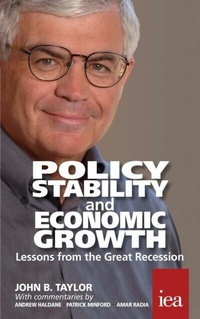
Policy Stability and Economic Growth
Lessons from the Great Recession
1st Edition
Published on 11. February 2016
112 pages
978-0-255-36720-2 (ISBN)
Description

John Taylor is one of the foremost economists of our generation. His ideas were implemented in central banks across the world during the period of price stability, economic growth and financial stability that followed the 1980s. Of course, this period culminated in the financial crisis of 2008, which was followed by a very slow recovery, which, eight years on, can hardly be said to be complete. This short book presents Taylor's view of the financial crisis and its aftermath as expressed in the 2014 F. A. Hayek Memorial Lecture. He believes that the rules-based monetary policy that he espoused broke down in the run-up to the crisis and afterwards. Furthermore, other aspects of policy became erratic and discretionary to the point that the rule of law could be said to be under threat. According to the author, these problems contributed to the crisis and to the slow recovery - indeed, they were a major cause. Two commentaries follow John Taylor's lecture. One is by Patrick Minford and the other is by the Bank of England's Chief Economist Andrew Haldane and Amar Radia. Both recognise Taylor's immense contribution to economic theory and policy. The commentaries are themselves an important contribution and they are followed by a response from John Taylor which addresses the issues raised by the commentators.
More details
Other editions
Additional editions
Book
02/2016
Institute of Economic Affairs
€14.50
Shipment within 10-20 days
Persons
Professor John B. Taylor is the Robert Raymond Professor of Economics at Stanford University and the George P. Shultz Senior Fellow in Economics at the Hoover Institution. John Taylor's academic fields of expertise are macroeconomics, monetary economics and international economics. In particular, he is known for his research on the foundations of modern monetary theory and policy. He has served on the US President's Council of Economic Advisors, the US Congressional Budget Office's panel of Economic Advisors and the California Governor's Council of Economic Advisors. From 2001 to 2005, John Taylor was Under Secretary of the US Treasury for International Affairs, where he was responsible for, amongst other things, currency markets, trade in financial services and oversight of the International Monetary Fund and the World Bank.
Content
- Intro
- The authors
- Foreword
- Acknowledgement
- Summary
- Tables and figures
- 1 Policy stability and economic growth: lessons from the Great Recession
- Introduction
- The Great Recession compared with earlier recessions
- The principles of good policy
- Monetary policy: to the Taylor rule and back
- Very unruly policy
- A return to rules-based policy
- References
- 2 Questions and discussion
- 3 Was failure to follow the Taylor rule enough to cause the crisis?
- A commentary on John Taylor's lecture
- Patrick Minford
- Evaluating John Taylor's particular thesis about the financial crisis
- Did the Taylor rule with inflation targeting fail during and before the crash?
- John Taylor's plea for a return to predictable rules of policy
- Conclusions
- References
- 4 The need for discretion and rules
- A commentary on John Taylor's lecture
- Andrew G. Haldane and Amar Radia
- Rules and discretion revisited
- Monetary policy rules in practice
- Concluding remarks
- References
- 5 A rejoinder
- John B. Taylor
- Reference
- About the IEA
- Figure?1 Great Recession and not-so-great recovery (US)
- Figure?2 Great Recession and not-so-great recovery (UK)
- Figure?3 US recession and recovery in early 1980s
- Figure?4 UK recession and recovery in early 1980s
- Figure?5 Growth rate in first eight quarters of a recovery from previous recessions with a financial crisis (identified by year recession began)
- Figure?6 Inflation from 1953 to 2013
- Figure?7 1965-80: monetary policy not well described by good rules-based policy
- Figure?8 Loose-fitting monetary policy
- Figure?9 Housing investment versus deviations from the Taylor rule in the euro zone countries, 2001-6
- Figure?10 Did the fiscal stimulus stimulate consumption?
- Figure?11 Debt to GDP ratio in the US
- Figure?12 Incidence of topics affecting inflation discussed by the MPC
- Figure?13 Incidence of topics linked to the labour market discussed by the MPC
- Figure?14 Distribution of inflation and growth outcomes relative to forecast
- Figure?15 Actual and Taylor rule paths for UK interest rates
- Figure?16 Taylor rule paths for UK interest rates with different judgements about the output gap
- Figure?17 Taylor rules for UK interest rates with different judgements about weight on output gap
- Figure?18 Taylor rules paths for interest rates with different judgements about r*
- Figure?19 Bank of England inflation forecasts
- Figure?20 Taylor rules paths for interest rates with different judgements about forward lookingness
- Figure?21 Range of possible Taylor rules based on different judgements
- Table?1 Simulated frequencies of crises with different monetary regimes
- Blank Page
