

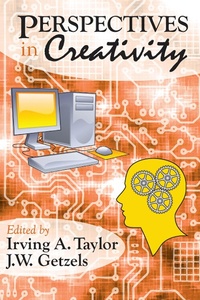
Perspectives in Creativity
Published on 12. July 2017
353 pages
978-1-351-50011-1 (ISBN)
Description

In Perspectives in Creativity experts in the psychology of creativity take stock of the field by examining their own experiences. The contributors relate how they embarked on their work, how their ideas developed, what in their thinking remained the same, what had changed, and how they evaluate their successes and failures.
The introductory chapter provides a historical context for subsequent contributions. J. P. Guilford then describes the development of the field of creativity from the perspective of the Structure of Intellect model. Donald W. MacKinnon describes his work at the Institute of Personality Assessment and Research. J. W. Getzels and Mihalyi Csikszentmihalyi recount in the following chapter how, though starting with a conception of creativity as a problem-solving process, they were driven through their work with artists to a conception of creativity as also a problem-finding process. In the fifth chapter, Frank M. Andrews describes his investigations of the social and psychological factors in scientific laboratories.
Frank Barron examines the problem of creativity and alienation. Anne Roe analyzes the sources and development of paintings as reported by twenty artists. In the following chapter, Salvatore Maddi examines the widely held belief that social integration and a permissive environment are conducive to creative endeavor. In chapter 9, Calvin Taylor and Richard Ellison describe the development of the Utah program of assessment and intervention with regard to the creativity of children in the classroom. Next, Sidney Parnes discusses his work on "brainstorming" and its emphasis on a balance between imagination and judgment, freedom, and discipline. George Prince tells of the development of "synectics" since its early formulation and recounts its application to creative production in industry. E. Paul Torrance then examines recent creativity in the schools and describes his own efforts in devising diagnostic tests and educati
The introductory chapter provides a historical context for subsequent contributions. J. P. Guilford then describes the development of the field of creativity from the perspective of the Structure of Intellect model. Donald W. MacKinnon describes his work at the Institute of Personality Assessment and Research. J. W. Getzels and Mihalyi Csikszentmihalyi recount in the following chapter how, though starting with a conception of creativity as a problem-solving process, they were driven through their work with artists to a conception of creativity as also a problem-finding process. In the fifth chapter, Frank M. Andrews describes his investigations of the social and psychological factors in scientific laboratories.
Frank Barron examines the problem of creativity and alienation. Anne Roe analyzes the sources and development of paintings as reported by twenty artists. In the following chapter, Salvatore Maddi examines the widely held belief that social integration and a permissive environment are conducive to creative endeavor. In chapter 9, Calvin Taylor and Richard Ellison describe the development of the Utah program of assessment and intervention with regard to the creativity of children in the classroom. Next, Sidney Parnes discusses his work on "brainstorming" and its emphasis on a balance between imagination and judgment, freedom, and discipline. George Prince tells of the development of "synectics" since its early formulation and recounts its application to creative production in industry. E. Paul Torrance then examines recent creativity in the schools and describes his own efforts in devising diagnostic tests and educati
More details
Language
English
Place of publication
London
United Kingdom
Publishing group
Taylor & Francis Ltd
Target group
College/higher education
File size
23,58 MB
ISBN-13
978-1-351-50011-1 (9781351500111)
Copyright in bibliographic data and cover images is held by Nielsen Book Services Limited or by the publishers or by their respective licensors: all rights reserved.
Schweitzer Classification
Other editions
Additional editions
Irving Taylor
Perspectives in Creativity
Book
12/2007
1st Edition
AldineTransaction
€72.00
Shipment within 10-15 days
Irving Taylor
Perspectives in Creativity
Book
12/1975
1st Edition
AldineTransaction
€60.24
Article exhausted; check different version
Content
1: A Retrospective View of Creativity Investigation; 2: Creativity; 3: IPAR's Contribution to the Conceptualization and Study of Creativity; 4: From Problem Solving to Problem Finding; 5: Social and Psychological Factors which Influence the Creative Process; 6: The Solitariness of Self and Its Mitigation Through Creative Imagination; 7: Painters and Painting; 8: The Strenuousness of the Creative Life; 9: Moving Toward Working Models in Creativity; 10: AHA!; 11: Creativity, Self, and Power; 12: Creativity Research in Education; 13: An Emerging View of Creative Actions; 14: Creativity
