

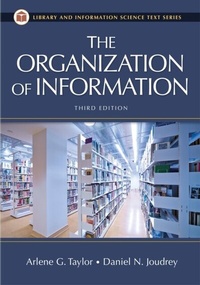
The Organization of Information
3rd Edition
Published on 23. December 2008
540 pages
978-1-59884-812-0 (ISBN)
Description

This third edition of Taylor's modern classic continues to articulate the theory, principles, standards, and tools behind information organization.
As with previous editions, it begins with strong justification for the continued importance of organizing principles and practice. Following a broad overview of the concept and its role in human endeavors, Taylor and Joudrey provide a detailed and insightful discussion of such basic retrieval tools as inventories, bibliographies, catalogs, indexes, finding aids, registers, databases, major bibliographic utilities, and other organizing entities; and subsequently trace the development of the organization of recorded information in Western civilization from 2000 B.C.E. to the present. Standards of codification (MARC, SGML, and various DTDs), controlled vocabularies and ontologies, and Web 2.0 technologies are but a sample of its extensive topical coverage.
The Organization of Information remains the title of choice for students and professionals eager to embrace the heritage, immediacy, and future of this fascinating field of study.
As with previous editions, it begins with strong justification for the continued importance of organizing principles and practice. Following a broad overview of the concept and its role in human endeavors, Taylor and Joudrey provide a detailed and insightful discussion of such basic retrieval tools as inventories, bibliographies, catalogs, indexes, finding aids, registers, databases, major bibliographic utilities, and other organizing entities; and subsequently trace the development of the organization of recorded information in Western civilization from 2000 B.C.E. to the present. Standards of codification (MARC, SGML, and various DTDs), controlled vocabularies and ontologies, and Web 2.0 technologies are but a sample of its extensive topical coverage.
The Organization of Information remains the title of choice for students and professionals eager to embrace the heritage, immediacy, and future of this fascinating field of study.
More details
Series
Edition
3rd edition
Language
English
Place of publication
New York
United States
Publishing group
Bloomsbury Publishing Plc
ISBN-13
978-1-59884-812-0 (9781598848120)
Copyright in bibliographic data and cover images is held by Nielsen Book Services Limited or by the publishers or by their respective licensors: all rights reserved.
Schweitzer Classification
Other editions
Additional editions
Arlene G. Taylor | Daniel N. Joudrey
The Organization of Information, 3rd Edition
Book
12/2008
3rd Edition
Libraries Unlimited Inc
€73.23
Article exhausted; check different version
Persons
Arlene G. Taylor is professor emerita, School of Information Sciences, University of Pittsburgh, and author of several works on cataloging and classification and authority control. She has received ALA's Margaret Mann Citation in Cataloging and Classification and the ALA Highsmith Library Literature Award.
Daniel N. Joudrey is assistant professor in the Graduate School of Library and Information Science, Simmons College, Boston, Massachusetts, where he teaches information organization and cataloging. His research interests include aboutness determination, subject access to information, and cataloging education.
Daniel N. Joudrey is assistant professor in the Graduate School of Library and Information Science, Simmons College, Boston, Massachusetts, where he teaches information organization and cataloging. His research interests include aboutness determination, subject access to information, and cataloging education.
Content
List of Figures
Preface
Acknowledgments by Arlene G. Taylor
Acknowledgments by Daniel N. Joudrey
Chapter 1: Organization of Recorded Information
Chapter 2: Retrieval Tools
Chapter 3: Development of the Organization of Recorded Information in Western Civilization
Chapter 4: Metadata
Chapter 5: Encoding Standards
Chapter 6: Systems and System Design
Chapter 7: Metadata: Description
Chapter 8: Metadata: Access and Authority Control
Chapter 9: Subject Analysis
Chapter 10: Systems for Vocabulary Control
Chapter 11: Systems for Categorization
Conclusion
Appendix A: An Approach to Subject Analysis
Appendix B: Arrangement of Physical Information Resources
Appendix C: Arrangement of Metadata Displays
Glossary
Selected Bibliography
Index
Preface
Acknowledgments by Arlene G. Taylor
Acknowledgments by Daniel N. Joudrey
Chapter 1: Organization of Recorded Information
Chapter 2: Retrieval Tools
Chapter 3: Development of the Organization of Recorded Information in Western Civilization
Chapter 4: Metadata
Chapter 5: Encoding Standards
Chapter 6: Systems and System Design
Chapter 7: Metadata: Description
Chapter 8: Metadata: Access and Authority Control
Chapter 9: Subject Analysis
Chapter 10: Systems for Vocabulary Control
Chapter 11: Systems for Categorization
Conclusion
Appendix A: An Approach to Subject Analysis
Appendix B: Arrangement of Physical Information Resources
Appendix C: Arrangement of Metadata Displays
Glossary
Selected Bibliography
Index
