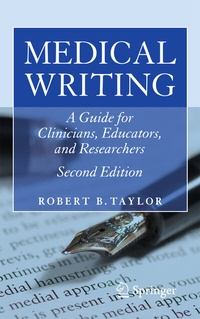
Medical Writing
Description

The first edition of this book (titled "The Clinician's Guide to Medical Writing") has become a standard in its field and remains an indispensible reference for any clinician, academic physician, or health professional who wishes to hone their writing skills. However, since its publication in 2004, significant changes have taken place in the way medical professionals communicate with each other and the world. Medical Writing: A Guide for Clinicians and Academicians, 2e retains all of the fundamental writing advice of the first edition and has been expanded to include two brand new chapters:
How to Write a Research Protocol (including why a research project needs a written protocol, elements of the research protocol and common problems)
How to Write a Grant Proposal ( including sections on government and private grant funding sources, what you need to know about grant writing, and elements of a successful grant proposal)
New information is also included throughout the book on becoming a successful writer, medical tables and figures, conflict of interest and disclosures, how to review a scientific article, statistical analysis, "pay-to-publish" journal publishing, electronic submission of manuscripts, issues in medical publishing and the future of medical writing and publication. New appendices address commonly encountered research and statistical terms and memorable aphorisms regarding writing, medical and otherwise.
Reviews / Votes
From the reviews of the second edition:
"The author presents the information, interspersing it with a number of personal reflections and stories, references, and quotations, making it a very pleasant read. . the audience is students, clinicians, educators, and researchers. The author is an experienced writer, which is clear in his approach and the candor of his writing. . Unquestionably, this is necessary reading for anyone interested in publishing medical information and a must of every university medical library." (Vincent F. Carr, Doody's Review Service, November, 2011)
"Medical writing became a must not only in academic medical life, but also in all aspects of basic and clinical medicine. A guide for medical writing in useful for students, for preparation of their theses, for scientists, in order to write grant applications, for clinicians, to prepare case reports. All aspects of medical writing are covered, from basic writing skills to technical issues, focusing on special features required by the field. . the book should be present in all laboratories and clinical departments . ." (C. Badiu, Acta Endocrinologica, Vol. VIII (2), April-June, 2012)
More details
Other editions
Additional editions