

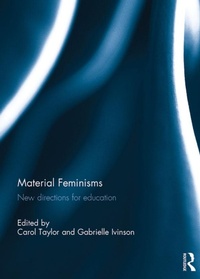
Material Feminisms
New Directions for Education
1st Edition
Published on 2. February 2018
148 pages
978-1-317-27056-0 (ISBN)
Description

Material Feminisms: New Directions for Education provides a range of powerful theoretical and innovative methodological examples to illuminate how new material feminism can be put to work in education to open up new avenues of research design and practice. It poses challenging questions about the nature of knowledge production, the role of the researcher, and the critical endeavour arising from inter- and post-disciplinarity. Working with diffractive methodologies and new materialist ecological epistemologies, the book offers resources for hope which widen the scope for how educational problems are interrogated, and provides a political counter-movement to neo-positivist, outcomes-based approaches within education.
Inspired by writers such as Barad, Bennett, and Deleuze and Guattari, the book makes a radical break with cognitive, dualist, and universal conceptions of human subjectivity and intelligence in education. By taking its starting point as the co-consitutiveness of discourse, materiality, corporeality, and place, the book foregrounds educational practices as material enactments of multiple, non-linear, entangled, affective, and relational forces. It offers new insights into how gender, class, and ethnicity are constituted in, and by, material assemblages that are often submerged or 'unseen'.
This book is an essential starting place for those intrigued by what new theoretical accounts of materiality, posthumanism, and affect can offer educational research. Diffractive methodologies challenge readers to take a fuller range of actors into account than in 'objective' humanist methodologies, and in so doing to pay closer attention to what data is. It invites researchers to engage with long-standing feminist concerns about power and knowledge production in research processes. This book was originally published as a special issue of Gender and Education.
Inspired by writers such as Barad, Bennett, and Deleuze and Guattari, the book makes a radical break with cognitive, dualist, and universal conceptions of human subjectivity and intelligence in education. By taking its starting point as the co-consitutiveness of discourse, materiality, corporeality, and place, the book foregrounds educational practices as material enactments of multiple, non-linear, entangled, affective, and relational forces. It offers new insights into how gender, class, and ethnicity are constituted in, and by, material assemblages that are often submerged or 'unseen'.
This book is an essential starting place for those intrigued by what new theoretical accounts of materiality, posthumanism, and affect can offer educational research. Diffractive methodologies challenge readers to take a fuller range of actors into account than in 'objective' humanist methodologies, and in so doing to pay closer attention to what data is. It invites researchers to engage with long-standing feminist concerns about power and knowledge production in research processes. This book was originally published as a special issue of Gender and Education.
More details
Edition
1. Auflage
Language
English
Place of publication
London
United Kingdom
Publishing group
Taylor & Francis Ltd
Target group
College/higher education
Product notice
Reflowable
File size
0,56 MB
ISBN-13
978-1-317-27056-0 (9781317270560)
Copyright in bibliographic data and cover images is held by Nielsen Book Services Limited or by the publishers or by their respective licensors: all rights reserved.
Schweitzer Classification
Other editions
Additional editions
Book
01/2019
1st Edition
Routledge
€69.10
Shipment within 10-20 days
Book
04/2016
1st Edition
Routledge
€204.90
Shipment within 10-20 days
Persons
Carol Taylor is a Reader in the Sheffield Institute of Education at Sheffield Hallam University, UK, where she leads the Higher Education Research Group. Her research focuses on space, gender and bodies, mundane materialities, student engagement, and ethics. She has recently co-edited two journal special issues: one on New Material Feminisms for Gender and Education (with Gabrielle Ivinson) and one on student engagement and ethics for the Journal of Applied Research in Higher Education (with Carol Robinson). Her work has been published in Cultural Studies=Critical Methodologies, Studies in Higher Education, and Gender and Education. Her recent funded projects include the development of an ethical framework for student partnership (Higher Education Academy) and an installation on workplace objects for the 2015 ESRC Festival of Social Science.
Gabrielle Ivinson is Professor in Education at the School of Education, University of Aberdeen, UK. She is the author of Rethinking Single-sex teaching: Gender, school subjects and learning (with Murphy, 2007), co-editor of Knowledge and Identity: concepts and applications in Bernstein's sociology of knowledge (with Davies and Fitz, 2011), and co-editor of the journal special issue 'Material Feminisms: New Directions for Education' for Gender and Education (with Carol Taylor). As a social and developmental psychologist, she researches the intergenerational transmission of knowledge as a social resource in places of poverty. Her recent projects involve working with a range of artists to co-produce art forms and artefacts to enable young people to communicate with persons in authority by drawing on the affective power of art to move.
Gabrielle Ivinson is Professor in Education at the School of Education, University of Aberdeen, UK. She is the author of Rethinking Single-sex teaching: Gender, school subjects and learning (with Murphy, 2007), co-editor of Knowledge and Identity: concepts and applications in Bernstein's sociology of knowledge (with Davies and Fitz, 2011), and co-editor of the journal special issue 'Material Feminisms: New Directions for Education' for Gender and Education (with Carol Taylor). As a social and developmental psychologist, she researches the intergenerational transmission of knowledge as a social resource in places of poverty. Her recent projects involve working with a range of artists to co-produce art forms and artefacts to enable young people to communicate with persons in authority by drawing on the affective power of art to move.
Content
Introduction - Material feminisms: new directions for education 1. A more 'livable' school? A diffractive analysis of the performative enactments of girls' ill-/well-being with(in) school environments 2. Objects, bodies and space: gender and embodied practices of mattering in the classroom 3. Valleys' girls: re-theorising bodies and agency in a semi-rural post-industrial locale 4. The teacher-student writing conference reimaged: entangled becoming-writingconferencing 5. Theorising learning and nature: post-human possibilities and problems 6. Gendered subjectivities of spacetimematter 7. Making matter making us: thinking with Grosz to find freedom in new feminist materialisms 8. Materialist mappings of knowing in being: researchers constituted in the production of knowledge 9. Re-turning feminist methodologies: from a social to an ecological epistemology
