

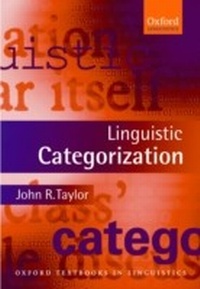
Linguistic Categorization
1st Edition
Published on 6. November 2003
325 pages
978-0-19-159397-0 (ISBN)
Description

This book provides a readable and clearly articulated introduction to the field of Cognitive Linguistics. It explores the far-reaching implications of Eleanor Rosch's seminal work on categorization and prototype theory, extending the application of prototype theory from lexical semantics to morphology, syntax, and phonology. The third edition is fully revised and updated to include the considerable developments in Cognitive Linguistics since 1987. It covers recent research on polysemy, meaning relatedness and metaphors, as well as expanding the discussion of syntactic categories and the relevance of computer simulations.
More details
Other editions
Additional editions
John R. Taylor
Linguistic Categorization
Book
11/2003
3rd Edition
Oxford University Press
€80.60
Shipment within 15-20 days
Content
- Cover
- Contents
- Preface to the third edition
- Typographical conventions
- Introduction and Overview
- 1 The Categorization of Colour
- 1.1 Why colour terms?
- 1.2 Arbitrariness
- 1.3 An alternative approach: focal colours
- 1.4 Autonomous linguistics vs. cognitive linguistics
- 2 The Classical Approach to Categorization
- 2.1 Aristotle
- 2.2 The classical approach in linguistics: phonology
- 2.3 The classical approach in semantics
- 2.4 What's wrong with the classical theory?
- 3 Prototype Categories: I
- 3.1 Wittgenstein
- 3.2 Prototypes: an alternative to the classical theory
- 3.3 Basic level terms
- 3.4 Prototypes and the basic level
- 3.5 Where do prototypes come from?
- 3.6 Some applications
- 4 Prototype Categories: II
- 4.1 Prototypes
- 4.2 Prototypes and schemas
- 4.3 Folk categories and expert categories
- 4.4 Hedges
- 5 Linguistic and Encyclopaedic Knowledge
- 5.1 The dictionary and the encyclopaedia
- 5.2 Domains and schemas
- 5.3 Frames and scripts
- 5.4 Perspectivization
- 5.5 Frames and scripts in the comprehension of nominals
- 5.6 Fake
- 5.7 Real
- 6 Polysemy and Meaning Chains
- 6.1 Monosemous and polysemous categories
- 6.2 An illustration: Climb
- 6.3 Over
- 6.4 Some problems
- 7 Category Extension: Metonymy and Metaphor
- 7.1 Metonymy
- 7.2 Metaphor
- 8 Polysemy, or: How Many Meanings Does a Word Really Have?
- 8.1 Polysemy and compositionality
- 8.2 The two-level approach
- 8.3 Two illustrations: in and round
- 8.4 Polysemy and the network model
- 9 Polysemous Categories in Morphology and Syntax
- 9.1 Case
- 9.2 The diminutive
- 9.3 The past tense
- 9.4 Yes-no questions
- 10 Polysemous Categories in Intonation
- 10.1 The problem of intonational meaning
- 10.2 The meanings of falling and rising tones
- 10.3 High key
- 11 Grammatical Categories
- 11.1 Words, affixes, and clitics
- 11.2 Grammatical categories
- 11.3 The semantic basis of grammatical categories
- 12 Syntactic Constructions as Prototype Categories
- 12.1 Why we need constructions
- 12.2 Elements of a construction grammar
- 12.3 The prenominal possessive
- 12.4 The transitive construction
- 12.5 The transitive construction: more marginal members
- 12.6 Metaphorical extension of syntactic constructions
- 12.7 A comparison with German
- 12.8 Concluding remarks
- 13 Prototype Categories in Phonology
- 13.1 Phoneme categories
- 13.2 The gradience of phonetic features
- 13.3 Syllable constructions
- 14 The Acquisition of Categories
- 14.1 Hypothesized acquisition routes
- 14.2 Grammatical categories and constructions
- 14.3 Conceptual development
- 14.4 Word meanings
- References
- Author index
- A
- B
- C
- D
- E
- F
- G
- H
- J
- K
- L
- M
- N
- O
- P
- Q
- R
- S
- T
- U
- V
- W
- Y
- Z
- Subject index
- A
- B
- C
- D
- E
- F
- G
- H
- I
- K
- L
- M
- N
- O
- P
- Q
- R
- S
- T
- V
- W
- Z
