

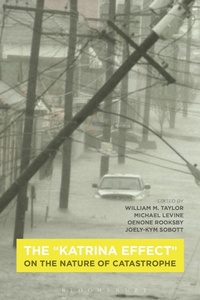
The "Katrina Effect"
On the Nature of Catastrophe
1st Edition
Published on 27. August 2015
304 pages
978-1-4725-9519-5 (ISBN)
Description

On August 29th 2005, the headwaters of Hurricane Katrina's storm-surge arrived at New Orleans, the levees broke and the city was inundated. Perhaps no other disaster of the 21st century has so captured the global media's attention and featured in the 'imagination of disaster' like Katrina. The Katrina Effect charts the important ethical territory that underscores thinking about disaster and the built environment globally. Given the unfolding of recent events, disasters are acquiring original and complex meanings. This is partly because of the global expansion and technological interaction of urban societies in which the multiple and varied impacts of disasters are recognized.
These meanings pose significant new problems for civil society: what becomes of public accountability, egalitarianism and other democratic ideals in the face of catastrophe? This collection of critical essays assesses the storm's global impact on overlapping urban, social and political imaginaries. Given the coincidence and 'perfect storm' of environmental, geo-political and economic challenges facing liberal democratic societies, communities will come under increasing strain to preserve and restore social fabric while affording all citizens equal opportunity in determining the forms that future cities and communities will take. Today, 21st century economic neo-liberalism, global warming or recent theories of 'urban vulnerability' and resilience provide key new contexts for understanding the meaning and legacy of Katrina.
These meanings pose significant new problems for civil society: what becomes of public accountability, egalitarianism and other democratic ideals in the face of catastrophe? This collection of critical essays assesses the storm's global impact on overlapping urban, social and political imaginaries. Given the coincidence and 'perfect storm' of environmental, geo-political and economic challenges facing liberal democratic societies, communities will come under increasing strain to preserve and restore social fabric while affording all citizens equal opportunity in determining the forms that future cities and communities will take. Today, 21st century economic neo-liberalism, global warming or recent theories of 'urban vulnerability' and resilience provide key new contexts for understanding the meaning and legacy of Katrina.
More details
Edition
1. Auflage
Language
English
Place of publication
London
United Kingdom
Publishing group
Bloomsbury Publishing PLC
Target group
Professional and scholarly
College/higher education
ISBN-13
978-1-4725-9519-5 (9781472595195)
Copyright in bibliographic data and cover images is held by Nielsen Book Services Limited or by the publishers or by their respective licensors: all rights reserved.
Schweitzer Classification
Other editions
Additional editions
William M. Taylor | Michael P. Levine | Oenone Rooksby
The "Katrina Effect"
On the Nature of Catastrophe
Book
08/2015
Bloomsbury Academic
€53.41
Article exhausted; check different version
William M. Taylor | Michael P. Levine | Oenone Rooksby
The "Katrina Effect"
On the Nature of Catastrophe
Book
08/2015
Bloomsbury Academic
€100.47
Article exhausted; check different version
Persons
William M. Taylor is Winthrop Professor of Architecture at the University of Western Australia, Australia.
Michael P. Levine is Winthrop Professor of Philosophy at the University of Western Australia, Australia.
Oenone Rooksby is a Research Associate at the University of Western Australia and a Graduate Architect at Officer Woods Architects, Australia.
Joely-Kym Sobott is a Research Associate at the University of Western Australia, and teaches in the field of Architectural History and Theory.
Michael P. Levine is Winthrop Professor of Philosophy at the University of Western Australia, Australia.
Oenone Rooksby is a Research Associate at the University of Western Australia and a Graduate Architect at Officer Woods Architects, Australia.
Joely-Kym Sobott is a Research Associate at the University of Western Australia, and teaches in the field of Architectural History and Theory.
Content
List of Illustrations
Notes on Contributors
Acknowledgements
Foreword
William M. Taylor and Michael P. Levine--Catastrophe and the "Katrina Effect"
Reckoning: Disaster and Justice
Naomi Zack--The Effect of Katrina on Ideas About Justice
Anna Hartnell--New Orleans, 2005 and Port-au-Prince, 2010: Some Reflections on
Trans-American Disaster in the Twenty-first Century
Recomposing Katrina
John Hannigan--"It's the end of the city (as we know it)": Katrina as Metaphor and Template for the "Urban Apocalypse"
Richard Campanella--A Katrina Lexicon
James O'Byrne--Bearing Witness: Journalists in the Eye of the Storm
Dissembling: Sociology, Philosophy and Ecology
James Rhodes--Extending the "Urban Disaster" Paradigm: From New Orleans to Detroit (and Beyond?)
Michael Levine--Witnessing Katrina: Morbid Curiosity and the Aesthetics of Disaster
Accounting for Disaster
Grahame Thompson--Post-Katrina and Post-Financial Crises: Competing Logics of Risk, Uncertainty, and Security
Michael Faure--Shifts in Compensating Victims of Disasters after Katrina
Tabula rasa: Urbanism and Architecture
Christine Boyer--Katrina Effect: The Ruination of New Orleans and the Planners of Injustice
William M. Taylor--Architecture after Katrina: Lessons from the Past or Designs for Someone Else's Future?
Jeffry Diefendorf--Historic Urban Catastrophes: Learning for the Future from Wartime Destruction
Memory: forgetfulness and commemoration
Craig Colten--Historic City with a Poor Memory
David Simpson--Natural and Man-Made: Memorializing Complex Causes
Bibliography
Index
Notes on Contributors
Acknowledgements
Foreword
William M. Taylor and Michael P. Levine--Catastrophe and the "Katrina Effect"
Reckoning: Disaster and Justice
Naomi Zack--The Effect of Katrina on Ideas About Justice
Anna Hartnell--New Orleans, 2005 and Port-au-Prince, 2010: Some Reflections on
Trans-American Disaster in the Twenty-first Century
Recomposing Katrina
John Hannigan--"It's the end of the city (as we know it)": Katrina as Metaphor and Template for the "Urban Apocalypse"
Richard Campanella--A Katrina Lexicon
James O'Byrne--Bearing Witness: Journalists in the Eye of the Storm
Dissembling: Sociology, Philosophy and Ecology
James Rhodes--Extending the "Urban Disaster" Paradigm: From New Orleans to Detroit (and Beyond?)
Michael Levine--Witnessing Katrina: Morbid Curiosity and the Aesthetics of Disaster
Accounting for Disaster
Grahame Thompson--Post-Katrina and Post-Financial Crises: Competing Logics of Risk, Uncertainty, and Security
Michael Faure--Shifts in Compensating Victims of Disasters after Katrina
Tabula rasa: Urbanism and Architecture
Christine Boyer--Katrina Effect: The Ruination of New Orleans and the Planners of Injustice
William M. Taylor--Architecture after Katrina: Lessons from the Past or Designs for Someone Else's Future?
Jeffry Diefendorf--Historic Urban Catastrophes: Learning for the Future from Wartime Destruction
Memory: forgetfulness and commemoration
Craig Colten--Historic City with a Poor Memory
David Simpson--Natural and Man-Made: Memorializing Complex Causes
Bibliography
Index
