

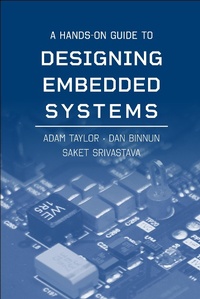
Hands-On Guide to Designing Embedded Systems
Published on 31. October 2021
286 pages
978-1-63081-684-1 (ISBN)
Description

This practical resource introduces readers to the design of field programmable gate array systems (FPGAs). Techniques and principles that can be applied by the engineer to understand challenges before starting a project are presented. The book provides a framework from which to work and approach development of embedded systems that will give readers a better understanding of the issues at hand and can develop solution which presents lower technical and programmatic risk and a faster time to market.Programmatic and system considerations are introduced, providing an overview of the engineering life cycle when developing an electronic solution from concept to completion. Hardware design architecture is discussed to help develop an architecture to meet the requirements placed upon it, and the trade-offs required to achieve the budget. The FPGA development lifecycle and the inputs and outputs from each stage, including design, test benches, synthesis, mapping, place and route and power estimation, are also presented. Finally, the importance of reliability, why it needs to be considered, the current standards that exist, and the impact of not considering this is explained. Written by experts in the field, this is the first book by "e;engineers in the trenches"e; that presents FPGA design on a practical level.
More details
Other editions
Additional editions
Adam Taylor | Dan Binnun | Saket Srivastava
A Hands-On Guide to Designing Embedded Systems
Book
10/2021
Artech House Publishers
€159.50
Shipment within 10-20 days
Content
- Intro
- A Hands-On Guide to Designing Embedded Systems
- Contents
- Acknowledgments
- Introduction
- CHAPTER 1 Programmatic and System-Level Considerations
- 1.1 Introduction: SensorsThink
- 1.2 Product Development Stages
- 1.3 Product Development Stages: Tailoring
- 1.4 Product Development: After Launch
- 1.5 Requirements
- 1.5.1 The V-Model
- 1.5.2 SensorsThink: Product Requirements
- 1.5.3 Creating Useful Requirements
- 1.5.4 Requirements: Finishing Up
- 1.6 Architectural Design
- 1.6.1 SEBOK: An Invaluable Resource
- 1.6.2 SensorsThink: Back to the Journey
- 1.6.3 Systems Engineering: An Overview
- 1.6.4 Architecting the System, Logically
- 1.6.5 Keep Things in Context (Diagrams)
- 1.6.6 Monitor Your Activity (Diagrams)
- 1.6.7 Know the Proper Sequence (Diagrams)
- 1.6.8 Architecting the System Physically
- 1.6.9 Physical Architecture: Playing with Blocks
- 1.6.10 Trace Your Steps
- 1.6.11 System Verification and Validation: Check Your Work
- 1.7 Engineering Budgets
- 1.7.1 Types of Budgets
- 1.7.2 Engineering Budgets: Some Examples
- 1.7.3 Engineering Budgets: Finishing Up
- 1.8 Interface Control Documents
- 1.8.1 Sticking Together: Signal Grouping
- 1.8.2 Playing with Legos: Connectorization
- 1.8.3 Talking Among Yourselves: Internal ICDs
- 1.9 Verification
- 1.9.1 Verifying Hardware
- 1.9.2 How Much Testing Is Enough?
- 1.9.3 Safely Navigating the World of Testing
- 1.9.4 A Deeper Dive into Derivation (of Test Cases)
- 1.10 Engineering Governance
- 1.10.1 Not Just Support for Design Reviews
- 1.10.2 Engineering Rule Sets
- 1.10.3 Compliance
- 1.10.4 Review Meetings
- References
- CHAPTER 2 Hardware Design Considerations
- 2.1 Component Selection
- 2.1.1 Key Component Identification for the SoC Platform
- 2.1.2 Key Component Selection Example: The SoC
- 2.1.3 Key Component Selection Example: Infrared Sensor
- 2.1.4 Key Component Selection: Finishing Up
- 2.2 Hardware Architecture
- 2.2.1 Hardware Architecture for the SoC Platform
- 2.2.2 Hardware Architecture: Interfaces
- 2.2.3 Hardware Architecture: Data Flows
- 2.2.4 Hardware Architecture: Finishing Up
- 2.3 Designing the System
- 2.3.1 What to Worry About
- 2.3.2 Power Supply Analysis, Architecture, and Simulation
- 2.3.3 Processor and FPGA Pinout Assignments
- 2.3.4 System Clocking Requirements
- 2.3.5 System Reset Requirements
- 2.3.6 System Programming Scheme
- 2.3.7 Summary
- 2.3.8 Example: Zynq Power Sequence Requirements
- 2.4 Decoupling your Components
- 2.4.1 Decoupling: By the Book
- 2.4.2 To Understand the Component, You Must Be the Component
- 2.4.3 Types of Decoupling
- 2.4.4 Example: Zynq-7000 Decoupling
- 2.4.5 Additional Thoughts: Specialized Decoupling
- 2.4.6 Additional Thoughts: Simulation
- 2.5 Connect with Your System
- 2.5.1 Contemplating Connectors
- 2.5.2 Example: System Communications
- 2.6 Extend the Life of the System: De-Rate
- 2.6.1 Why De-Rate?
- 2.6.2 What Can Be De-Rated?
- 2.6.3 Example: De-Rating the Zynq-7000
- 2.6.4 Additional Thoughts: Exceptions to the Rule
- 2.7 Test, Test, Test
- 2.7.1 Back to Basics: Pre-Power-On Checklist
- 2.7.2 Check for Signs of Life: Crawl Before Walking
- 2.7.3 Roll Up Your Sleeves and Get Ready to Run
- 2.7.4 Example: I2C Interface
- 2.7.5 Additional Thoughts
- 2.8 Integrity: Important for Electronics
- 2.8.1 Power Integrity
- 2.8.2 Signal Integrity
- 2.8.3 Digging Deeper into Power Integrity
- 2.8.4 Digging Deeper into Signal Integrity
- 2.8.5 Example: ULPI Pre-Layout Analysis
- 2.8.6 Suggested Additional Reading
- 2.9 PCB Layout: Not for the Faint of Heart
- 2.9.1 Floor Planning
- 2.9.2 Follow the Rats
- 2.9.3 Mechanical Constraints
- 2.9.4 Electrical Constraints
- 2.9.5 Stack-Up Design
- 2.9.6 Experience Matters
- References
- CHAPTER 3 FPGA Design Considerations
- 3.1 Introduction
- 3.2 FPGA Development Process
- 3.2.1 Introduction to the Target Device
- 3.2.2 FPGA Requirements
- 3.2.3 FPGA Architecture
- 3.3 Accelerating Design Using IP Libraries
- 3.4 Pin Planning and Constraints
- 3.4.1 Physical Constraints
- 3.4.2 Timing Constraints
- 3.4.3 Timing Exceptions
- 3.4.4 Physical Constraints: Placement
- 3.5 Clock Domain Crossing
- 3.6 Test Bench and Verification
- 3.6.1 What Is Verification?
- 3.6.2 Self-Checking Test Benches
- 3.6.3 Corner Cases, Boundary Conditions, and Stress Testing
- 3.6.4 Code Coverage
- 3.6.5 Test Functions and Procedures
- 3.6.6 Behavioral Models
- 3.6.7 Using Text IO Files
- 3.6.8 What Else Might We Consider?
- 3.7 Finite State Machine Design
- 3.7.1 Defining a State Machine
- 3.7.2 Algorithmic State Diagrams
- 3.7.3 Moore or Mealy: What Should I Choose?
- 3.7.4 Implementing the State Machine
- 3.7.5 State Machine Encoding
- 3.7.6 Increasing Performance of State Machines
- 3.7.7 Good Design Practices for FPGA Implementation
- 3.7.8 FLIR Lepton Interface
- 3.8 Defensive State Machine Design
- 3.8.1 Detection Schemes
- 3.8.2 Hamming Schemes
- 3.8.3 Deadlock and Other Issues
- 3.8.4 Implementing Defensive State Machines in Xilinx Devices
- 3.9 How Does FPGA Do Math?
- 3.9.1 Representation of Numbers
- 3.10 Fixed Point Mathematics
- 3.10.1 Fixed-Point Rules
- 3.10.2 Overflow
- 3.10.3 Real-World Implementation
- 3.10.4 RTL Implementation
- 3.11 Polynomial Approximation
- 3.11.1 The Challenge with Some Algorithms
- 3.11.2 Capitalize on FPGA Resources
- 3.11.3 Multiple Trend Lines Selected by Input Value
- 3.12 The CORDIC Algorithm
- 3.13 Convergence
- 3.14 Where Are These Used
- 3.15 Modeling in Excel
- 3.16 Implementing the CORDIC
- 3.17 Digital Filter Design and Implementation
- 3.17.1 Filter Types and Topologies
- 3.17.2 Frequency Response
- 3.17.3 Impulse Response
- 3.17.4 Step Response
- 3.17.5 Windowing the Filter
- 3.18 Fast Fourier Transforms
- 3.18.1 Time or Frequency Domain?
- 3.19 How Do We Get There?
- 3.19.1 Where Do We Use These?
- 3.19.2 FPGA-Based Implementation
- 3.19.3 Higher-Speed Sampling
- 3.20 Working with ADC and DAC
- 3.20.1 ADC and DAC Key Parameters
- 3.20.2 The Frequency Spectrum
- 3.20.3 Communication
- 3.20.4 DAC Filtering
- 3.20.5 In-System Test
- 3.21 High-Level Synthesis
- CHAPTER 4 When Reliability Counts
- 4.1 Introduction to Reliability
- 4.2 Mathematical Interpretation of System Reliability
- 4.2.1 The Bathtub Curve
- 4.2.2 Failure Rate (?)
- 4.2.3 Early Life Failure Rate
- 4.2.4 Key Terms
- 4.2.5 Repairable and Nonrepairable Systems
- 4.2.6 MTTF, MTBF, and MTTR
- 4.2.7 Maintainability
- 4.2.8 Availability
- 4.3 Calculating System Reliability
- 4.3.1 Scenario 1: All Critical Components Connected in Series
- 4.3.2 Scenario 2: All Critical Components Connected in Parallel
- 4.3.3 Scenario 3: All Critical Components Are Connected in Series-Parallel Configuration
- 4.4 Faults, Errors, and Failure
- 4.4.1 Classification of Faults
- 4.4.2 Fault Prevention Versus Fault Tolerance: Which One Can Address System Failure Better?
- 4.5 Fault Tolerance Techniques
- 4.5.1 Redundancy Technique for Hardware Fault Tolerance
- 4.5.2 Software Fault Tolerance
- 4.6 Worst-Case Circuit Analysis
- 4.6.1 Sources of Variation
- 4.6.2 Numerical Analysis Using SPICE Modeling
- Selected Bibliography
- About the Authors
- Index
