

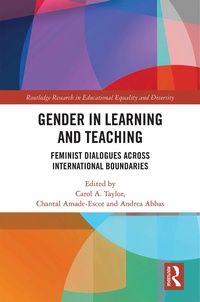
Gender in Learning and Teaching
Feminist Dialogues Across International Boundaries
Published on 30. April 2019
206 pages
978-1-351-06645-7 (ISBN)
Description

Gender in Learning and Teaching brings together leading gender and feminist scholars to provide a unique collection of international research into learning and teaching. Through dialogues across national traditions and boundaries, the authors provide new insights into the relations between feminist scholarship of pedagogy, gender and didactics, and offer in-depth accounts that critically investigate how gender relations are enacted, contested and analysed at the level of the classroom, the curriculum, and the institution.
Drawing on original research, the chapters explore gender dynamics in relation to student-teacher interactions, gendered classroom practices, curriculum content and knowledge formation in different subjects. The book includes accounts of innovative approaches to curriculum development to address gender inequality. It includes new theoretical frameworks and methodological approaches which provide fresh insights into gendered practices including intersectionality, new material feminism, epistemic gender positioning and cultural anthropology. The chapters span all education phases from early years to higher education.
This book makes a compelling case for the continuing relevance of feminist pedagogy and the urgent need for strategies to address gender inequalities in the classroom and beyond. It will be of great interest to academics and postgraduate students in the fields of theory, philosophy and feminist politics of learning and teaching; education and didactics; feminism and pedagogy; sociology and the arts.
Drawing on original research, the chapters explore gender dynamics in relation to student-teacher interactions, gendered classroom practices, curriculum content and knowledge formation in different subjects. The book includes accounts of innovative approaches to curriculum development to address gender inequality. It includes new theoretical frameworks and methodological approaches which provide fresh insights into gendered practices including intersectionality, new material feminism, epistemic gender positioning and cultural anthropology. The chapters span all education phases from early years to higher education.
This book makes a compelling case for the continuing relevance of feminist pedagogy and the urgent need for strategies to address gender inequalities in the classroom and beyond. It will be of great interest to academics and postgraduate students in the fields of theory, philosophy and feminist politics of learning and teaching; education and didactics; feminism and pedagogy; sociology and the arts.
Reviews / Votes
"Gender in Learning and Teaching presents an intriguing set of chapters that explore both the interstices between feminist theory, European didactics, and the Anglophone tradition in teaching and learning and the points of interference that challenge those of us from differing philosophical and research positions to a more nuanced appreciation of the complexities of these interactions. Coming from the "Anglophone" quarter, I appreciate the didactical fine grained exploration of how various disciplines are constructed and then reproduced or transformed in pedagogy and curriculum that is presented in many of the book's chapters. The debates across traditions, which materialize with the innovative use of paired dialogues, provide nuance for the main argument. At their best, they serve to problematize the arguments of the main chapter opening them up for further exploration. The chapters in this book served to highlight that when it comes to gender there is so much more that needs to be done within education especially in contexts involving vulnerable groups of learners."Catherine Milne, Professor of Science Education, New York University.
More details
Series
Language
English
Place of publication
London
United Kingdom
Publishing group
Taylor & Francis Ltd
Target group
College/higher education
Illustrations
6 Tables, black and white; 24 Halftones, black and white
File size
3,06 MB
ISBN-13
978-1-351-06645-7 (9781351066457)
Copyright in bibliographic data and cover images is held by Nielsen Book Services Limited or by the publishers or by their respective licensors: all rights reserved.
Schweitzer Classification
Other editions
Additional editions
Carol Taylor | Chantal Amade-Escot | Andrea Abbas
Gender in Learning and Teaching
Feminist Dialogues Across International Boundaries
Book
12/2020
1st Edition
Routledge
€51.98
Shipment within 15-20 days
Carol Taylor | Chantal Amade-Escot | Andrea Abbas
Gender in Learning and Teaching
Feminist Dialogues Across International Boundaries
Book
04/2019
1st Edition
Routledge
€212.20
Shipment within 10-20 days
Persons
Carol A. Taylor is Professor of Higher Education and Gender at the University of Bath, UK. Her research utilizes feminist, new materialist and posthumanist theories and methodologies to explore gendered inequalities, spatial practices, and staff and students' participation in a range of higher educational sites. Her latest co-edited book is Posthuman Research Practices in Education (with Christina Hughes) and she is a co-editor of the journal Gender and Education.
Chantal Amade-Escot is Professor of Educational Sciences at the University of Toulouse - Jean Jaures, France. Her research interests lie in the situated process of teaching and learning with a focus on gender, teacher and students' joint action, teachers' practical epistemology and the specificity of the content. She is also interested in the analytical power of the conceptual constructions developed by subject didactics research in classrooms. She is a co-editor of the French international journal Education & Didactics.
Andrea Abbas is Head of the Department of Education at the University of Bath, UK. Her research uses critical sociological theory to explore how gender and intersecting differences (age, class, disability, ethnicity) are challenged, perpetuated or transformed through educational practices and experiences. She co-leads the China Centre at the University of Bath. Her latest book is Quality in Undergraduate Education (with Monica McLean and Paul Ashwin).
Chantal Amade-Escot is Professor of Educational Sciences at the University of Toulouse - Jean Jaures, France. Her research interests lie in the situated process of teaching and learning with a focus on gender, teacher and students' joint action, teachers' practical epistemology and the specificity of the content. She is also interested in the analytical power of the conceptual constructions developed by subject didactics research in classrooms. She is a co-editor of the French international journal Education & Didactics.
Andrea Abbas is Head of the Department of Education at the University of Bath, UK. Her research uses critical sociological theory to explore how gender and intersecting differences (age, class, disability, ethnicity) are challenged, perpetuated or transformed through educational practices and experiences. She co-leads the China Centre at the University of Bath. Her latest book is Quality in Undergraduate Education (with Monica McLean and Paul Ashwin).
Content
Preface
Andrea Abbas, Carol A. Taylor and Chantal Amade-Escot
Acknowledgements
Chapter 1
Introduction: Debates Across Anglophone and European Didactic Traditions
Andrea Abbas, Carol A. Taylor and Chantal Amade-Escot
Chapter 2
The Gendered History of Bildung as Concept and Practice: A Speculative Feminist Analysis
Carol A. Taylor
Paired Dialogue: Notes on the Potential of a Feminist Bildung: A French Perspective?
Joel Lebeaume
Chapter 3
Epistemic Gender Positioning: An Analytical Concept to (Re)consider Classroom Practices within the French Didactique Research Tradition
Chantal Amade-Escot
Paired Dialogue: Subjects of Learning and Pedagogical Encounters
Susanne Gannon
Chapter 4
Queering Dissection: 'I Wanted to Bury its Heart, at Least'
Sara Tolbert
Paired Dialogue: Didactic Transposition of Scientific Knowledge in the Classroom
Florence Ligozat
Chapter 5
Gender, the Postmodern Paradigm Shift, and Pedagogical Anthropology
Anja Kraus
Paired Dialogue: Ways of Knowing: Bodies, Knowledge and Power
Carol Taylor
Chapter 6
Tackling Intersecting Gender Inequalities through Disciplinary Based Higher Education Curricula: A Bernsteinian Approach
Andrea Abbas
Paired Dialogue: Can a Bernsteinian Focus on Intersecting Gender Inequalities Support Curriculum and Disciplinary change?
Isabelle Collet
Chapter 7
An Historical Exploration of Gender Representations in French Scientific and Technological Education School Textbooks
Joel Lebeaume
Paired Dialogue: Gender Differentiation in Craft and Domestic Education: Contrasting National Approaches
Carrie Paechter
Chapter 8
Temporalities, Pedagogies and Gender-Based Violence Education in Australian Schools
Susanne Gannon
Paired Dialogue: Toward an Articulation of the Two Layers of Didactic Transposition
Chantal Amade-Escot
Chapter 9
Butterflies for Girls, Tornadoes for Boys: Primary School Science Teaching in France and Geneva
Isabelle Collet
Paired Dialogue: Pokemon, Dragons and Dinosaurs: A Narrative of Gender and Science In/Exclusions and Why Tackling Them Matters
Sara Tolbert
Chapter 10
Playing, Teaching and Caring: Generative Productions of Gender and Pedagogy In/Through Early Years Assemblages
Nikki Fairchild
Paired Dialogue: Humanities, Pedagogy and Didactics: The Tacit Dimensions of Early Childhood Education
Anja Kraus
Chapter 11
Students' Gendered Learning in Physical Education: A Didactic Study of a French Multi-Ethnic Middle School in an Underprivileged Area
Ingrid Verscheure and Claire Debars
Paired Dialogue: Sport, Physical Education and Gender: Analysing Complex Pedagogic Encounters
Andreas Abbas
Chapter 12
Beyond Binary Discourses: Making LGBTQI+ Identities Visible in the Curriculum
Carrie Paechter
Paired Dialogue: Why Some Bodies Matter More Than Other Bodies: A Posthumanist/ New Material Feminist Perspective
Nikki Fairchild
Chapter 13
In Conversation: Debating Gender and Feminism in Learning, Teaching and Didactics
Carol A. Taylor and Florence Ligozat
Andrea Abbas, Carol A. Taylor and Chantal Amade-Escot
Acknowledgements
Chapter 1
Introduction: Debates Across Anglophone and European Didactic Traditions
Andrea Abbas, Carol A. Taylor and Chantal Amade-Escot
Chapter 2
The Gendered History of Bildung as Concept and Practice: A Speculative Feminist Analysis
Carol A. Taylor
Paired Dialogue: Notes on the Potential of a Feminist Bildung: A French Perspective?
Joel Lebeaume
Chapter 3
Epistemic Gender Positioning: An Analytical Concept to (Re)consider Classroom Practices within the French Didactique Research Tradition
Chantal Amade-Escot
Paired Dialogue: Subjects of Learning and Pedagogical Encounters
Susanne Gannon
Chapter 4
Queering Dissection: 'I Wanted to Bury its Heart, at Least'
Sara Tolbert
Paired Dialogue: Didactic Transposition of Scientific Knowledge in the Classroom
Florence Ligozat
Chapter 5
Gender, the Postmodern Paradigm Shift, and Pedagogical Anthropology
Anja Kraus
Paired Dialogue: Ways of Knowing: Bodies, Knowledge and Power
Carol Taylor
Chapter 6
Tackling Intersecting Gender Inequalities through Disciplinary Based Higher Education Curricula: A Bernsteinian Approach
Andrea Abbas
Paired Dialogue: Can a Bernsteinian Focus on Intersecting Gender Inequalities Support Curriculum and Disciplinary change?
Isabelle Collet
Chapter 7
An Historical Exploration of Gender Representations in French Scientific and Technological Education School Textbooks
Joel Lebeaume
Paired Dialogue: Gender Differentiation in Craft and Domestic Education: Contrasting National Approaches
Carrie Paechter
Chapter 8
Temporalities, Pedagogies and Gender-Based Violence Education in Australian Schools
Susanne Gannon
Paired Dialogue: Toward an Articulation of the Two Layers of Didactic Transposition
Chantal Amade-Escot
Chapter 9
Butterflies for Girls, Tornadoes for Boys: Primary School Science Teaching in France and Geneva
Isabelle Collet
Paired Dialogue: Pokemon, Dragons and Dinosaurs: A Narrative of Gender and Science In/Exclusions and Why Tackling Them Matters
Sara Tolbert
Chapter 10
Playing, Teaching and Caring: Generative Productions of Gender and Pedagogy In/Through Early Years Assemblages
Nikki Fairchild
Paired Dialogue: Humanities, Pedagogy and Didactics: The Tacit Dimensions of Early Childhood Education
Anja Kraus
Chapter 11
Students' Gendered Learning in Physical Education: A Didactic Study of a French Multi-Ethnic Middle School in an Underprivileged Area
Ingrid Verscheure and Claire Debars
Paired Dialogue: Sport, Physical Education and Gender: Analysing Complex Pedagogic Encounters
Andreas Abbas
Chapter 12
Beyond Binary Discourses: Making LGBTQI+ Identities Visible in the Curriculum
Carrie Paechter
Paired Dialogue: Why Some Bodies Matter More Than Other Bodies: A Posthumanist/ New Material Feminist Perspective
Nikki Fairchild
Chapter 13
In Conversation: Debating Gender and Feminism in Learning, Teaching and Didactics
Carol A. Taylor and Florence Ligozat
