

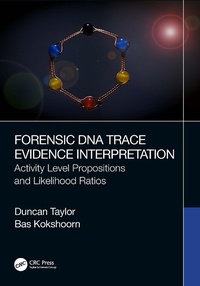
Forensic DNA Trace Evidence Interpretation
Activity Level Propositions and Likelihood Ratios
1st Edition
Published on 30. May 2023
582 pages
978-1-000-80138-5 (ISBN)
Description

Forensic DNA Trace Evidence Interpretation: Activity Level Propositions and Likelihood Ratios provides all foundational information required for a reader to understand the practice of evaluating forensic biology evidence given activity level propositions and to implement the practice into active casework within a forensic institution. The book begins by explaining basic concepts and foundational theory, pulling together research and studies that have accumulated in forensic journal literature over the last 20 years.
The book explains the laws of probability - showing how they can be used to derive, from first principles, the likelihood ratio - used throughout the book to express the strength of evidence for any evaluation. Concepts such as the hierarchy of propositions, the difference between experts working in an investigative or evaluative mode and the practice of case assessment and interpretation are explained to provide the reader with a broad grounding in the topics that are important to understanding evaluation of evidence. Activity level evaluations are discussed in relation to biological material transferred from one object to another, the ability for biological material to persist on an item for a period of time or through an event, the ability to recover the biological material from the object when sampled for forensic testing and the expectations of the prevalence of biological material on objects in our environment. These concepts of transfer, persistence, prevalence and recovery are discussed in detail in addition to the factors that affect each of them.
The authors go on to explain the evaluation process: how to structure case information and formulate propositions. This includes how a likelihood ratio formula can be derived to evaluate the forensic findings, introducing Bayesian networks and explaining what they represent and how they can be used in evaluations and showing how evaluation can be tested for robustness. Using these tools, the authors also demonstrate the ways that the methods used in activity level evaluations are applied to questions about body fluids. There are also chapters dedicated to reporting of results and implementation of activity level evaluation in a working forensic laboratory. Throughout the book, four cases are used as examples to demonstrate how to relate the theory to practice and detail how laboratories can integrate and implement activity level evaluation into their active casework.
The book explains the laws of probability - showing how they can be used to derive, from first principles, the likelihood ratio - used throughout the book to express the strength of evidence for any evaluation. Concepts such as the hierarchy of propositions, the difference between experts working in an investigative or evaluative mode and the practice of case assessment and interpretation are explained to provide the reader with a broad grounding in the topics that are important to understanding evaluation of evidence. Activity level evaluations are discussed in relation to biological material transferred from one object to another, the ability for biological material to persist on an item for a period of time or through an event, the ability to recover the biological material from the object when sampled for forensic testing and the expectations of the prevalence of biological material on objects in our environment. These concepts of transfer, persistence, prevalence and recovery are discussed in detail in addition to the factors that affect each of them.
The authors go on to explain the evaluation process: how to structure case information and formulate propositions. This includes how a likelihood ratio formula can be derived to evaluate the forensic findings, introducing Bayesian networks and explaining what they represent and how they can be used in evaluations and showing how evaluation can be tested for robustness. Using these tools, the authors also demonstrate the ways that the methods used in activity level evaluations are applied to questions about body fluids. There are also chapters dedicated to reporting of results and implementation of activity level evaluation in a working forensic laboratory. Throughout the book, four cases are used as examples to demonstrate how to relate the theory to practice and detail how laboratories can integrate and implement activity level evaluation into their active casework.
More details
Edition
1. Auflage
Language
English
Place of publication
London
United Kingdom
Publishing group
Taylor & Francis Ltd
Target group
Professional and scholarly
Illustrations
109 Tables, black and white; 110 Line drawings, color; 69 Line drawings, black and white; 13 Halftones, color; 3 Halftones, black and white; 123 Illustrations, color; 72 Illustrations, black and white
ISBN-13
978-1-000-80138-5 (9781000801385)
Copyright in bibliographic data and cover images is held by Nielsen Book Services Limited or by the publishers or by their respective licensors: all rights reserved.
Schweitzer Classification
Other editions
Additional editions
Duncan Taylor | Bas Kokshoorn
Forensic DNA Trace Evidence Interpretation
Activity Level Propositions and Likelihood Ratios
Book
05/2023
1st Edition
CRC Press
€215.77
Shipment within 10-20 days
Duncan Taylor | Bas Kokshoorn
Forensic DNA Trace Evidence Interpretation
Activity Level Propositions and Likelihood Ratios
Book
05/2023
1st Edition
CRC Press
€100.50
Shipment within 10-20 days
Persons
Duncan Taylor is the Chief Scientist of Forensic Statistics at Forensic Science South Australia (FSSA), Adelaide, Australia. He has studied and worked in the forensic field for over 20 years, supervising criminal casework in hundreds of cases for both prosecution and defence, and testifying in Courts around Australia. He holds PhDs in molecular biology and statistics, both obtained from Flinders University. Dr Taylor is one of the developers of STRmix (TM), a probabilistic DNA interpretation software being used in forensic DNA laboratories around the world and a developer of the neural network component of FaSTR (TM), a DNA profile reading software. He is an Associate Professor of biology and Distinguished Alumni at Flinders University, supervising honours, masters and PhD students in biology and statistics projects. Duncan collaborates with colleagues around the world and has over 120 peer-reviewed publications, and a book on DNA evidence interpretation. In 2017 Duncan was awarded the SA Science Excellence STEM professional award and in 2018 was part of the group that won the New Zealand Prime Minister's Science Award. In 2021 Duncan was awarded the Public Service Medal for contributions to forensic statistics.
Bas Kokshoorn is a principal scientist at the Netherlands Forensic Institute (NFI) in The Hague (The International City of Peace and Justice). Bas started his career at the NFI in 2008 and since then has submitted over 1,000 reports on forensic biology examinations and interpretations to the Dutch criminal justice system, as well as to international tribunals, and other jurisdictions in continental Europe, the UK, and Australia. Bas holds a PhD in evolutionary biology from Leiden University and is currently appointed professor in 'Forensic Trace Dynamics' at the Amsterdam University of Applied Sciences (AUAS). In this role he supervises bachelor, masters and PhD students working on research projects aimed at understanding the dynamics of transfer, persistence, prevalence, and recovery of biological and other types of trace evidence and the interpretation of such findings in criminal cases.
Bas Kokshoorn is a principal scientist at the Netherlands Forensic Institute (NFI) in The Hague (The International City of Peace and Justice). Bas started his career at the NFI in 2008 and since then has submitted over 1,000 reports on forensic biology examinations and interpretations to the Dutch criminal justice system, as well as to international tribunals, and other jurisdictions in continental Europe, the UK, and Australia. Bas holds a PhD in evolutionary biology from Leiden University and is currently appointed professor in 'Forensic Trace Dynamics' at the Amsterdam University of Applied Sciences (AUAS). In this role he supervises bachelor, masters and PhD students working on research projects aimed at understanding the dynamics of transfer, persistence, prevalence, and recovery of biological and other types of trace evidence and the interpretation of such findings in criminal cases.
Content
1. Principles of Evaluation 2. Evaluation of Observations Given Activity Level Propositions 3. Transfer, Persistence, Prevalence, and Recovery of Biological Traces 4. Structuring Case Information 5. Basic Mechanisms of Evaluation 6. Fundamentals of Bayesian Networks 7. Advanced Mechanisms of Evaluation 8. Testing Robustness of Evaluation 9. Cell Type Testing 10. Reporting 11. Implementation 12. Beyond Forensic Biology 13. Looking to the Future 14. Answers to Practice Questions
