

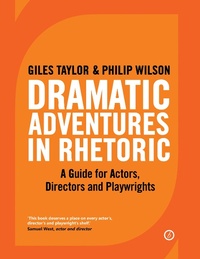
Dramatic Adventures in Rhetoric
A Guide for Actors, Directors and Playwrights
1st Edition
Published on 4. November 2015
240 pages
978-1-78319-817-7 (ISBN)
Description

A practical, accessible and thorough guide to identifying and using rhetorical devices in drama, using examples from both classical and contemporary plays. An unprecedented reference and handbook for actors, directors, playwrights and teachers; written by practitioners for practitioners.
Little has been written about how dramatists draw on rhetorical devices, and how a study of these can unlock a text for a performer or director, or indeed inspire contemporary playwrights. This book addresses in detail - yet in straightforward terms - the many different rhetorical forms used in drama, and enables the reader to identify and analyse them.
Dramatic Adventures in Rhetoric may be read cover to cover, or it may be dipped into; it is both an analytic tool and a reference aid for use in the classroom or rehearsal room, revealing how careful study of language is one of the best ways of accessing the richness of texts both classical and contemporary.
Little has been written about how dramatists draw on rhetorical devices, and how a study of these can unlock a text for a performer or director, or indeed inspire contemporary playwrights. This book addresses in detail - yet in straightforward terms - the many different rhetorical forms used in drama, and enables the reader to identify and analyse them.
Dramatic Adventures in Rhetoric may be read cover to cover, or it may be dipped into; it is both an analytic tool and a reference aid for use in the classroom or rehearsal room, revealing how careful study of language is one of the best ways of accessing the richness of texts both classical and contemporary.
Reviews / Votes
This book deserves a place on every actor's, director's and playwright's shelfMore details
Series
Edition
1. Auflage
Language
English
Place of publication
London
United Kingdom
Publishing group
Bloomsbury Publishing PLC
ISBN-13
978-1-78319-817-7 (9781783198177)
Copyright in bibliographic data and cover images is held by Nielsen Book Services Limited or by the publishers or by their respective licensors: all rights reserved.
Schweitzer Classification
Other editions
Additional editions
Giles Taylor | Philip Wilson
Dramatic Adventures in Rhetoric
A Guide for Actors, Directors and Playwrights
Book
10/2015
Oberon Books Ltd
€44.75
Shipment within 3-4 weeks
Persons
Giles Taylor is an actor who has appeared at the National Theatre, Royal Shakespeare Company and at numerous regional theatres, as well as on television. He is also a Shakespeare Consultant, working on productions across the country and running workshops for both actors and directors. Giles has a degree in Classics from Bristol University.
Philip Wilson is a director who has worked at theatres including Birmingham Rep, the Bush, Chichester Minerva, Liverpool Playhouse, Sheffield Crucible and the Traverse. He was the Artistic Director of Salisbury Playhouse (2007-11), and has adapted Philip Pullman's Grimm Tales and JL Carr's A Month in the Country.
Philip Wilson is a director who has worked at theatres including Birmingham Rep, the Bush, Chichester Minerva, Liverpool Playhouse, Sheffield Crucible and the Traverse. He was the Artistic Director of Salisbury Playhouse (2007-11), and has adapted Philip Pullman's Grimm Tales and JL Carr's A Month in the Country.
Content
- Cover
- Title page
- Copyright
- Thanks
- Contents
- Introduction
- Chapter 1 A Brief History of Rhetoric
- The Origins of Classical Rhetoric
- Ancient Greece: The Sophists
- Ancient Greece: Socrates and Plato
- Classical Rome: Cicero and Quintilian
- The Six Steps of an Argument
- The Five Canons of Rhetoric
- From the Classical Era to Medieval Times: 5th to 15th Century
- The Renaissance
- The Restoration, the Victorians and Beyond
- Chapter 2 Sound
- The Alliterative Family
- The Assonant Family
- Combined Sounds
- Sound Effects
- Chapter 3 Imagery
- Through Comparison
- Through Example
- Through Description
- Through Qualification
- Through Economy
- Through Substitution
- Chapter 4 Wit
- Play on Words
- Sparring
- Sayings
- Irony
- Deflation
- Belittlement
- Paradox
- Cleverness
- Ignorance
- Evasion
- Affectation
- Chapter 5 Debate
- Reasoning
- Balance
- Defence
- Attack
- Correction
- Questioning
- Coercion
- Summary
- Praise
- Chapter 6 Structure
- Antithesis
- Qualification
- Insertion
- Length of Phrase
- Brevity
- Excess
- Verbosity
- Chapter 7 The Rule of Three
- The Tricolonic Family
- Tricolonic Interbreeding
- With SOUND
- With IMAGERY
- With WIT
- With DEBATE
- With STRUCTURE
- With REPETITION
- Chapter 8 Repetition
- Simple
- Clever
- Emphatic
- Structural
- Glossary of Rhetorical Devices
- Index of Playwrights and Plays Quoted
- Appendix Further Reading
- Acknowledgements
