

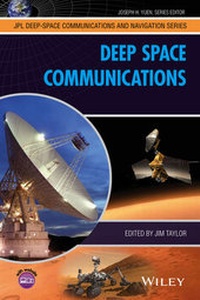
Deep Space Communications
Description

More details
Other editions
Additional editions
Person
Content
Foreword xv Preface xvii
Acknowledgments xix
Contributors xxiii
Chapter 1 Deep Space Communications: An Introduction 1 by Joseph H. Yuen
1.1 Introduction and Overview 1
1.2 Telecommunications Link Analysis 4
1.2.1 Received Power 4
1.2.2 Noise Spectral Density 5
1.2.3 Carrier Performance Margin 6
1.2.4 Telemetry and Command Performance Margins 6
1.2.5 Ranging Performance Margin 7
1.3 Communications Design Control 8
1.3.1 Design Control Tables 8
1.3.2 Design Procedure and Performance Criterion Selection 9
References 12
Chapter 2 The Deep Space Network: A Functional Description 15 by Jim Taylor
2.1 Uplink and Downlink Carrier Operation 17
2.1.1 The 34-m BWG Stations 17
2.1.2 The 70-m (DSS-14 and DSS-43) Stations 19
2.2 Radiometric Data (Doppler and Ranging) 21
2.3 Delta Differential One-Way Ranging 24
2.4 Command Processing and Radiation 25
2.5 Telemetry Demodulation and Decoding 28
2.6 DSN Performance 31
2.6.1 Antenna Gain 32
2.6.2 Transmitter Power 33
2.6.3 System Noise Temperature 33
2.6.4 Thresholds and Limits 33
References 35
Chapter 3 Voyager Telecommunications 37 by Roger Ludwig and Jim Taylor
3.1 Voyager Interstellar Mission Description 37
3.2 Overview of Telecom Functional Capabilities 44
3.2.1 Uplink 46
3.2.2 Downlink 47
3.3 Spacecraft Telecom System Design 48
3.3.1 Spacecraft Telecom System Overview 48
3.3.2 Modulation Demodulation Subsystem 51
3.3.3 Radio Frequency Subsystem 52
3.3.4 S/X-Band Antenna Subsystem 54
3.3.5 Telecom System Input Power and Mass 55
3.4 Telecom Ground System Description 56
3.4.1 Uplink and Downlink Carrier Operation 57
3.4.2 Command Processing 59
3.4.3 Telemetry Processing 59
3.5 Sample Telecom System Performance 60
3.5.1 Design Control Tables 61
3.5.2 Long-Term Planning Predicts 61
3.6 New Spacecraft and Ground Telecom Technology 64
3.6.1 Spacecraft and Telecom Link Design Compared with Previous Missions 64
3.6.2 Spacecraft Improvements for Uranus and Neptune Encounters 64
3.6.3 Ground System Performance Improvements 65
3.6.4 Ground Display and Operability Improvements 68
3.7 Operational Scenarios of the Voyager Interstellar Mission 69
3.7.1 Tracking Coverage 69
3.7.2 RFS Strategies 70
3.7.3 Spacecraft Fault Protection 72
References 74
Additional Resources 76
Chapter 4 Galileo Telecommunications 79 by Jim Taylor, Kar-Ming Cheung, and Dongae Seo
4.1 Mission and Spacecraft Description 79
4.1.1 The Mission 79
4.1.2 The Spacecraft 82
4.2 Galileo Spacecraft Telecommunications System 86
4.2.1 Galileo Telecommunications Functions and Modes 87
4.2.2 Radio Frequency Subsystem 89
4.2.3 Modulation Demodulation Subsystem 90
4.2.4 S-/X-Band Antenna Subsystem 92
4.2.5 X- to S-Band Downconverter 93
4.2.6 Telecom Hardware Performance during Flight 93
4.2.7 Orbiter Input Power and Mass Summary 96
4.3 Galileo S-Band Mission 98
4.3.1 Overview 98
4.3.2 Ground System Improvements for Galileo S-Band Mission 101
4.3.3 Data Compression 103
4.3.4 Galileo Encoding and Feedback Concatenated Decoding 106
4.4 Telecom Link Performance 110
4.4.1 Design Control Tables 111
4.4.2 Long-Term Planning Predicts 112
4.5 Telecom Operational Scenarios 115
4.5.1 Planned and Actual DSN Coverage 115
4.5.2 Launch Phase 115
4.5.3 Cruise Phase 116
4.5.4 HGA Deployment Attempts 118
4.5.5 Probe Separation, Jupiter Cruise, and Jupiter Orbit Insertion 120
4.5.6 Orbital Operational Phase 121
4.5.7 Solar Conjunction 123
4.5.8 Galileo Europa Mission and Galileo Millennium Mission 125
4.6 Probe-to-Orbiter Relay-Link Design 125
4.6.1 Overview 125
4.6.2 Link Requirements and Design 126
4.6.3 Summary of Achieved Relay-Link Performance 128
4.7 Lessons Learned 129
References 131
Chapter 5 Deep Space 1 135 by Jim Taylor, Michela Muñoz Fernández, Ana I. Bolea-Alamañac, and Kar-Ming Cheung
5.1 Mission and Spacecraft Description 136
5.1.1 Technology Validation 136
5.1.2 Mission Overview 137
5.1.3 Telecom Subsystem Overview 138
5.2 Telecom Subsystem Requirements 139
5.3 Telecom System Description 140
5.4 DS1 Telecom Technology 144
5.4.1 Small Deep Space Transponder (SDST) 144
5.4.2 Ka-Band Solid-State Power Amplifier (KaPA) 147
5.4.3 Beacon Monitor Operations Experiment (BMOX) 149
5.4.4 Telecom System Mass and Input Power 153
5.5 Telecom Ground System Description 153
5.5.1 Uplink and Downlink Carrier Operation 154
5.5.2 Radiometric Data (Doppler and Ranging) 154
5.5.3 Command Processing and Radiation 157
5.5.4 Telemetry Demodulation, Decoding, Synchronization, and Display 158
5.6 Telecom Link Performance 161
5.7 Operational Scenarios 173
5.7.1 Launch 173
5.7.2 Safing 174
5.7.3 Anchor Pass (at HGA Earth Point, High Rate) 174
5.7.4 Midweek Pass (at Thrust Attitude for IPS Operation) 175
5.7.5 High-Gain-Antenna Activity (January-June 2000, March 2001) 176
5.7.6 Solar Conjunction 181
5.7.7 Ka-Band Downlink 183
5.8 Lessons Learned 183
5.8.1 Telecom-Related Lessons Learned 183
5.8.2 Project-Level Lessons Learned 188
References 190
Additional Resources 192
Chapter 6 Mars Reconnaissance Orbiter 193 by Jim Taylor, Dennis K. Lee, and Shervin Shambayati
6.1 Mission Overview 193
6.2 Mission Phases and Orbit Summary 194
6.2.1 Mission Objectives 194
6.2.2 The MRO Spacecraft 195
6.2.3 Mission Phases 196
6.2.4 The MRO Orbit and Its Relay Coverage for Surface Vehicles 204
6.2.5 MRO Orbit Phasing to Support Landing Vehicle EDL 206
6.3 Telecommunications Subsystem Overview 207
6.3.1 X-Band: Cruise and Orbital Operations 207
6.3.2 UHF: Proximity Relay Communications 219
6.3.3 Ka-Band: Operational Demonstration 227
6.4 Ground Data System 227
6.4.1 Deep Space Network 227
6.4.2 Ka-Band Demonstration Requirements 228
6.4.3 Ground Data Network Flow for Relay Data through Electra 229
6.5 X-Band Telecom Operations 231
6.5.1 Cruise Calibrations 231
6.5.2 MOI Telecom Configurations 231
6.5.3 Aerobraking Telecom Configurations 232
6.5.4 Downlink Telemetry Modulation and Coding 233
6.5.5 Coordinating MRO and MER X-Band Operations 236
6.6 Ka-Band Cruise Verification 240
6.6.1 Ka-Band Operations Overview 240
6.6.2 Ka-Band Link Prediction and Performance during Cruise 240
6.6.3 Ka-Band Communications Demonstration Plans 242
6.6.4 Spacecraft X-Band and Ka-Band Constraints and Operational Factors 243
6.6.5 Delta-DOR X-Band and Ka-Band Operations and Performance 244
6.6.6 Planned Solar Conjunction Experiments 245
6.7 Lessons Learned 246
6.7.1 X-Band 246
6.7.2 Ka-Band 247
6.7.3 UHF 248
References 248
Chapter 7 Mars Exploration Rover Telecommunications 251 by Jim Taylor, Andre Makovsky, Andrea Barbieri, Ramona Tung, Polly Estabrook, and A. Gail Thomas
7.1 Mission and Spacecraft Summary 252
7.1.1 Mission Objectives 252
7.1.2 Mission Description 253
7.1.3 The Spacecraft 255
7.2 Telecommunications Subsystem Overview 261
7.2.1 X-Band: Cruise, EDL, Surface 261
7.2.2 UHF: EDL, Surface 262
7.2.3 Direct-to-Earth Downlink Capability 263
7.2.4 UHF Relay Capability 263
7.3 Telecom Subsystem Hardware and Software 267
7.3.1 X-Band Flight Subsystem Description 267
7.3.2 UHF 280
7.3.3 MER Telecom Hardware Mass and Power Summary 285
7.4 Ground Systems 285
7.4.1 Deep Space Network 285
7.4.2 Entry, Descent, and Landing Communications 291
7.4.3 Relay Data Flow 296
7.5 Telecom Subsystem and Link Performance 299
7.5.1 X-Band: Cruise, EDL, and Surface 299
7.5.2 UHF: EDL and Primary Mission Surface Operations 322
7.6 Lessons Learned 336
7.6.1 What Could Serve as a Model for the Future 337
7.6.2 What Could Be Improved 344
7.7 Beyond the Extended Mission 355
7.7.1 Spirit 355
7.7.2 Opportunity 356
References 356
Chapter 8 Mars Science Laboratory 359 by Andre Makovsky, Peter Ilott, and Jim Taylor
8.1 Mars Science Laboratory Mission and Spacecraft
Summary 359
8.1.1 Mission Description 362
8.1.2 Launch/Arrival Period Selection 364
8.1.3 Launch Phase and Initial Acquisition 370
8.1.4 Cruise Phase 381
8.1.5 Approach Phase 384
8.1.6 EDL Phase 385
8.1.7 Flight System Description 400
8.2 Telecom Subsystem Overview 407
8.2.1 Telecom for Launch, Cruise, and into EDL 412
8.2.2 Surface Operations 413
8.2.3 X-Band Flight Subsystem Description 415
8.2.4 UHF Flight Subsystem Description 441
8.2.5 Terminal Descent Sensor (Landing Radar) Description 454
8.2.6 MSL Telecom Hardware Mass and Power Summary 457
8.3 Ground Systems EDL Operations: EDL Data Analysis (EDA) 459
8.4 Telecom Subsystem Link Performance 460
8.4.1 X-Band 460
8.4.2 UHF 474
8.5 Surface Operations (Plans) 481
8.5.1 Mission Operations System Approach 481
8.5.2 Initial Surface Ground Operations 482
8.5.3 Tactical Operations after First 90 Sols 484
8.5.4 UHF Telecom Constraints 484
8.6 Surface Operations (Characterized in Flight) 488
8.6.1 Mitigating the Effects of Electromagnetic Interference 489
8.6.2 Data Volume Achieved with MRO and Odyssey Links 489
8.6.3 Relay Link Models 491
References 494
Acronyms and Abbreviations 499
About the Companion Website 523
Index 525
Acknowledgments
This book presents results of research carried out at the Jet Propulsion Laboratory, California Institute of Technology, under a contract with the National Aeronautics and Space Administration.
As editor and authors, we acknowledge the constant advice, help, comments, and encouragement from Joseph H. Yuen, the editor-in-chief of the Deep Space Communications and Navigations Systems (DESCANSO) series. David J. Bell's thorough review resulted in much improved clarity and completeness of the spacecraft chapters. In addition, they acknowledge the always helpful inputs and advice of Roger V. Carlson, the JPL editor.
Chapter 1, Telecommunications Link Analysis, lays out the principles and the statistical mathematical models for the design control table, or "link budget" in much the original form created by its author Joseph H. Yuen in the 1970s. We have retained this form in sections of Chapter 1 basically unchanged from the version as written by Dr. Yuen in the 1982 edition of Deep Space Telecommunications Systems Engineering.
Chapter 2, the Deep Space Network, draws extensively from the Deep Space Network (DSN) Telecommunications Link Design Handbook (810-005) as do sections of the other chapters. As the DSN evolved, many people have created and updated the material in the modules of this handbook. For this chapter we are most indebted to Robert Sniffin, the principal author and editor of the handbook for many decades. Some of the modules in 810-005 carry the names of the principal authors of those modules. In addition, numerous individuals, far too many to name, have contributed to the technology that is documented in their papers in the Interplanetary Network (IPN) Progress Reports. This technology has gone into the stations and the control centers, the hardware and software development, the thorough testing involved for each new system or software update, and the continued operation of the network in support of the missions represented in the following chapters.
Each of the remaining chapters describes the telecommunications system aboard a particular spacecraft. Each such subsystem operates in one to three frequency bands and consists generally of multiple antennas and their routing elements, one or more transponders or individual receivers and transmitters, and the command-receiving and telemetry-generating elements. Each subsystem involved the efforts and time of dozens of individuals or teams that developed the technologies, the functional design, the hardware, and the software. Many others performed the integration of the subsystem into the whole spacecraft and the testing before and after integration. The references in each chapter are those project documents, papers, conference proceedings, and websites that the coauthors and editor of this book drew on directly.
In Chapter 3, Voyager, much of the telecom design information was obtained from original Voyager prime mission design documentation: the design control document for the telecommunications links, the functional description of the telecommunications system, and the hardware design requirement for the modulation demodulation subsystem. Much of the mission and operational information was obtained from the Voyager Operational Handbook and the Voyager Neptune Travel Guide. The authors are grateful to Dave Bell, Kar-Ming Cheung, and Ed Massey for their Voyager background and development information.
For Chapter 4, Galileo, the authors express their appreciation to many individuals in the Interplanetary Network Directorate and the Telecommunications Science and Engineering Division (33) at JPL and other organizations who contributed directly to the success of the Galileo mission. In addition to the papers cited in the references, Richard Brace, Vic Albrecht, Rick Nybakken, and Gordon Wood, as the spacecraft telecom hardware cognizant engineers, oversaw the development and testing of the transponder, the modulation-demodulation subsystem, the antennas, and the ultra-stable oscillator. Prof. Wai-Kuen Cham of the Chinese University of Hong Kong invented the integer cosine transform (ICT) and helped to refine the ICT algorithm that was used as a form of lossy compression mostly for image data after the high-gain antenna (HGA) failed to deploy. The compression reduced the data volume to fit through the smaller bandwidth provided by the low-gain antenna link to Earth. Dr. Andrew Watson and Sherry Chuang at NASA Ames designed the ICT quantization matrix and performed subject tests with Galileo scientists to determine acceptable fidelity with ICT lossy compression. The authors are especially grateful to Eilene Theilig for her project systems perspective and to Steve Townes for his organizational recommendations that carried over to subsequent chapters.
For Chapter 5, Deep Space 1, the on-board telecom hardware development and testing was overseen by cognizant engineer Sam Valas and the antennas by Joe Vacchione. DS1 carried the first Small Deep Space Transponder, developed by Motorola with Keith Siemsen as the technical lead. Marc Rayman, as DS1 system engineer, added much to the clarity of the DESCANSO article the chapter is based on, as well as the success of the mission. The DS1 software team led by Dan Eldred helped the AutoNav team as it ventured for the first time into the realm of deep-space flight software. Finally, and perhaps most importantly, thanks go to the attitude control system (ACS) team, led by Sima Lisman, and including Tony Vanelli and Steve Collins. Besides their function of keeping the spacecraft pointed correctly, ACS was key to working with Jim Taylor of telecom to develop the HGA pointing workaround after the in-flight failure of the stellar reference unit.
For Chapter 6, Mars Reconnaissance Orbiter (MRO), as well as for the two Mars rover missions (Mars Exploration Rover [MER] and Mars Science Laboratory [MSL]) that conclude the book, Chad Edwards was the Mars Program office sponsor, and Edgar Satorius was the relay link signal processing lead. Key to the technical and managerial success of the Electra relay radio program development was Tom Jedrey. Eric Schwartzbaum was the Electra program manager, Ann Devereaux was responsible for the baseband processor, Ken Peters was responsible for software, and Todd Ely was responsible for radiometrics. The Electra first flew in the MRO and first operated on the surface in MSL. As MRO telecom lead, Stan Butman provided several suggestions and graphics for the chapter. Ricardo Mendoza conceived and developed the data volume capability file that is fundamental for science data return planning for all the Mars relay missions and inter-project coordination. The authors are grateful to David Bell, Tom Jedrey, and Ramona Tung for the information they contributed to the descriptions of the Electra transceiver and its use in relaying information with landers on the surface. We thank Charles Lee for the surface communications opportunities simulation, James Border for the information on delta differential one-way ranging (delta-DOR), and David Morabito for the discussion of solar conjunction effects on communications and the experiment plans during the MRO solar conjunctions.
For Chapter 7, Mars Exploration Rover, the authors express their appreciation to Brian Cook and Peter Ilott for the wealth of information on the heritage, performance, and testing of the X-band and UHF subsystems, respectively. Thanks also to Bill Adams, the Odyssey and MGS Flight Team Telecom lead at Lockheed Martin Aerospace. We also, thank Jan Ludwinski, whose excellent mission plan became an integral part of this chapter. The authors are grateful to Monika Danos, for scripts that made summaries of data from years of MER prime and extended mission flight operations consistent. Ramona Tung and Ricardo Mendoza were key to developing seamless relay link prediction capabilities involving the geometric intricacies of a roving surface vehicle working with several relay orbiters. Finally, the authors are indebted to Ed Satorius, Sue Finley, Christine Chang, Doug Johnston, Dave Fort, and Sami Asmar for their contributions to the analysis, development, testing, and operation of the Entry, Descent, and Landing (EDL) Data Analysis (EDA) system that enabled the return of the intricate series of signals with their rapidly varying signal levels and frequencies.
For Chapter 8, Mars Science Laboratory, the authors appreciate the access to information and documents provided by members of the MSL spacecraft development, test and flight operations teams. Many of those acknowledged for MRO and MER also participated in MSL. Peter Ilott was the telecom cognizant engineer and provided "better art" for many of the graphics in this chapter. Melissa Soriano, Sue Finley, and Polly Estabrook developed the EDA configuration to receive the X-band signal during EDL. Melissa Soriano, Sue Finley, Kamal Oudrhiri, and Daniel Kahan tested and operated the EDA and Radio Science Receiver during EDL. Mazen Shihabi and David Bell adapted telemetry analysis tools, first developed by Brad Arnold and Tom Jedrey, to rapidly process analyses of relay link performance the first month post-landing. This led to the successful "tuning" of the MRO Electra radio to overcome electromagnetic interference from MRO science instruments that degraded the MSL relay link performance. The new adaptive data rate mode, first used on the MSL/MRO return link was also tuned to maximize data return volume. Much of the information on spacecraft configuration, the...
