

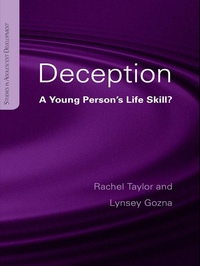
Deception
A Young Person's Life Skill?
1st Edition
Published on 1. December 2010
192 pages
978-1-136-84518-5 (ISBN)
Description

This book considers the role of deception during adolescence, and explores the factors which underpin adolescents' choice to deceive, whether these deceptions will be successful, and the ways in which such lies could be detected. While deception is considered to be antisocial or even pathological in some circumstances, the central argument of this book is that lying can be a skilled behaviour which is necessary to allow adolescents to establish autonomy.
Deception builds on the recent influential developmental challenge model (Hendry and Kloep, 2002, 2009), exploring how it can provide a useful explanatory framework for the development of the skill of deception in adolescence. Interpersonal and forensic settings for deceptive behaviour are referred to, and illustrated with reference to both published research and new data obtained from a variety of different interviews and focus groups with young people. It also considers how the choice to communicate truthfully is as important as the choice to communicate deceptively in illuminating the developmental process. It concludes with a discussion of how adolescents' deceptions could be detected and presents a range of strategies to maximize the effectiveness of interpersonal interactions with suspected deceivers.
By considering everyday, forensic and clinical deception situations, this book is ideal for academic researchers, practitioners working with children and young people, as well as parents. The observations, interviews and focus groups provide a unique insight into the factors influencing young people's communication choices, and integrate research from developmental, social and forensic psychology.
Deception builds on the recent influential developmental challenge model (Hendry and Kloep, 2002, 2009), exploring how it can provide a useful explanatory framework for the development of the skill of deception in adolescence. Interpersonal and forensic settings for deceptive behaviour are referred to, and illustrated with reference to both published research and new data obtained from a variety of different interviews and focus groups with young people. It also considers how the choice to communicate truthfully is as important as the choice to communicate deceptively in illuminating the developmental process. It concludes with a discussion of how adolescents' deceptions could be detected and presents a range of strategies to maximize the effectiveness of interpersonal interactions with suspected deceivers.
By considering everyday, forensic and clinical deception situations, this book is ideal for academic researchers, practitioners working with children and young people, as well as parents. The observations, interviews and focus groups provide a unique insight into the factors influencing young people's communication choices, and integrate research from developmental, social and forensic psychology.
Reviews / Votes
"This book accessibly describes the theory and evidence related to strategic deception and its detection in adolescence. The developmental issues covered give it cross-disciplinary appeal, and pointers on deception detection are invaluable to practitioners in forensic and educational psychology, and insightful for students of psychology and the behavioural sciences." - Bere Mahoney, Senior Lecturer in Psychological Sciences, University of Worcester UK"This groundbreaking book positions deceptive communication as a developmental life skill. Moving beyond simple understandings and utilizing a systems approach, the authors consider deception as embedded within social contexts. It will be required reading for practitioners, researchers and students to understand adolescent deceptive behaviour in both clinical and non-clinical contexts." - Angie Williams, Senior Lecturer, Centre for Language and Communication Research, Cardiff University UK "This book accessibly describes the theory and evidence related to strategic deception and its detection in adolescence. The developmental issues covered give it cross-disciplinary appeal, and pointers on deception detection are invaluable to practitioners in forensic and educational psychology, and insightful for students of psychology and the behavioural sciences." - Bere Mahoney, Senior Lecturer in Psychological Sciences, University of Worcester UK
"This groundbreaking book positions deceptive communication as a developmental life skill. Moving beyond simple understandings and utilizing a systems approach, the authors consider deception as embedded within social contexts. It will be required reading for practitioners, researchers and students to understand adolescent deceptive behaviour in both clinical and non-clinical contexts." - Angie Williams, Centre for Language and Communication Research, Cardiff University UK
More details
Series
Edition
1. Auflage
Language
English
Place of publication
London
United Kingdom
Publishing group
Taylor & Francis Ltd
Target group
College/higher education
Product notice
Reflowable
Illustrations
1 s/w Abbildung, 4 s/w Tabellen
4 Tables, black and white; 1 Illustrations, black and white
File size
0,70 MB
ISBN-13
978-1-136-84518-5 (9781136845185)
Copyright in bibliographic data and cover images is held by Nielsen Book Services Limited or by the publishers or by their respective licensors: all rights reserved.
Schweitzer Classification
Other editions
Additional editions

Book
11/2010
1st Edition
Psychology Press Ltd
€215.41
Shipment within 3-4 weeks
Book
Psychology Press
Unfortunately, price unknown
The article will not be published
Persons
Rachel Taylor is a Senior Lecturer in Social Psychology at University of Glamorgan with a strong background in deception research, and has presented and published internationally on a range of factors influencing deceptive communication.
Lynsey Gozna is a Senior Lecturer in Forensic Psychology at University of Lincoln, with research interests focusing on interviewing in pre and post-conviction forensic and mental health settings.
Lynsey Gozna is a Senior Lecturer in Forensic Psychology at University of Lincoln, with research interests focusing on interviewing in pre and post-conviction forensic and mental health settings.
Content
1. The Development of Deceptive Communication 2. Factors Influencing Adolescent Communication 3. Deceptive Interactions and Communications 4. Strategies and Tactics in Interpersonal Interaction 5. Challenges of Conduct and Personality 6. Techniques in Detecting Deceit 7. Conclusions, Thoughts and Future Directions
