

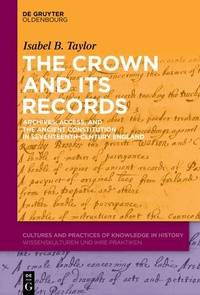
The Crown and Its Records
Archives, Access, and the Ancient Constitution in Seventeenth-Century England
1st Edition
Published on 24. October 2023
XI, 479 pages
978-3-11-079146-4 (ISBN)
Description

No detailed description available for "The Crown and Its Records".
Reviews / Votes
Taylor's work offers a meticulous exploration of the English archives' role in shaping constitutional debates during a century of political turmoil. Taylor demonstrates that archives were far more than static repositories: their custodianship and accessibility intertwined with the broader currents of early modern political history. Therefore, the book stands as an essential contribution to the historiography of both English constitutionalism and archival studies. (Rocco Giurato in forum historiae iuris , 2.7.2025)
More details
Other editions
Additional editions
Isabel B. Taylor
The Crown and Its Records
Archives, Access, and the Ancient Constitution in Seventeenth-Century England
Book
10/2023
1st Edition
De Gruyter Oldenbourg
€139.95
Shipment within 5-7 days
Isabel B. Taylor
The Crown and Its Records
Archives, Access, and the Ancient Constitution in Seventeenth-Century England
E-Book
10/2023
1st Edition
De Gruyter Oldenbourg
€129.95
Available for download
Person
Isabel Taylor, Eberhard Karls Universität Tübingen.
Content
- Intro
- Foreword and Acknowledgements
- Contents
- Introduction, focus, sources and method
- Part One: The Institutional Background
- 1 English archives: The beginnings
- 2 Records mismanagement
- 3 Preservation, misplacing, destruction, and embezzlement
- 4 Specific record-keeping situations: Provincial and legal records
- 5 Arrangement and description: Inventories, calendars, and records editions
- 6 Attempts at reforming government records before 1640
- 7 The records in the Revolutionary era
- 8 The Restoration and afterwards
- 9 An ironic counterpoint: Sir Robert Cotton's 'private library'
- Part Two: English Archives and the Seventeenth-Century Constitutional Controversies
- 10 Archives' role in the constitutional debates, and the Whig theory of history
- 11 The English legal system in the seventeenth century and the permissions regime for the public records
- 12 The foundation of the seventeenth century: History, Reformation and the 'Ancient Church'
- 13 History-writing, treason, and censorship
- 14 The Society of Antiquaries, primary source research, and the Ancient Constitution
- 15 Sir Edward Coke, Magna Carta, and records seizures
- 16 Parliamentary research orders
- 17 Sir Robert Cotton as archival research assistant to government and Parliament
- 18 John Selden: Archival research, legal history, and constitutional activism
- 19 William Prynne and the counter-revolution in the records editions
- 20 Epilogue to Part Two: The Civil War, the Tower records clerks, and espionage
- Part Three: Secrecy and Access at the State Paper Office
- 21 Thomas Wilson's appointment as Keeper: The political background
- 22 The establishment of the State Paper Office
- 23 Francis Bacon, George Villiers, and records classification
- 24 Practical problems at the State Paper Office: Records storage, Jacobean court intrigues, and money matters
- 25 The political uses of history and the Crown's records
- 26 Records accessioning and power politics during Wilson's tenure
- 27 Archives and intrigue: Wilson and the judicial persecution of Sir Walter Ralegh
- 28 The State Paper Office after Wilson
- 29 The Civil War and Interregnum
- 30 The Restoration, records seizures from Revolutionaries, and cataloguing
- 31 Official secrecy and research permissions
- 32 Use requests under James I
- 33 Use requests after the Restoration
- Conclusion: English archives and the wider European context
- Bibliography
- Biographical note
- Index of Persons
