

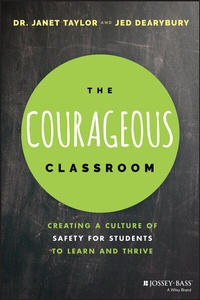
The Courageous Classroom
Description

In The Courageous Classroom: Creating a Culture of Safety for Students to Learn and Thrive, community psychiatrist Dr. Janet Taylor and nationally acclaimed educator, Jed Dearybury deliver a concise and insightful take on the culture of fear in schools around the country. You'll learn about the various ways fear is present in students and educators, practical tools and strategies for educators to cope with fear and anxiety in the classroom, the reality of racism, homophobia and microaggressions and their impact on learning, and how to create a landscape of calm in your classroom.
This important book will show you:
* The difference between fear and anxiety and how to respond to both
* How to create social-emotional learning environments where students feel mentally and physically safe
* Why, despite schools being safer than ever, students and educators fear for their personal safety
* How to manage educator stress, fear, and anxiety in a time of increasing coverage of school shootings
Perfect for K-12 public school educators, Courageous Classrooms will also earn a place in the libraries of educators in training and parents with school-age children who wish to better help children cope with fear.
More details
Other editions
Additional editions
Persons
JANET TAYLOR, MD, is a community psychiatrist and self-care expert with a focus on mental wellness. Dr. Janet is an international speaker on the impact of racial trauma, racism, anti-racism and conscious allyship, and frequent national media contributor. She is the mother of four daughters and resides in Florida.
JED DEARYBURY is a nationally acclaimed, educational leader providing quality, hands-on, engaging learning experiences for students and teachers across the country. Jed has been featured in GQ magazine as Male Leader of the Year, and met President Obama as the SC winner of the Presidential Award for Excellence in Math and Science Teaching. He is the author of another Jossey-Bass title, The Playful Classroom.
Content
About the Authors xiii
Foreword xv
Kwame Scruggs, PhD
Introduction xix
Dr. Janet's Story xxii
Jed's Story xxii
What to Expect in This Book xxvi
Chapter 1: The Brain's Fear System 1
Fear Is Normal 1
Fear Keeps Us Alive 3
Fear Becomes Courage 7
Fear and Trauma Affects Learning 9
Fear as a Teacher 12
Fear Is Paralyzing 14
Fear's Capacity 17
The Story of Kimmie 20
Let's Chat 25
Fear Is Overcome- able 27
Tips for the Courageous Classroom 27
Learning Principle 28
Chapter 2: Animals and Fear 29
Animals Can Cause Fear 29
Let's Chat 33
Animals Survive Because of Fear 34
Animals and Mental Health 37
Animals in the Classroom 39
Tips for the Courageous Classroom 43
Learning Principle 44
Chapter 3: Fear Outside School 47
Trauma Is an Adverse Childhood Experience 47
Trauma and the Brain's Development 51
Trauma Presenting in Children 53
Trauma as a Student and Educator 54
Let's Chat 59
Trauma's Effect on You 60
Take the ACE Questionnaire 61
The Story of Johnnie 64
Let's Chat 68
Tips for the Courageous Classroom 70
Learning Principle 70
Tips for Dealing with Your Trauma 71
Chapter 4: Crossing the Threshold into Schools 73
Courage in Spite of Circumstances 73
Courage at The Eagle Academy for Young Men 74
Courage During Car- Line Duty 77
Multi- focal Approach 78
The Story of Mary 80
Let's Chat 83
Tips for the Courageous Classroom 85
Learning Principle 85
Chapter 5: Fear Inside School 87
School Shootings 87
School Bullying 95
School Safety 97
School Anti-Bullying Programs 100
Bullying in the Classroom/Supporting Students: Tips for Teachers and Parents 103
Schools and LGBTQ+ Bullying 104
Let's Chat 108
Tips for the Courageous Classroom 110
A Courageous Mindset 110
Chapter 6: The Brain and Learning 111
The Impact on the Brain 111
The Brain Needs Time 113
The Brain and Sleep 115
The Brain and Adversity 117
The Brain and the Long- Term Effects of Trauma 118
Let's Chat 121
The Brain of a Coping Teacher 123
The Brain and Classroom Needs 125
The Brain's Health 127
Resilience 128
Tips for the Courageous Classroom 130
Learning Principle 130
Chapter 7: When Teachers Are Targeted 131
Aggression Against Teachers 131
A Story of Lawrence 133
Aggression and Teacher Safety? 135
Aggression Defined 137
Aggression and Social Learning 139
Aggression Disclaimer 141
Aggression Management 144
A Story of Tatum 146
Let's Chat 148
Tips for the Courageous Classroom 150
Learning Principle 150
Chapter 8: When a Child Is/Might Be in Danger 153
Relationships Are Paramount 153
Relationships with Student's Parents 155
Relationships with Students 156
Relationships and Mental Health 157
A Story of Frankie 159
Let's Chat 161
Tips for the Courageous Classroom 163
Learning Principle 163
Chapter 9: Building Courageous Classrooms 165
A Courageous First Day of School 165
A Courageous Man 166
A Courageous Definition and Neurobiology 168
A Courageous Story 169
Let's Chat 172
A Courageous Choice 173
Tips for the Courageous Classroom 175
Learning Principle 175
Chapter 10: Creating a Landscape of Calm in the Classroom 177
Acknowledge Diversity 177
Acknowledge the School Environment 179
Acknowledge Physical Spaces 180
Acknowledge Peace and Tranquility 183
Acknowledge Emotions 185
A Story About the Absence of Pride, Comfort, and Safety 185
Let's Chat 186
Tips for the Courageous Classroom 188
Learning Principle 188
Chapter 11: Health and Education 189
Obesity and School 189
Stress and School 190
Self- Care and School 192
A Story of Teacher Self- Care 195
Let's Chat 199
Tips for the Courageous Classroom 200
Learning Principles 201
Chapter 12: Talking with Parents 203
Approach as a Partner 203
Approach Without Assumptions 204
Approach with Grace 205
A Story About Anne 206
Approach with Care 208
Approach with Respect 209
Approach with Sensitivity 211
Approach with Resources 214
Let's Chat 215
Learning Principle 216
Chapter 13: What Now? 219
Let's Chat 222
Learning Principle 223
Appendix A: External Stimulus of the Brain 225
Appendix B: The Brain's Fear Circuit 227
References 229
Index 241
Introduction
There is no courage without fear.
What is fear? Fear is an emotional experience in reaction to a situation perceived as threatening, unsafe, or dangerous. Although it is often perceived as negative, fear is a response that has evolved to help us both survive and reproduce as a species. When we experience fear, we have three kinds of responses: behavioral, physiological, and emotional. The behavioral response might be to attack (fight), run away (flight), or immobilize ourselves (freeze). Physiological responses include elevated heart rate, perspiration, or a trembly voice. The emotional response typically includes feelings of anger or sadness. Freezing can include hiding or "shutting down" emotionally. Most of us know how we feel and can recall a time when we were very afraid. Many of us have recurrent fears or specific phobias, or even what we still may be afraid of or have a phobia about but why? What happens to the brain and our body when we hear a sound, see something that frightens us, smell a noxious agent, or are touched by something unexpected?
To understand how fear impacts our body, we first need to understand some basics of the brain. The brain has two different kinds of tasks that it must balance. On the one hand, it must keep our body running, making sure our metabolism is humming along. On the other hand, it must process information from our environment to make sure we are not under threat. The brain has an evolutionary drive to balance our metabolic functioning with information processing and fear responses (Woods and Khierbeck 2017). Since survival is a foundational evolutionary concern, the hypothalamus, responsible for fear-related emotional behaviors in animals and humans, is one of the oldest structures, deeply located in the brain (Hasan et al. 2019). It is responsible for fear-related emotional behaviors in animals and humans. It has evolved over time as have newer structures like the amygdala and medial prefrontal cortex. The amygdala is a hub in the brain for the expression and processing of threat and fear. When it receives cues - it receives visual, olfactory, auditory, and gustatory - it sends output to the prefrontal motor cortex (decision-making, mindful self-regulation) and the brainstem for behavioral and physiological output (freezing, fight, or flight). In other words, it tells our whole body whether we need to freeze, fight, or flee.
Fear and its associated behaviors have developed over millions of years so that we as humans could get through the day by listening, using our other senses, and being aware that danger was close, using our brain to adapt to threatening, dangerous situations. To survive, fear acquisition or fear learning had to happen quickly. There were no do-overs when the prehistoric wooly mammoth had you in his clutches. After one exposure to danger, humans and animals can form long-lasting fear memories and have the capacity to predict danger (Schiller et al. 2008). Fear learning is "rapid and resistant to modification" (Schiller et al. 2008) with the realization that constantly returning to dangerous situations is not advantageous to survival. The ability to flexibly analyze and adjust behavior is critical in unpredictable, changing environments. We are no longer living side-by-side with prehistoric predators, but we still maintain these evolutionary adaptations that influence how we respond to our environment, like school classrooms and within the four walls of home.
Our brain can be conditioned to automatically fear something: if we know a particular predator wants to make us his lunch, it is in our best interest not to waste valuable time and energy deciding whether we want to stick around and chat with him. However, in more nuanced circumstances - like our present-day world often presents - our brain can also update itself, leading to a concept known as fear safety. Thanks to research carried out in mice, scientists believe that we have a "courage switch" that can shift fear to courage: a mouse that would ordinarily freeze in response to a visual threat, can become bold, fiercely thumping its tail (Huberman 2018). A similar structure exists in humans.
Fear might be evolutionarily adaptive, but so too is courage.
Courage, the process of addressing your own fear to achieve a specific purpose, is not just something that can be learned, it is learning itself. Defined as "the act or experience of one that learns," learning also means "the modification of a behavioral tendency by experience" (Merriam-Webster n.d.).
Fear is a learned association between at least two things that are meant to be adaptive for us in an effort for minimizing exposure to danger. Rather than having to constantly expend energy to relearn what is dangerous or safe, we preserve fear memories and fear learning. However, our brain has the capacity for fear extinction and fear reversal, which allows us to gain cognitive control over our fears. In other words, your brain wants to keep you safe but not afraid. You can use emotional awareness and self-regulation to calm yourself and unlearn fear, using breathing techniques and having a courageous mindset.
What is the difference between a classroom governed by fear and a courageous classroom? While a fearful classroom is focused on student ability, a courageous classroom prioritizes learning for and from the students who are valued for their potential. And what makes that difference? The teacher. As noted psychologist, Carol Dweck writes, "Every student has something to teach me" (Dweck 2014/2015). The underlying principle of a courageous classroom is belief in the capacity for students and teachers to be courageous in their learning and teaching.
Dr. Janet's Story
This book is a collaboration between two professionals with different experiences with and viewpoints on education. I (Dr. Janet) am not a teacher but a psychiatrist who usually sees kids who are not progressing in school and/or who have mental health issues impacting their ability to focus, learn information, or get along with their peers. As they grapple with underlying trauma, I am motivated by a desire to assist them as they face their own reality. My voice in this book is evidence-based, providing the neuroscience of fear and courage while sharing my own personal stories of finding my own courage. As the mother of four daughters, I respect teachers who, while raising their own families, skillfully and selflessly taught mine.
Jed's Story
As Dr. Janet's co-author, I (Jed) bring my almost-two-decade-long experience as a teacher and a direct voice of my own trauma, in the manner of a speaking wound, "the trauma born by an Other that speaks to the wound of the healer" (Dutro and Bien 2014). I share raw accounts of the difficulties of many of my students to illustrate the challenging experiences of trauma and fear that students and teachers bring into the classroom. These stories are the heart and soul of this book. They are told in a personal narrative format. I am more of a story teller than a researcher, so the tone of the book may feel a bit different when I chime in. The students I write about are the ones who above all need(ed) a culture of safety within their classroom walls. The retelling of their stories is multi-purpose. One, to let other teachers know they are not alone in the work. We all have students with lots of trauma that we must talk about so we can figure out how to help them best. Two, talking about the needs of our students helps us to identify the strategies we need for assisting and teaching them. Three, talking about the effects of their trauma on their learning helps us to see where our own education fell short in preparing us for this profession. As a point of caution here, some of the stories may create deep grief for you. You may cry, you may cuss. You may even get mad at me because I didn't handle the situation like I should have. I admit, I wish I could have a rerun with some of these students as I have learned more now than I knew then. Some of the stories may be triggers for you as you process and navigate the waters of your own childhood trauma. Lord knows I have had my fair share: sexually, physically, mentally abused by my father; being gay in the Bible Belt South; and attending a Southern Baptist college while being gay and enduring two years of conversion therapy so I'd "turn straight" and Jesus would love me. These are just a few of the details of my own traumatic past. They alone could be a whole book. I digress.
Through research and relationships, this book will answer the question of how teachers can thrive and learn in spaces where, at times, both parties may experience stress, distress, fear, and anxiety from both internal and external sources. There are moments when the work may read like a college lecture and others where a therapist is talking to a client on the couch in the consulting room. The hope is that we provide advice about how to harness our neurobiological understanding of fear, and help educators and students realize how to push fear aside both inside and outside classrooms. We believe it will show you how to tap into your own potential for healthy psychological functioning and intellectual growth as an individual, and within your institutional culture, by learning how to establish and maintain Courageous Classrooms and promote a growth mindset. Fear and adversity can disrupt the environment of optimal learning. Classrooms and schools that promote a culture of safety, creativity, resilience,...
