

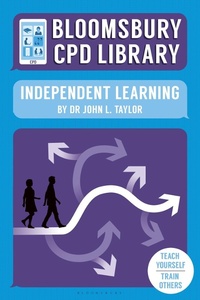
Bloomsbury CPD Library: Independent Learning
1st Edition
Published on 8. February 2018
272 pages
978-1-4729-4582-2 (ISBN)
Description

Independent learning is an ideal which many teachers aspire to but find difficult to achieve. This book provides ten training plans that enable you to easily deliver hours of CPD sessions in your school. All presentations and hand-outs are provided in the book and online, making Bloomsbury CPD Library: Independent Learning all you need to help your students think independently, for a richer learning experience, and to impress inspectors.
It is common for school inspectors to comment on the need for students to learn more independently, and from higher education admissions officers and employers there is a constant call for students to be better equipped to be able to learn and think for themselves. Students themselves enjoy and benefit from lessons in which they are given the opportunity to begin to take charge of the learning process, particularly when there is space for them to explore and inquire into topics that grab their attention.
At the same time, there is enormous pressure on schools to 'teach to the test', leading many teachers to feel that they have to play safe and cannot risk giving their students genuine responsibility for their own learning, lest results suffer. Critics also argue that students need to be taught directly, as the capacity for meaningful inquiry is not one that most students possess, and even when it is present, the open-ended nature of the inquiry process can make learning inefficient.
In this book, John L. Taylor shows how the rhetoric about independent learning can be turned into a practical reality. The book explores the foundations of effective learning and demonstrates how it is possible to implement an approach to learning which encourages students to learn to think for themselves. It shows how by teaching students to think better, teachers can ensure that they both succeed in jumping assessment hurdles and also enjoy a richer, more meaningful educational experience.
It is common for school inspectors to comment on the need for students to learn more independently, and from higher education admissions officers and employers there is a constant call for students to be better equipped to be able to learn and think for themselves. Students themselves enjoy and benefit from lessons in which they are given the opportunity to begin to take charge of the learning process, particularly when there is space for them to explore and inquire into topics that grab their attention.
At the same time, there is enormous pressure on schools to 'teach to the test', leading many teachers to feel that they have to play safe and cannot risk giving their students genuine responsibility for their own learning, lest results suffer. Critics also argue that students need to be taught directly, as the capacity for meaningful inquiry is not one that most students possess, and even when it is present, the open-ended nature of the inquiry process can make learning inefficient.
In this book, John L. Taylor shows how the rhetoric about independent learning can be turned into a practical reality. The book explores the foundations of effective learning and demonstrates how it is possible to implement an approach to learning which encourages students to learn to think for themselves. It shows how by teaching students to think better, teachers can ensure that they both succeed in jumping assessment hurdles and also enjoy a richer, more meaningful educational experience.
Reviews / Votes
'John Taylor has produced a typically well-researched, thoughtful and, above all, practical guide to making classrooms hotbeds of independent learning. Tomorrow's students will depend on their ability to think for themselves - and we need teachers who can expertly help them. John brings all his experience to the challenge of "independence without fear", and succeeds brilliantly.' * David Price OBE, Director of Educational Arts, @DavidPriceOBE *More details
Series
Edition
1. Auflage
Language
English
Place of publication
London
United Kingdom
Publishing group
Bloomsbury Publishing PLC (Digital)
Target group
Professional and scholarly
ISBN-13
978-1-4729-4582-2 (9781472945822)
Copyright in bibliographic data and cover images is held by Nielsen Book Services Limited or by the publishers or by their respective licensors: all rights reserved.
Schweitzer Classification
Other editions
Additional editions
John L. Taylor | Bloomsbury CPD Library | Sarah Findlater
Bloomsbury CPD Library: Independent Learning
Book
02/2018
Bloomsbury Education
€50.94
Article exhausted; check different version
Persons
John L. Taylor is Assistant Head (Director of Learning, Teaching and Innovation) at Cranleigh School responsible for the development of independent learning across the three schools in the Cranleigh Foundation. John works closely with staff, providing professional development opportunities and organising and leading CPD in areas connected to independent learning. He is one of the principal architects of the Extended Project and other project-based qualifications in the UK.
John has written blogs or features for the Guardian Teacher Network and TES. He has extensive experience as a teacher trainer, providing regular INSET for schools and colleges on matters relating to independent learning, project work, the management of classroom discussion, teaching research and inquiry skills.
John has written blogs or features for the Guardian Teacher Network and TES. He has extensive experience as a teacher trainer, providing regular INSET for schools and colleges on matters relating to independent learning, project work, the management of classroom discussion, teaching research and inquiry skills.
Content
- Cover
- Title
- Copyright
- Contents
- Acknowledgements
- How to use this book
- Part 1: Teach yourself
- Stage1: Assess
- Chapter 1 - What's it all about?
- Chapter 2 - Self-assessment
- Stage 2: Improve
- Chapter 3 - Getting to grips with the key researchers
- Chapter 4 - Strategies for independent learning
- Chapter 5 - Putting it into practice
- Stage 3: Evaluate
- Chapter 6 - Assessing thinking in practice
- Stage 4: Excel
- Chapter 7 - Embedding and developing the practice
- Part 2: Train others
- Chapter 1 - Planning and preparing CPD
- Chapter 2 - Training plans
- Bibliography and further reading
- Index
