

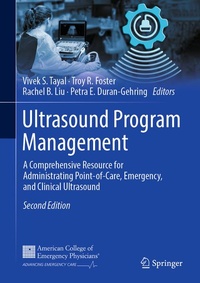
Ultrasound Program Management
Description

This book addresses the diverse challenges clinical ultrasound program leaders face, including choosing equipment, building quality improvement programs, understanding credentialing and privileging, and optimizing reimbursement. While mastering the ultrasound probe may seem straightforward, the real challenge lies in delivering safe, efficient, meaningful, transferable, and reimbursable services in modern medicine.
This update to the widely used predecessor expands on the original chapters and introduces new ones that explore nuanced aspects of ultrasound program management. Early chapters focus on leadership in ultrasound programs within departments or institutions. Later chapters delve into specific applications, such as hospitalist services, outpatient medicine, pediatrics, prehospital care, and intensive care units. This edition also highlights emerging technologies and their integration into an ultrasound program. New chapters cover topics such as "Social Media in Ultrasound Management," "Cybersecurity," "Artificial Intelligence in Point-of-Care Ultrasound," and "Practical Operating Solutions for Resource-Limited Settings."
This edition of Ultrasound Program Management will be invaluable for ultrasound program and medical academic leaders, and those seeking to build successful clinician-performed ultrasound programs.
More details
Other editions
Additional editions
Persons
Vivek S. Tayal, MD, FACEP, FAIUM, FAEMUS
Division of Emergency Ultrasound
Department of Emergency Medicine
Carolinas Medical Center, Charlotte, NC
Professor, Wake Forest School of Medicine
Advocate Healthcare
Troy Foster, MD, FACEP
Lutheran General Hospital
Park Ridge, IL, USA
Rachel Liu, MD
Yale School of Medicine
New Haven, CT, USA
Petra E. Duran-Gehring
University of Florida College of Medicine-Jacksonville
Department of Emergency Medicine
Jacksonville, FL, USA
Content
1. Initial Approach to Ultrasound Management: Making Ultrasound Meaningful from the Start.- 2. Ultrasound Director and Leadership.- 3. Career Strategy and Negotiations.- 4. Institutional Point of Care Ultrasound.- 5. Principles of Education in Ultrasound Practice.- 6. Undergraduate Ultrasound Education.- 7. Residency and Specialty-Specific Ultrasound Education.- 8. Ultrasound Fellowship Programs.- 9. Continuing Education.- 10. Social Media in Ultrasound Management.- 11. Ultrasound Research.- 12. Ultrasonography for Advanced Practice Providers and Nursing Programs.- 13. Ultrasound Simulation.- 14. Ultrasound Equipment and Purchase.- 15. Ultrasound Equipment Maintenance and Facility Considerations.- 16. Ultrasound Associated Materials and Equipment.- 17. Ultrasound Safety and Infection Control.- 18. Ultrasound Quality Programs and Risk Management.- 19. Workflow and Middleware.- 20. Cybersecurity.- 21. Artificial Intelligence in Point-of-Care Ultrasound.- 22. Practical Operating Solutions for Resource Limited Settings.- 23. Design Principles to Optimize Ultrasound Programs.- 24. Politics of Point-of-Care Ultrasound.- 25. Credentialing and Privileging.- 26. Ultrasound Certification.- 27. Ultrasound Accreditation.- 28. Point of Care Ultrasound Reimbursement and Coding.- 29. Global Medicine, Rural, and Remote Perspectives.- 30. Pediatric-specific issues.- 31. Ultrasound Management Issues for the Hospitalist.- 32. Ultrasound in the Prehospital, Disaster, and Military Settings.- 33. Community Ultrasound.- 34. Critical Care Medicine.- 35. POCUS in Primary Care.- 36. Point of Care Ultrasound: Vision, Innovation, Longevity.
