

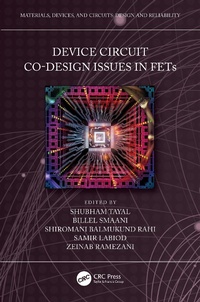
Device Circuit Co-Design Issues in FETs
1st Edition
Published on 22. August 2023
280 pages
978-1-000-92642-2 (ISBN)
Description

This book provides an overview of emerging semiconductor devices and their applications in electronic circuits, which form the foundation of electronic devices. Device Circuit Co-Design Issues in FETs provides readers with a better understanding of the ever-growing field of low-power electronic devices and their applications in the wireless, biosensing, and circuit domains. The book brings researchers and engineers from various disciplines of the VLSI domain together to tackle the emerging challenges in the field of engineering and applications of advanced low-power devices in an effort to improve the performance of these technologies. The chapters examine the challenges and scope of FinFET device circuits, 3D FETs, and advanced FET for circuit applications. The book also discusses low-power memory design, neuromorphic computing, and issues related to thermal reliability. The authors provide a good understanding of device physics and circuits, and discuss transistors based on the new channel/dielectric materials and device architectures to achieve low-power dissipation and ultra-high switching speeds to fulfill the requirements of the semiconductor industry.
This book is intended for students, researchers, and professionals in the field of semiconductor devices and nanodevices, as well as those working on device-circuit co-design issues.
This book is intended for students, researchers, and professionals in the field of semiconductor devices and nanodevices, as well as those working on device-circuit co-design issues.
More details
Series
Edition
1. Auflage
Language
English
Place of publication
London
United Kingdom
Publishing group
Taylor & Francis Ltd
Target group
Professional and scholarly
Illustrations
34 Tables, black and white; 259 Line drawings, black and white; 10 Halftones, black and white; 269 Illustrations, black and white
ISBN-13
978-1-000-92642-2 (9781000926422)
Copyright in bibliographic data and cover images is held by Nielsen Book Services Limited or by the publishers or by their respective licensors: all rights reserved.
Schweitzer Classification
Other editions
Additional editions
Shubham Tayal | Billel Smaani | Shiromani Balmukund Rahi
Device Circuit Co-Design Issues in FETs
Book
01/2025
1st Edition
CRC Press
€71.60
Shipment within 10-20 days
Shubham Tayal | Billel Smaani | Shiromani Balmukund Rahi
Device Circuit Co-Design Issues in FETs
Book
08/2023
1st Edition
CRC Press
€186.40
Shipment within 10-20 days
Persons
Shubham Tayal is an assistant professor in the Department of Electronics and Communication Engineering at SR University, Warangal, India. He has more than six years of academic/research experience teaching at undergraduate and postgraduate levels. He received his Ph.D. in microelectronics and VLSI design from the National Institute of Technology, Kurukshetra, M.Tech (VLSI Design) from YMCA University of Science and Technology, Faridabad, and B.Tech (Electronics and Communication Engineering) from MDU, Rohtak. He has published more than 40 research papers in various international journals and conferences of repute, and many papers are under review. He is on the editorial and reviewer panel of many SCI/SCOPUS-indexed international journals and conferences. He is editor/co-editor of eight books published by CRC Press (Taylor & Francis Group, USA) and Springer Nature. He acted as a keynote speaker and delivered professional talks on various forums. He is a member of various professional bodies including IEEE and IRED. He is on the advisory panel of many international conferences. He is a recipient of the Green ThinkerZ International Distinguished Young Researcher Award 2020. His research interests include the simulation and modeling of multi-gate semiconductor devices, device-circuit co-design in the digital/ analog domain, machine learning, and IoT.
Billel Smaani received his Ph.D. degree from the University of Frere Mentouri, Constantine, Algeria, in 2015. He joined the Centre Universitaire Abdelhafid Boussouf, Mila, Algeria, in 2021, where he has been an associate professor since June 2022. From 2015 to 2021, he was with the University of M'hamed Bougara Boumerdes, Algeria. His current research interests include the study, analysis, and compact modeling of advanced nanoscale field-effect transistors for analog and digital circuit co-design.
Shiromani Balmukund Rahi received a B.Sc. (Physics, Chemistry Mathematics) in 2002, an M.Sc. (Electronics) from Deen Dyal Upadhyaya Gorakhpur University, Gorakhpur, in 2005, M. Tech. (Microelectronics) from Panjab University Chandigarh in 2011, and a Doctorate of Philosophy in 2018 from the Indian Institute of Technology, Kanpur, India. He completed his Master project (M.Sc.) at the Central Electronics Engineering Research Institute (CEERI, 2005), Pilani Rajasthan, under the supervision of Dr. P C Panchariya (Director and Chief Scientist, CEERI, Pilani) and thesis (M. Tech.) under Prof. RenuVig (director and Professor, UIET Panjab University Chandigarh), post-doctoral research (Department of Computer Science, Korea Military Academy, Seoul, Republic of Korea). He has 25 international publications and ten book chapters. He has edited two books for CRC publication. He is associated with research with the Indian Institute of Technology Kanpur, India, and in the electronics department at the University Mostefa Benboulaid of Algeria, developing ultra-low power devices such as tunnel FETs, NC TFET, negative capacitance, and nanosheet FETS.
Samir Labiod was born in Constantine, Algeria, on January 5, 1981. He received electrical engineering and magister degrees in electronics from Constantine University, Algeria, in 2005 and 2008, respectively. He also received his Ph.D. from Constantine University Institute of Sciences and Technology, Constantine, Algeria, in 2013. His current research interests include the numerical modeling of electromagnetic compatibility of semiconductor devices.
Zeinab Ramezani received her Ph.D. in Electrical and Computer Engineering in 2017. She worked as an assistant professor at IAU University from 2017 to 2019 and as a research scientist at Northeastern University in Boston, MA, USA, from 2019 to 2021.She is a scientist with over ten years of experience in modeling, simulation, and characterization of novel structures; micro-and nanoelectronics; nanotechnology; nanophotonic and nanomagnetic power semiconductor devices; wide bandgap semiconductors; optoelectronic devices; plasmonic devices; and bioelectronics and biosensors. Her current research at the University of Miami, FL, USA, is focused on developing and modeling new materials and electronic tools to enable leapfrog advancements in health applications.
Billel Smaani received his Ph.D. degree from the University of Frere Mentouri, Constantine, Algeria, in 2015. He joined the Centre Universitaire Abdelhafid Boussouf, Mila, Algeria, in 2021, where he has been an associate professor since June 2022. From 2015 to 2021, he was with the University of M'hamed Bougara Boumerdes, Algeria. His current research interests include the study, analysis, and compact modeling of advanced nanoscale field-effect transistors for analog and digital circuit co-design.
Shiromani Balmukund Rahi received a B.Sc. (Physics, Chemistry Mathematics) in 2002, an M.Sc. (Electronics) from Deen Dyal Upadhyaya Gorakhpur University, Gorakhpur, in 2005, M. Tech. (Microelectronics) from Panjab University Chandigarh in 2011, and a Doctorate of Philosophy in 2018 from the Indian Institute of Technology, Kanpur, India. He completed his Master project (M.Sc.) at the Central Electronics Engineering Research Institute (CEERI, 2005), Pilani Rajasthan, under the supervision of Dr. P C Panchariya (Director and Chief Scientist, CEERI, Pilani) and thesis (M. Tech.) under Prof. RenuVig (director and Professor, UIET Panjab University Chandigarh), post-doctoral research (Department of Computer Science, Korea Military Academy, Seoul, Republic of Korea). He has 25 international publications and ten book chapters. He has edited two books for CRC publication. He is associated with research with the Indian Institute of Technology Kanpur, India, and in the electronics department at the University Mostefa Benboulaid of Algeria, developing ultra-low power devices such as tunnel FETs, NC TFET, negative capacitance, and nanosheet FETS.
Samir Labiod was born in Constantine, Algeria, on January 5, 1981. He received electrical engineering and magister degrees in electronics from Constantine University, Algeria, in 2005 and 2008, respectively. He also received his Ph.D. from Constantine University Institute of Sciences and Technology, Constantine, Algeria, in 2013. His current research interests include the numerical modeling of electromagnetic compatibility of semiconductor devices.
Zeinab Ramezani received her Ph.D. in Electrical and Computer Engineering in 2017. She worked as an assistant professor at IAU University from 2017 to 2019 and as a research scientist at Northeastern University in Boston, MA, USA, from 2019 to 2021.She is a scientist with over ten years of experience in modeling, simulation, and characterization of novel structures; micro-and nanoelectronics; nanotechnology; nanophotonic and nanomagnetic power semiconductor devices; wide bandgap semiconductors; optoelectronic devices; plasmonic devices; and bioelectronics and biosensors. Her current research at the University of Miami, FL, USA, is focused on developing and modeling new materials and electronic tools to enable leapfrog advancements in health applications.
Content
1. Modeling for CMOS Circuit Design. 2. Conventional CMOS Circuit Design. 3. Compact modeling of junctionless Gate-All-Around MOSFET for circuit simulation. 4. Novel Gate-Overlap Tunnel FETs for Superior Analog, Digital, and Ternary Logic Circuit Applications. 5. Phase Transition Materials for Low Power Electronics. 6. Impact of total ionizing dose effect on SOI-FinFET with spacer engineering. 7. Scope and Challenges with Nanosheet FET based Circuit design. 8. Scope with TFET based Circuit and System Design. 9. An overview of FinFET based Capacitorless 1T-DRAM. 10. Literature Review of the SRAM Circuits Design Challenges. 11. Challenges and Future Scope of Gate-All-Around (GAA) Transistors: Physical Insights of Device-Circuit Interactions.
