

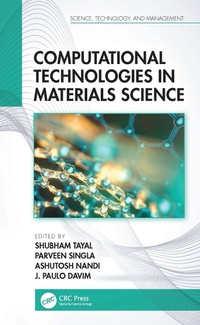
Computational Technologies in Materials Science
1st Edition
Published on 6. October 2021
250 pages
978-1-000-45974-6 (ISBN)
Description

Advanced materials are essential for economic security and human well-being, with applications in industries aimed at addressing challenges in clean energy, national security, and human welfare. Yet, it can take years to move a material to the market after its initial discovery. Computational techniques have accelerated the exploration and development of materials, offering the chance to move new materials to the market quickly. Computational Technologies in Materials Science addresses topics related to AI, machine learning, deep learning, and cloud computing in materials science. It explores characterization and fabrication of materials, machine-learning-based models, and computational intelligence for the synthesis and identification of materials. This book
* Covers material testing and development using computational intelligence
* Highlights the technologies to integrate computational intelligence and materials science
* Details case studies and detailed applications
* Investigates challenges in developing and using computational intelligence in materials science
* Analyzes historic changes that are taking place in designing materials.
This book encourages material researchers and academics to develop novel theories and sustainable computational techniques and explores the potential for computational intelligence to replace traditional materials research.
* Covers material testing and development using computational intelligence
* Highlights the technologies to integrate computational intelligence and materials science
* Details case studies and detailed applications
* Investigates challenges in developing and using computational intelligence in materials science
* Analyzes historic changes that are taking place in designing materials.
This book encourages material researchers and academics to develop novel theories and sustainable computational techniques and explores the potential for computational intelligence to replace traditional materials research.
More details
Series
Edition
1. Auflage
Language
English
Place of publication
London
United Kingdom
Publishing group
Taylor & Francis Ltd
Target group
Professional and scholarly
Illustrations
52 Tables, black and white; 125 Line drawings, black and white; 27 Halftones, black and white; 152 Illustrations, black and white
ISBN-13
978-1-000-45974-6 (9781000459746)
Copyright in bibliographic data and cover images is held by Nielsen Book Services Limited or by the publishers or by their respective licensors: all rights reserved.
Schweitzer Classification
Other editions
Additional editions
Shubham Tayal | Parveen Singla | Ashutosh Nandi
Computational Technologies in Materials Science
Book
11/2024
1st Edition
CRC Press
€71.40
Shipment within 15-20 days
Shubham Tayal | Parveen Singla | Ashutosh Nandi
Computational Technologies in Materials Science
Book
10/2021
1st Edition
CRC Press
€171.00
Shipment within 15-20 days
Persons
Dr. Shubham Tayal is Assistant Professor, Department of Electronics and Communication Engineering, SR University, Warangal, India. He has more than 6 years of academic/research experience of teaching at UG and PG level. He has received his B.Tech (ECE) from Maharishi Dayanand University, Rohtak, M.Tech (Electronics) from YMCA University of Science & Technology, Faridabad and PhD from National Institute of Technology, Kurukshetra. He has published several papers in various international journals and conferences of repute and many papers are under review. He is on the editorial and reviewer panel of many international journals. He has received Green ThinkerZ International Distinguished Young Researcher Award 2020. His research area includes semiconductor devices, VLSI design, device-circuit co-design issues, machine learning and IOT.
Dr. Parveen Singla is Professor, Electronics & Communication Engineering, Department of Chandigarh Engineering College- Chandigarh Group of Colleges, Landran, Mohali, Punjab. He received the Bachelor of Engineering in Electronics & Communication Engineering with honors from Maharishi Dayanand University, Rohtak, Master in Technology in Electronics & Communication Engineering with honors from Kurukshetra University, & PhD in Communication Systems from IKG Punjab Technical University, Jalandhar, India. He has 16 years of experience in the field of teaching and research. He has published more than 35 papers in various reputed journals and national and international conferences. He also organised more than 30 technical events for the students in order to enhance their technical skills and received Best International Technical Event Organiser Award. He is the guest editor of various reputed journals. His interest area includes drone technology, wireless networks, smart antenna and soft computing.
Dr. Ashutosh Nandi is Assistant Professor with the Department of Electronics and Communication Engineering, National Institute of Technology Kurukshetra, India. He received the Ph.D. degree from IIT Roorkee, India, in 2015. He has authored more than 50 articles in various international journals and conferences of repute. His current research interests include low-power very large scale integration design, device circuit codesign in the digital/analog domain, and device modeling of multigate semiconductor devices.
Dr. J. Paulo Davim received his Ph.D. degree in Mechanical Engineering in 1997, M.Sc. degree in Mechanical Engineering (materials and manufacturing processes) in 1991, Mechanical Engineering degree (5 years) in 1986, from the University of Porto (FEUP), the Aggregate title (Full Habilitation) from the University of Coimbra in 2005 and the D.Sc. (Higher Doctorate) from London Metropolitan University in 2013. He is Senior Chartered Engineer by the Portuguese Institution of Engineers with an MBA and Specialist titles in Engineering and Industrial Management as well as in Metrology. He is also Eur Ing by FEANI-Brussels and Fellow (FIET) of IET-London. Currently, he is Professor at the Department of Mechanical Engineering of the University of Aveiro, Portugal. He is also distinguished as honorary professor in several universities/colleges. He has more than 30 years of teaching and research experience in Manufacturing, Materials, Mechanical and Industrial Engineering, with special emphasis in Machining & Tribology. He has also interest in Management, Engineering Education and Higher Education for Sustainability. He has guided large numbers of postdoc, Ph.D. and master's students as well as has coordinated and participated in several financed research projects. He has received several scientific awards and honors. He has worked as evaluator of projects for ERC-European Research Council and other international research agencies as well as examiner of Ph.D. thesis for many universities in different countries. He is the Editor in Chief of several international journals, Guest Editor of journals, books Editor, book Series Editor and Scientific Advisory for many international journals and conferences. Presently, he is an Editorial Board member of 30 international journals and acts as reviewer for more than 100 prestigious Web of Science journals. In addition, he has also published as editor (and co-editor) more than 150 books and as author (and co-author) more than 15 books, 100 book chapters and 500 articles in journals and conferences (more than 250 articles in journals indexed in Web of Science core collection/h-index 55+/9500+ citations, SCOPUS/h-index 60+/12000+ citations, Google Scholar/h-index 77+/19500+ citations).
Dr. Parveen Singla is Professor, Electronics & Communication Engineering, Department of Chandigarh Engineering College- Chandigarh Group of Colleges, Landran, Mohali, Punjab. He received the Bachelor of Engineering in Electronics & Communication Engineering with honors from Maharishi Dayanand University, Rohtak, Master in Technology in Electronics & Communication Engineering with honors from Kurukshetra University, & PhD in Communication Systems from IKG Punjab Technical University, Jalandhar, India. He has 16 years of experience in the field of teaching and research. He has published more than 35 papers in various reputed journals and national and international conferences. He also organised more than 30 technical events for the students in order to enhance their technical skills and received Best International Technical Event Organiser Award. He is the guest editor of various reputed journals. His interest area includes drone technology, wireless networks, smart antenna and soft computing.
Dr. Ashutosh Nandi is Assistant Professor with the Department of Electronics and Communication Engineering, National Institute of Technology Kurukshetra, India. He received the Ph.D. degree from IIT Roorkee, India, in 2015. He has authored more than 50 articles in various international journals and conferences of repute. His current research interests include low-power very large scale integration design, device circuit codesign in the digital/analog domain, and device modeling of multigate semiconductor devices.
Dr. J. Paulo Davim received his Ph.D. degree in Mechanical Engineering in 1997, M.Sc. degree in Mechanical Engineering (materials and manufacturing processes) in 1991, Mechanical Engineering degree (5 years) in 1986, from the University of Porto (FEUP), the Aggregate title (Full Habilitation) from the University of Coimbra in 2005 and the D.Sc. (Higher Doctorate) from London Metropolitan University in 2013. He is Senior Chartered Engineer by the Portuguese Institution of Engineers with an MBA and Specialist titles in Engineering and Industrial Management as well as in Metrology. He is also Eur Ing by FEANI-Brussels and Fellow (FIET) of IET-London. Currently, he is Professor at the Department of Mechanical Engineering of the University of Aveiro, Portugal. He is also distinguished as honorary professor in several universities/colleges. He has more than 30 years of teaching and research experience in Manufacturing, Materials, Mechanical and Industrial Engineering, with special emphasis in Machining & Tribology. He has also interest in Management, Engineering Education and Higher Education for Sustainability. He has guided large numbers of postdoc, Ph.D. and master's students as well as has coordinated and participated in several financed research projects. He has received several scientific awards and honors. He has worked as evaluator of projects for ERC-European Research Council and other international research agencies as well as examiner of Ph.D. thesis for many universities in different countries. He is the Editor in Chief of several international journals, Guest Editor of journals, books Editor, book Series Editor and Scientific Advisory for many international journals and conferences. Presently, he is an Editorial Board member of 30 international journals and acts as reviewer for more than 100 prestigious Web of Science journals. In addition, he has also published as editor (and co-editor) more than 150 books and as author (and co-author) more than 15 books, 100 book chapters and 500 articles in journals and conferences (more than 250 articles in journals indexed in Web of Science core collection/h-index 55+/9500+ citations, SCOPUS/h-index 60+/12000+ citations, Google Scholar/h-index 77+/19500+ citations).
Content
Chapter 1 Fabrication and Characterization of Materials Chapter 2 Application to Advanced Materials Simulation Chapter 3 Molecular Dynamics Simulations for Structural Characterization and Property Prediction of Materials Chapter 4 Desirability Approach-Based Optimization of Process Parameters in Turning of Aluminum Matrix Composites Chapter 5 Spark Plasma-Induced Combustion Synthesis, Densification, and Characterization of Nanostructured Magnesium Silicide for Mid Temperature Energy Conversion Energy Harvesting Application Chapter 6 The Role of Computational Intelligence in Materials Science: An Overview Chapter 7 Characterization Techniques for Composites using AI and Machine Learning Techniques Chapter 8 Experimental Evaluation on Tribological Behavior of TiO2 Reinforced Polyamide Composites Validated by Taguchi and Machine Learning Methods Chapter 9 Prediction of Compressive Strength of SCC-Containing Metakaolin and Rice Husk Ash Using Machine Learning Algorithms Chapter 10 Predicting Compressive Strength of Concrete Matrix Using Engineered Cementitious Composites: A Comparative Study between ANN and RF Models Chapter 11 Estimation of Marshall Stability of Asphalt Concrete Mix Using Neural Network and M5P Tree
