

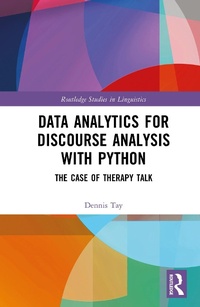
Data Analytics for Discourse Analysis with Python
The Case of Therapy Talk
1st Edition
Published on 19. April 2024
190 pages
978-1-040-00769-3 (ISBN)
Description

This concise volume, using examples of psychotherapy talk, showcases the potential applications of data analytics for advancing discourse research and other related disciplines.
The book provides a brief primer on data analytics, defined as the science of analyzing raw data to reveal new insights and support decision making. Currently underutilized in discourse research, Tay draws on the case of psychotherapy talk, in which clients' concerns are worked through via verbal interaction with therapists, to demonstrate how data analytics can address both practical and theoretical concerns. Each chapter follows a consistent structure, offering a streamlined walkthrough of a key technique, an example case study, and annotated Python code. The volume shows how techniques such as simulations, classification, clustering, and time series analysis can address such issues as incomplete data transcripts, therapist-client (a)synchrony, and client prognosis, offering inspiration for research, training, and practitioner self-reflection in psychotherapy and other discourse contexts.
This volume is a valuable resource for discourse and linguistics researchers, particularly for those interested in complementary approaches to qualitative methods, as well as active practitioners.
The book provides a brief primer on data analytics, defined as the science of analyzing raw data to reveal new insights and support decision making. Currently underutilized in discourse research, Tay draws on the case of psychotherapy talk, in which clients' concerns are worked through via verbal interaction with therapists, to demonstrate how data analytics can address both practical and theoretical concerns. Each chapter follows a consistent structure, offering a streamlined walkthrough of a key technique, an example case study, and annotated Python code. The volume shows how techniques such as simulations, classification, clustering, and time series analysis can address such issues as incomplete data transcripts, therapist-client (a)synchrony, and client prognosis, offering inspiration for research, training, and practitioner self-reflection in psychotherapy and other discourse contexts.
This volume is a valuable resource for discourse and linguistics researchers, particularly for those interested in complementary approaches to qualitative methods, as well as active practitioners.
More details
Series
Edition
1. Auflage
Language
English
Place of publication
London
United Kingdom
Publishing group
Taylor & Francis Ltd
Target group
College/higher education
Illustrations
11 Tables, black and white; 26 Line drawings, black and white; 26 Illustrations, black and white
ISBN-13
978-1-040-00769-3 (9781040007693)
Copyright in bibliographic data and cover images is held by Nielsen Book Services Limited or by the publishers or by their respective licensors: all rights reserved.
Schweitzer Classification
Other editions
Additional editions
Book
08/2025
1st Edition
Routledge
€62.80
Shipment within 10-20 days
Book
04/2024
1st Edition
Routledge
€193.40
Shipment within 10-20 days
Person
Dennis Tay is Professor at the Department of English and Communication, the Hong Kong Polytechnic University. He is Co-Editor-in-Chief of Metaphor and the Social World, Associate Editor of Metaphor and Symbol, Academic Editor of PLOS One, and Review Editor of Cognitive Linguistic Studies. His recent Routledge publication is Time Series Analysis of Discourse: Method and Case Studies (2020).
Content
Introduction
Defining data analytics
Data analytics for discourse analysis
The case of psychotherapy talk
Outline of the book
Quantifying language and implementing data analytics
Quantification of language: word embedding
Quantification of language: LIWC scores
Introduction to Python and basic operations
Chapter 2 Monte Carlo simulations
Introduction to MCS: bombs, birthdays, and casinos
The birthday problem
Spinning the casino roulette
Case study: Simulating missing or incomplete transcripts
Step 1: Data and LIWC scoring
Step 2: Simulation runs with a train-test approach
Step 3: Analysis and validation of aggregated outcomes
Python code used in this chapter
Chapter 3 Cluster analysis
Introduction to cluster analysis: creating groups for objects
Agglomerative hierarchical clustering (AHC)
k-means clustering
Case study: Measuring linguistic (a)synchrony between therapists and clients
Step 1: Data and LIWC scoring
Step 2: k-means clustering and model validation
Step 3: Qualitative analysis in context
Python code used in this chapter
Chapter 4 Classification
Introduction to classification: predicting groups from objects
Case study: Predicting therapy types from therapist-client language
Step 1: Data and LIWC scoring
Step 2: k-NN and model validation
Python code used in this chapter
Chapter 5 Time series analysis
Introduction to time series analysis: squeezing juice from sugarcane
Structure and components of time series data
Time series models as structural signatures
Case study: Modeling and forecasting psychotherapy language across sessions
Step 1: Inspect series
Step 2: Compute (P)ACF
Step 3: Identify candidate models
Step 4: Fit model and estimate parameters
Step 5: Evaluate predictive accuracy, model fit, and residual diagnostics
Step 6: Interpret models in context
Python code used in this chapter
Conclusion
Data analytics as a rifle and a spade
Applications in other discourse contexts
Combining data analytic techniques in a project
Final words: invigorate, collaborate, and empower
Defining data analytics
Data analytics for discourse analysis
The case of psychotherapy talk
Outline of the book
Quantifying language and implementing data analytics
Quantification of language: word embedding
Quantification of language: LIWC scores
Introduction to Python and basic operations
Chapter 2 Monte Carlo simulations
Introduction to MCS: bombs, birthdays, and casinos
The birthday problem
Spinning the casino roulette
Case study: Simulating missing or incomplete transcripts
Step 1: Data and LIWC scoring
Step 2: Simulation runs with a train-test approach
Step 3: Analysis and validation of aggregated outcomes
Python code used in this chapter
Chapter 3 Cluster analysis
Introduction to cluster analysis: creating groups for objects
Agglomerative hierarchical clustering (AHC)
k-means clustering
Case study: Measuring linguistic (a)synchrony between therapists and clients
Step 1: Data and LIWC scoring
Step 2: k-means clustering and model validation
Step 3: Qualitative analysis in context
Python code used in this chapter
Chapter 4 Classification
Introduction to classification: predicting groups from objects
Case study: Predicting therapy types from therapist-client language
Step 1: Data and LIWC scoring
Step 2: k-NN and model validation
Python code used in this chapter
Chapter 5 Time series analysis
Introduction to time series analysis: squeezing juice from sugarcane
Structure and components of time series data
Time series models as structural signatures
Case study: Modeling and forecasting psychotherapy language across sessions
Step 1: Inspect series
Step 2: Compute (P)ACF
Step 3: Identify candidate models
Step 4: Fit model and estimate parameters
Step 5: Evaluate predictive accuracy, model fit, and residual diagnostics
Step 6: Interpret models in context
Python code used in this chapter
Conclusion
Data analytics as a rifle and a spade
Applications in other discourse contexts
Combining data analytic techniques in a project
Final words: invigorate, collaborate, and empower
