
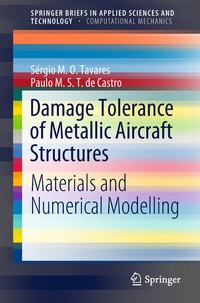
Damage Tolerance of Metallic Aircraft Structures
Description
Alles über E-Books | Antworten auf Fragen rund um E-Books, Kopierschutz und Dateiformate finden Sie in unserem Info- & Hilfebereich.
This book provides a state-of-the-art review of the fail-safe and damage tolerance approaches, allowing weight savings and increasing aircraft reliability and structural integrity.
The application of the damage tolerance approach requires extensive know-how of the fatigue and fracture properties, corrosion strength, potential failure modes and non-destructive inspection techniques, particularly minimum detectable defect and inspection intervals. In parallel, engineering practice involving damage tolerance requires numerical techniques for stress analysis of cracked structures. These evolved from basic mode I evaluations using rough finite element approaches, to current 3D modeling based on energetic approaches as the VCCT, or simulation of joining processes. This book provides a concise introduction to this subject.
More details
Other editions
Additional editions
Persons
Sergio Tavares got his doctorate at the Universidade do Porto in 2011, in the frame of the MIT-Portugal programme; his thesis and subsequent R&D work concern integral structures. Paulo de Castro got his PhD at Cranfield Institute of Technology in 1980, and has since worked in fracture and fatigue problems, through a variety of R&D projects as EU SMAAC, ADMIRE and DATON, Al-Li work for ESA, among others.

Content
System requirements
File format: PDF
Copy protection: Watermark-DRM (Digital Rights Management)
System requirements:
- Computer (Windows; MacOS X; Linux): Use the free software Adobe Reader, Adobe Digital Editions, or any other PDF viewer of your choice (see eBook Help).
- Tablet/Smartphone (Android; iOS): Install the free app Adobe Digital Editions or another reading app for eBooks, e.g., PocketBook (see eBook Help).
- E-reader: Bookeen, Kobo, Pocketbook, Sony, Tolino and many more (only limited: Kindle).
The file format PDF always displays a book page identically on any hardware. This makes PDF suitable for complex layouts such as those used in textbooks and reference books (images, tables, columns, footnotes). Unfortunately, on the small screens of e-readers or smartphones, PDFs are rather annoying, requiring too much scrolling.
This eBook uses Watermark-DRM, a „soft” copy protection. This means that there are no technical restrictions to prevent illegal distribution. However, there is a personalised watermark embedded in the eBook that can be used to identify the purchaser of the eBook in the event of misuse and to provide evidence for legal purposes.
For more information, see our eBook Help page.