

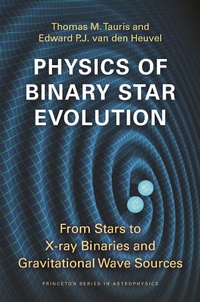
Physics of Binary Star Evolution
From Stars to X-ray Binaries and Gravitational Wave Sources
1st Edition
Published on 22. November 2023
864 pages
978-0-691-23926-2 (ISBN)
Description

A graduate-level textbook on the astrophysics of binary star systems and their evolution
Physics of Binary Star Evolution is an up-to-date textbook on the astrophysics and evolution of binary star systems. Theoretical astrophysicists Thomas Tauris and Edward van den Heuvel cover a wide range of phenomena and processes, including mass transfer and ejection, common envelopes, novae and supernovae, X-ray binaries, millisecond radio pulsars, and gravitational wave (GW) sources, and their links to stellar evolution.
The authors walk through the observed properties and evolution of different types of binaries, with special emphasis on those containing compact objects (neutron stars, black holes, and white dwarfs). Attention is given to the formation mechanisms of GW sources-merging double neutron stars and black holes as well as ultra-compact GW binaries hosting white dwarfs-and to the progenitors of these sources and how they are observed with radio telescopes, X-ray satellites, and GW detectors (LIGO, Virgo, KAGRA, Einstein Telescope, Cosmic Explorer, and LISA). Supported by illustrations, equations, and exercises, Physics of Binary Star Evolution combines theory and observations to guide readers through the wonders of a field that will play a central role in modern astrophysics for decades to come.
- 465 equations, 47 tables, and 350+ figures
- More than 80 exercises (analytical, numerical, and computational)
- Over 2,500 extensive, up-to-date references
Physics of Binary Star Evolution is an up-to-date textbook on the astrophysics and evolution of binary star systems. Theoretical astrophysicists Thomas Tauris and Edward van den Heuvel cover a wide range of phenomena and processes, including mass transfer and ejection, common envelopes, novae and supernovae, X-ray binaries, millisecond radio pulsars, and gravitational wave (GW) sources, and their links to stellar evolution.
The authors walk through the observed properties and evolution of different types of binaries, with special emphasis on those containing compact objects (neutron stars, black holes, and white dwarfs). Attention is given to the formation mechanisms of GW sources-merging double neutron stars and black holes as well as ultra-compact GW binaries hosting white dwarfs-and to the progenitors of these sources and how they are observed with radio telescopes, X-ray satellites, and GW detectors (LIGO, Virgo, KAGRA, Einstein Telescope, Cosmic Explorer, and LISA). Supported by illustrations, equations, and exercises, Physics of Binary Star Evolution combines theory and observations to guide readers through the wonders of a field that will play a central role in modern astrophysics for decades to come.
- 465 equations, 47 tables, and 350+ figures
- More than 80 exercises (analytical, numerical, and computational)
- Over 2,500 extensive, up-to-date references
More details
Other editions
Additional editions
Thomas M. Tauris | Edward P.J. van den Heuvel
Physics of Binary Star Evolution
From Stars to X-ray Binaries and Gravitational Wave Sources
Book
06/2023
Princeton University Press
€99.00
Shipment within 10-20 days
Thomas M. Tauris | Edward P.J. van den Heuvel
Physics of Binary Star Evolution
From Stars to X-ray Binaries and Gravitational Wave Sources
Book
06/2023
Princeton University Press
€177.50
Article exhausted; check different version
Persons
Thomas M. Tauris is professor of theoretical astrophysics at Aalborg University. Edward P. J. van den Heuvel is emeritus professor of astrophysics at the University of Amsterdam and the Vrije Universiteit, Brussels. His books include Accretion-Driven Stellar X-ray Sources, Interacting Binaries, and X-ray Binaries.
Content
- Cover
- Contents
- Preface
- 1. Introduction: The Role of Binary Star Evolution in Astrophysics
- 2. Historical Notes on Binary Star Discoveries
- 2.1 Visual Binaries and the Universal Validity of the Laws of Physics
- 2.2 Astrometric Binaries
- 2.3 Spectroscopic Binaries
- 2.4 Eclipsing Binaries
- 2.5 The Discovery of the Binary Nature of Novae and Other Cataclysmic Variables
- 2.6 The Discovery of the Binary Nature of the Brightest X-ray Sources in the Sky
- 2.7 Centaurus X-3: Discovery of the First Neutron Star X-ray Binary
- 2.8 Cygnus X-1: Discovery of the First Black Hole X-ray Binary
- 2.9 The Discovery of the Existence of Double NSs and Double BHs
- 2.10 The Discovery of Millisecond Radio Pulsars: Remnants of LMXBs
- 2.11 Type Ia, Ib, and Ic SNe: Results of the Evolution of Binary Systems
- 2.12 Binary Nature of Blue Stragglers, Barium Stars, and Peculiar Post-AGB Stars
- Exercises
- 3. Orbits and Masses of Spectroscopic Binaries
- 3.1 Some Basics about Binary Orbits
- 3.2 Orbit Determination
- 3.3 Determination of Stellar Masses
- 3.4 Masses of Unevolved Main-sequence Stars
- 3.5 The Most Massive Stars
- 3.6 Falsification of Radial Velocity Curves
- 3.7 The Incidence of Interacting Binaries and Their Orbital Distributions and Masses
- Exercises
- 4. Mass Transfer and Mass Loss in Binary Systems
- 4.1 Roche Equipotentials
- 4.2 Limitations in the Concept of Roche Equipotentials
- 4.3 Orbital Changes due to Mass Transfer and Mass Loss in Binary Systems
- 4.4 Observational Examples
- 4.5 Basic Physics of Mass Transfer via L1
- 4.6 Accretion Disks
- 4.7 Tidal Evolution in Binary Systems
- 4.8 Common Envelopes
- 4.9 Eddington Accretion Limit
- Exercises
- 5. Observed Binaries with Non-degenerate or White Dwarf Components
- 5.1 Introduction
- 5.2 Unevolved Systems
- 5.3 Evolved Systems with Non-degenerative Components
- 5.4 Systems with One or Two White Dwarfs
- Exercises
- 6. Observed Binaries with Accreting Neutron Stars and Black Holes: X-ray Binaries
- 6.1 Discovery of NS and BH Character of Bright Galactic X-ray Sources
- 6.2 Two Types of Persistent Strong X-ray Sources: HMXBs and LMXBs
- 6.3 HMXBs and LMXBs vs. IMXBs
- 6.4 Determinations of NS Masses in X-ray Binaries
- 6.5 BH X-ray Binaries
- 6.6 Binaries and Triples with Non-interacting BHs
- Exercises
- 7. Observed Properties of X-ray Binaries in More Detail
- 7.1 High-mass X-ray Binaries in More Detail
- 7.2 Stellar Wind Accretion in More Detail
- 7.3 Spin Evolution of Neutron Stars
- 7.4 The Corbet Diagram for Pulsating HMXBs
- 7.5 Orbital Changes due to Torques by Stellar Wind Accretion, Mass Loss, and Tides
- 7.6 Measuring BH Spins in X-ray Binaries
- 7.7 Ultra-luminous X-ray Binaries
- 7.8 Low-mass X-ray Binaries in More Detail
- Exercises
- 8. Evolution of Single Stars
- 8.1 Overview of the Evolution of Single Stars
- 8.2 Final Evolution and Core Collapse of Stars More Massive than 8 M
- 8.3 Evolution of Helium Stars
- Exercises
- 9. Stellar Evolution in Binaries
- 9.1 Historical Introduction: Importance of Mass Transfer
- 9.2 Evolution of the Stellar Radius and Cases of Mass Transfer
- 9.3 RLO: Reasons for Large-scale Mass Transfer and Conditions for Stability of the Transfer
- 9.4 Results of Calculations of Binary Evolution with Conservative Mass Transfer
- 9.5 Examples of Non-conservative Mass Transfer
- 9.6 Comparison of Case B Results with Some Observed Types of Systems
- 9.7 Differences in Final Remnants of Mass-transfer Binaries and Single Stars
- 9.8 Slowly Rotating Magnetic Main-sequence Stars: The Products of Mergers?
- Exercises
- 10. Formation and Evolution of High-mass X-ray Binaries
- 10.1 Introduction: HMXBs are Normal Products of Massive Binary Star Evolution
- 10.2 Formation of Supergiant HMXBs
- 10.3 Formation of B-emission (Be)/X-ray Binaries
- 10.4 WR Binaries, HMXBs, and Runaway Stars
- 10.5 Stability of Mass Transfer in HMXBs
- 10.6 The X-ray Lifetime and Formation Rate of the Blue Supergiant HMXBs
- 10.7 Highly Non-conservative Evolution and Formation of Very Close Relativistic Binaries
- 10.8 Formation Models of HMXBs Different from Conservative Case B Evolution
- 10.9 The Lower Mass Limit of Binary Stars for Terminating as a BH
- 10.10 Final Evolution of BH-HMXBs: Two Formation Channels for Double BHs
- 10.11 Final Evolution of Wide-orbit BH-HMXBs via CE Evolution
- 10.12 Final Evolution of Relatively Close-orbit BH-HMXBs via Stable RLO
- 10.13 Refinement of the DNS Formation Model: Case BB RLO in Post-HMXB Systems
- Exercises
- 11. Formation and Evolution of Low-mass X-ray Binaries
- 11.1 Origin of LMXBs with Neutron Stars
- 11.2 Origin of LMXBs with Black Holes
- 11.3 Mechanisms Driving Mass Transfer in Close-orbit LMXBs and CVs
- 11.4 Formation and Evolution of UCXBs
- 11.5 Mechanisms Driving Mass Transfer in Wide-orbit LMXBs and Symbiotic Binaries
- 11.6 Stability of Mass Transfer in Intermediate-Mass and High-Mass X-ray Binaries
- Exercises
- 12. Dynamical Formation of Compact Star Binaries in Dense Star Clusters
- 12.1 Introduction
- 12.2 Observed Compact Object Binaries in Globular Clusters: X-ray Binaries and Radio Pulsars
- 12.3 Possible Formation Processes of NS Binaries in Globular Clusters
- 12.4 Dynamical Formation of Double BHs
- 12.5 Compact Objects in Globular Clusters Constrain Birth Kicks
- 13. Supernovae in Binaries
- 13.1 Introduction
- 13.2 Supernovae of Type Ia
- 13.3 Stripped-Envelope Core-Collapse SNe
- 13.4 Electron-capture SNe in Single and Binary Stars
- 13.5 Ultra-Stripped Supernovae
- 13.6 Comparison between Theory and Observations of SNe Ib and Ic
- 13.7 Supernova Kicks
- 13.8 Kinematic Impacts on Post-SN Binaries
- Exercises
- 14. Binary and Millisecond Pulsars
- 14.1 Introduction to Radio Pulsars
- 14.2 To Be Recycled or Not to Be Recycled
- 14.3 MSPs with He WD or Sub-stellar Dwarf Companions-Evolution from LMXBs
- 14.4 MSPs with CO WD Companions-Evolution from IMXBs
- 14.5 Formation of MSPs via Accretion-induced Collapse
- 14.6 Recycling of Pulsars
- 14.7 Masses of Binary Neutron Stars
- 14.8 Pulsar Kicks
- 14.9 Formation of Double Neutron Star Systems
- Exercises
- 15. Gravitational Waves from Binary Compact Objects
- 15.1 The Evidence of GWs prior to LIGO
- 15.2 GW Luminosity and Merger Timescale
- 15.3 Observations of GW Signals from Binaries
- 15.4 Galactic Merger Rates of Neutron Star/Black Hole Binaries
- 15.5 Formation of Double Black Hole Binaries
- 15.6 Properties of GW Sources Detected so Far
- 15.7 Empirical Merger Rates
- 15.8 BH Spins-Expectations and Observations
- 15.9 Anticipated Other Sources to be Detected in the GW Era
- 15.10 GW Follow-up Multimessenger Astronomy
- 15.11 Cosmological Implications
- 15.12 LISA Sources
- 15.13 LISA Sensitivity Curve and Source Strain
- Exercises
- 16. Binary Population Synthesis and Statistics
- 16.1 Introduction
- 16.2 Methodology of Population Synthesis
- 16.3 Empirical vs. Binary Population Synthesis-Based Estimates of Double Compact Object Merger Rates
- 16.4 Some History of Early Binary Population Synthesis: Evolution of Open Star Clusters with Binaries
- Acknowledgments
- Answers to Exercises
- List of Acronyms
- References
- Index
